
Advertisement


Sections
Rapid warming of Indo-Pacific Ocean cited as reason for rainfall decline over Northern India
Continued warming of the Indo-Pacific Ocean is highly likely, which may further intensify these changes in global rainfall patterns.

Rapid warming of the Indo-Pacific ocean could be the reason behind erratic rainfall patterns with heavy rains pummeling some parts of the world while others, including north India, experiencing declines, a new study has said.The study, led by Roxy Mathew Koll of the Pune-based Indian Institute of Tropical Meteorology (IITM) warned that warming of the ocean has altered the most dominant mode of weather fluctuation originating in the tropics, known as the Madden Julian Oscillation (MJO), which has reduced rainfall in northern India between the months of November and April."The rainfall pattern across the globe is likely changing due to rapid warming of the Indo-Pacific Ocean," it said, adding that the changes in the MJO behaviour have increased the rainfall over northern Australia, west Pacific, the Amazon basin, southwest Africa and southeast Asia (Indonesia, Philippines and Papua New Guinea)."At the same time these changes have brought a decline in rainfall over central Pacific, along the west and east coast of the United States (e.g. California), north India, east Africa, and the Yangtze basin in China," the study said.[caption id="attachment_7710771" align="alignnone" width="1282"]![Rainfall changes due to warming in the Indo-Pacific Ocean and corresponding changes in global weather pattern. Image credit: Roxy et al. (2019)]() Rainfall changes due to warming in the Indo-Pacific Ocean and corresponding changes in global weather pattern. Image credit: Roxy et al. (2019)[/caption]The study is part of an Indo-US collaboration, between the Ministry of Earth Sciences (India) and the US National Oceanic and Atmospheric Administration (NOAA), facilitated by the US National Academy of Sciences.The research was conducted in collaboration with other scientists Panini Dasgupta (IITM), Michael McPhaden and Chidong Zhang (NOAA), Deahyun Kim (University of Washington) and Tamaki Suematsu (University of Tokyo).The MJO is characterized by a band of rain clouds moving eastward over the tropics. The MJO regulates tropical cyclones, monsoons, and the El Nino cycle and occasionally contributes to severe weather events over Asia, Australia, Africa, Europe and America, the study said.[caption id="attachment_7710801" align="alignnone" width="1024"]
Rainfall changes due to warming in the Indo-Pacific Ocean and corresponding changes in global weather pattern. Image credit: Roxy et al. (2019)[/caption]The study is part of an Indo-US collaboration, between the Ministry of Earth Sciences (India) and the US National Oceanic and Atmospheric Administration (NOAA), facilitated by the US National Academy of Sciences.The research was conducted in collaboration with other scientists Panini Dasgupta (IITM), Michael McPhaden and Chidong Zhang (NOAA), Deahyun Kim (University of Washington) and Tamaki Suematsu (University of Tokyo).The MJO is characterized by a band of rain clouds moving eastward over the tropics. The MJO regulates tropical cyclones, monsoons, and the El Nino cycle and occasionally contributes to severe weather events over Asia, Australia, Africa, Europe and America, the study said.[caption id="attachment_7710801" align="alignnone" width="1024"]![Commuters walk through fog as they hold umbrellas during a rainfall in Shimla in the India's northern state of Himachal Pradesh on 9 October 2019. Image: Getty/AFP]() Commuters walk through fog as they hold umbrellas during a rainfall in Shimla in the India's northern state of Himachal Pradesh on 9 October 2019. Image: Getty/AFP[/caption]"The MJO travels a stretch of 12,000-20,000 kms over the tropical oceans, mainly over the Indo-Pacific warm pool, which has ocean temperatures generally warmer than 28 C. This Indo-Pacific warm pool has been warming rapidly and expanding during the recent decades in response to increasing carbon emissions."The warm pool expanded double its size, from an area of 2.2 107 square km during 1900 1980, to an area of 4 107 square km during 1981 2018. The rate of expansion is 4 105 square km, an area equal to the size of California, every year," a statement from IITM Pune said.Though the entire Indo-Pacific has warmed, the warmest waters are over the west Pacific, creating a temperature contrast that drives moisture from the Indian Ocean to the west Pacific Maritime Continent, enhancing the cloud formation there. As a result, the lifecycle of MJO has changed, Koll said."Climate model simulations indicate that continued warming of the Indo-Pacific Ocean is highly likely, which may further intensify these changes in global rainfall patterns in the future," said Koll, adding "This means that we need to enhance our ocean observational arrays to monitor these changes accurately...and update our climate models to skillfully predict the challenges presented by a warming world."October 2019 might have been second-hottest month in the second-hottest year on record
Commuters walk through fog as they hold umbrellas during a rainfall in Shimla in the India's northern state of Himachal Pradesh on 9 October 2019. Image: Getty/AFP[/caption]"The MJO travels a stretch of 12,000-20,000 kms over the tropical oceans, mainly over the Indo-Pacific warm pool, which has ocean temperatures generally warmer than 28 C. This Indo-Pacific warm pool has been warming rapidly and expanding during the recent decades in response to increasing carbon emissions."The warm pool expanded double its size, from an area of 2.2 107 square km during 1900 1980, to an area of 4 107 square km during 1981 2018. The rate of expansion is 4 105 square km, an area equal to the size of California, every year," a statement from IITM Pune said.Though the entire Indo-Pacific has warmed, the warmest waters are over the west Pacific, creating a temperature contrast that drives moisture from the Indian Ocean to the west Pacific Maritime Continent, enhancing the cloud formation there. As a result, the lifecycle of MJO has changed, Koll said."Climate model simulations indicate that continued warming of the Indo-Pacific Ocean is highly likely, which may further intensify these changes in global rainfall patterns in the future," said Koll, adding "This means that we need to enhance our ocean observational arrays to monitor these changes accurately...and update our climate models to skillfully predict the challenges presented by a warming world."October 2019 might have been second-hottest month in the second-hottest year on record
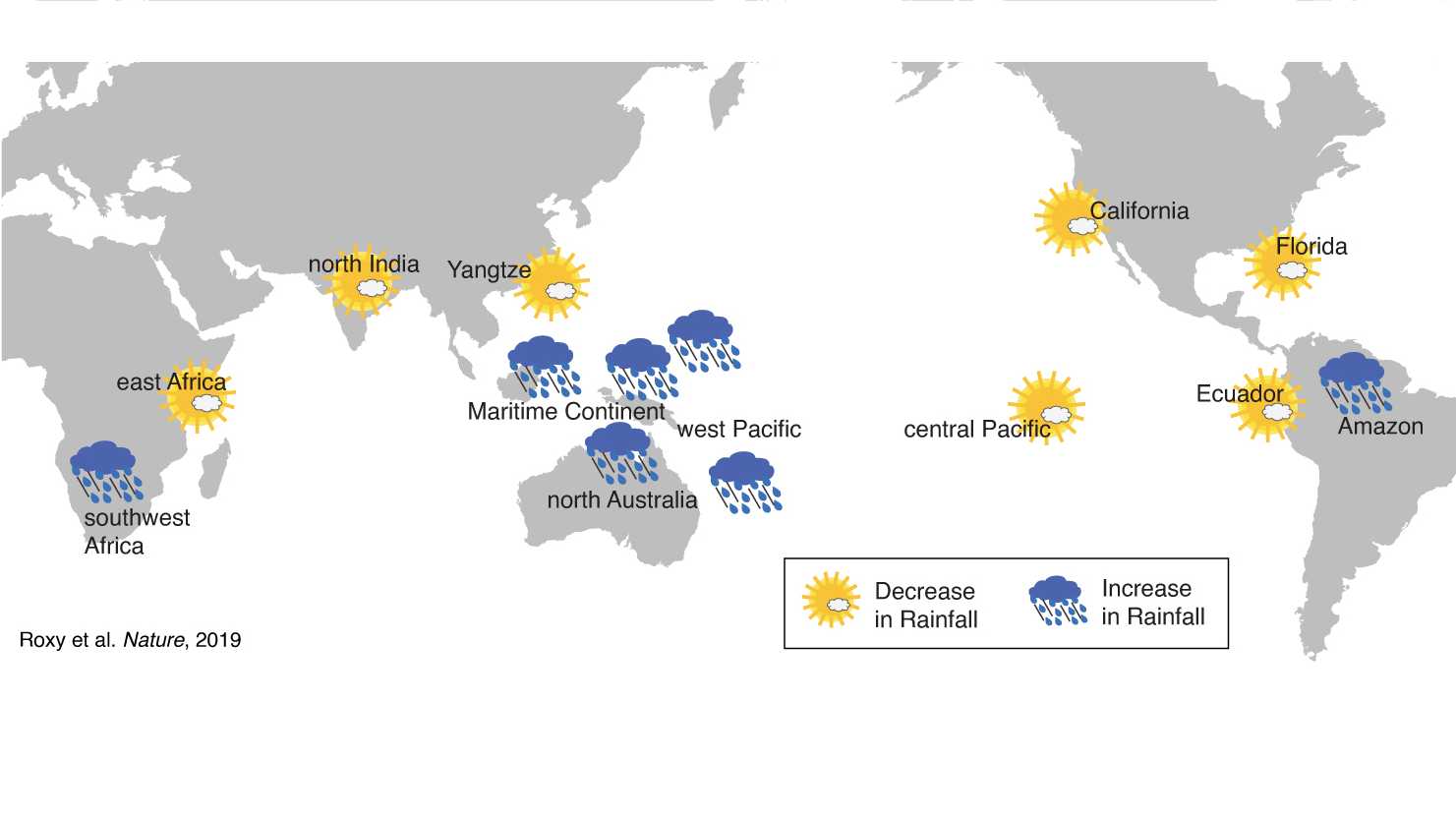 Rainfall changes due to warming in the Indo-Pacific Ocean and corresponding changes in global weather pattern. Image credit: Roxy et al. (2019)[/caption]The study is part of an Indo-US collaboration, between the Ministry of Earth Sciences (India) and the US National Oceanic and Atmospheric Administration (NOAA), facilitated by the US National Academy of Sciences.The research was conducted in collaboration with other scientists Panini Dasgupta (IITM), Michael McPhaden and Chidong Zhang (NOAA), Deahyun Kim (University of Washington) and Tamaki Suematsu (University of Tokyo).The MJO is characterized by a band of rain clouds moving eastward over the tropics. The MJO regulates tropical cyclones, monsoons, and the El Nino cycle and occasionally contributes to severe weather events over Asia, Australia, Africa, Europe and America, the study said.[caption id="attachment_7710801" align="alignnone" width="1024"]
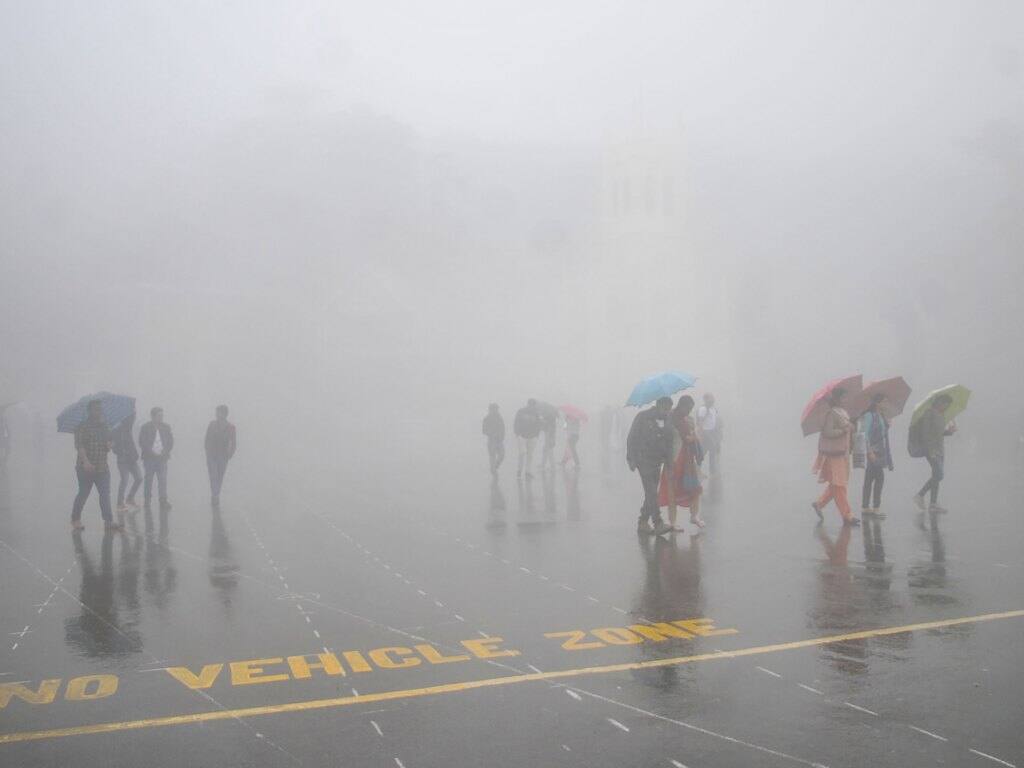 Commuters walk through fog as they hold umbrellas during a rainfall in Shimla in the India's northern state of Himachal Pradesh on 9 October 2019. Image: Getty/AFP[/caption]"The MJO travels a stretch of 12,000-20,000 kms over the tropical oceans, mainly over the Indo-Pacific warm pool, which has ocean temperatures generally warmer than 28 C. This Indo-Pacific warm pool has been warming rapidly and expanding during the recent decades in response to increasing carbon emissions."The warm pool expanded double its size, from an area of 2.2 107 square km during 1900 1980, to an area of 4 107 square km during 1981 2018. The rate of expansion is 4 105 square km, an area equal to the size of California, every year," a statement from IITM Pune said.Though the entire Indo-Pacific has warmed, the warmest waters are over the west Pacific, creating a temperature contrast that drives moisture from the Indian Ocean to the west Pacific Maritime Continent, enhancing the cloud formation there. As a result, the lifecycle of MJO has changed, Koll said."Climate model simulations indicate that continued warming of the Indo-Pacific Ocean is highly likely, which may further intensify these changes in global rainfall patterns in the future," said Koll, adding "This means that we need to enhance our ocean observational arrays to monitor these changes accurately...and update our climate models to skillfully predict the challenges presented by a warming world."October 2019 might have been second-hottest month in the second-hottest year on record
First Published:Nov 28, 2019, 09:45:51 IST
Advertisement
Advertisement

Careless Whispers: Scientists discover that plants can 'talk' to each other using smells
Japanese scientists have recorded a video that shows plants, in certain conditions, communicate with each other using mists that carry smells. The discovery, reveals that plants release a fine mist of airborne compounds, to warn nearby plants of potential dangers
Life on Mars? European Space Agency’s Orbiter discovers ice water deposits at equator
European Space Agency's Mars Express Orbiter has identified massive ice and ice water deposits beneath the surface of Mars. The Mars Express orbiter was also the first to confirmed the presence of ice on Mars in 2004
Microsoft briefly overtakes Apple as the most valuable company, Apple back on top again
At its peak during the session, Microsoft's value reached $2.903 trillion, with a 2% surge. As of writing this article, Apple closed at $2.89 trillion, whereas Microsoft closed at $2.86 trillion
Even NASA is facing a tough time, starts layoffs following major budget cuts
NASA is facing some massive budget cuts, because of which, it has been forced to postpone some upcoming missions. NASA's Jet Propulsion Laboratory has been hit hard by recent federal budget cuts, resulting in the layoff of 100 contractors last week
ISRO, NASA's NISAR satellite to get ready by Jan-end, will monitor Earth's snow-covered regions
The NISAR satellite which has been developed jointly ISRO and NASA, should be ready for launch by the end of January 2024. The collaboration between NASA and ISRO on NISAR is the first time the two agencies have cooperated on hardware development for an Earth-observing mission
Advertisement
Advertisement