


Oldest shell horn found in a cave in 1931 plays its songs as clear as the sea
The horn was found in Marsoulas cave that isn't located near an ocean, so prehistoric people either moved around a lot or used trading networks to get it.

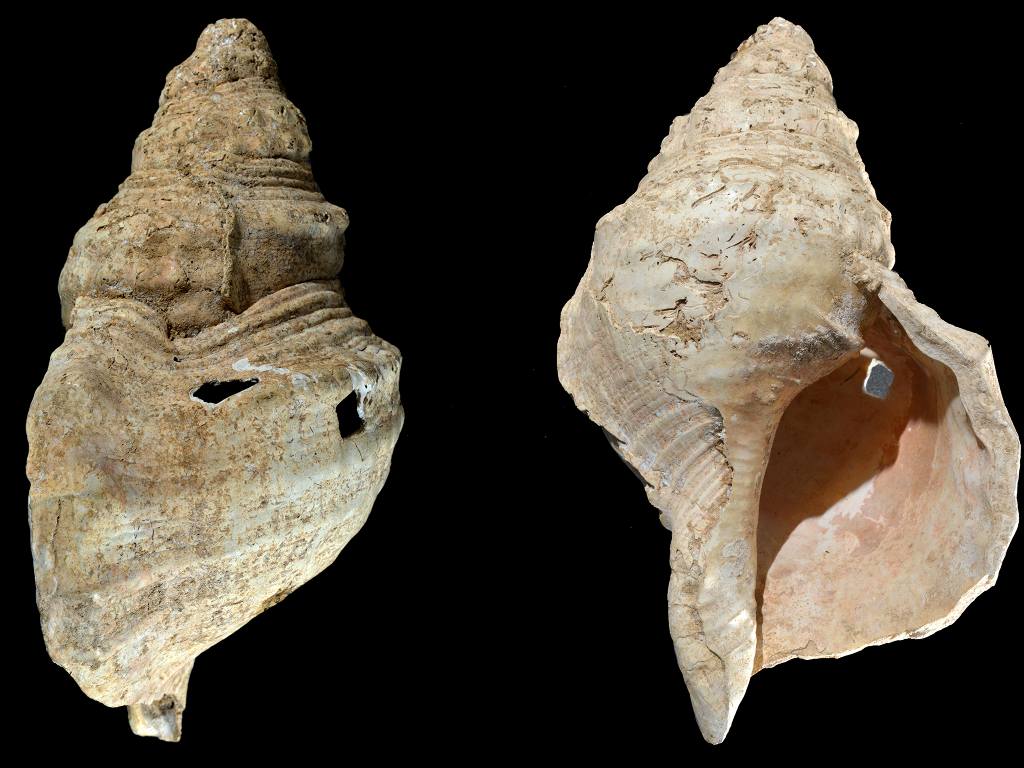
This combination of images provided by researcher Carole Fritz in February 2021 shows two sides of a conch shell discovered in a French cave with prehistoric wall paintings in 1931. Using modern microscopy techniques to examine how the shell was modified and hiring a French horn player to test it out, they found the shell could produce C, C-sharp, and D notes. By carbon dating other related artifacts in the cave, researchers estimate the age to be around 18,000 years, making it the world’s oldest seashell instrument. (Carole Fritz via AP)[/caption]“Hearing it for the first time, for me, it was a big emotion — and a big stress,” said archaeologist Carole Fritz.She feared that playing the 31-centimetre shell might damage it, but it didn’t. The horn produced clear C, C sharp and D notes. The researchers estimate it to be around 18,000 years old. Their findings were published Wednesday in the journal Science Advances.Conch shells have been used widely in musical and ceremonial traditions, including in ancient Greece, Japan, India and Peru. The shell instrument found in the Marsoulas cave is now the oldest known example. Previously, a conch shell instrument found in Syria had been dated to about 6,000 years old, said another Toulouse archaeologist, Gilles Tosello.The latest discovery was made after a recent inventory at the Natural History Museum of Toulouse. The researchers noticed some unusual holes in the shell. Crucially, the tip of the shell was broken off, creating a hole large enough to blow through. Microscopic inspection revealed the opening was the result of deliberate craftsmanship, not accidental wear, according to Tosello.By inserting a tiny medical camera, they found that another hole had been carefully drilled in the shell’s inner chamber. They also detected traces of red pigment on the mouth of the conch, matching a decorative pattern found on the wall of Marsoulas cave.“This is classic, really solid archaeology,” said Margaret Conkey, an archaeologist at the University of California, Berkeley, who was not involved in the research. “This discovery reminds us that their lives were much richer and more complex than just stone tools and big game.”Marsoulas cave is not located near an ocean, so the prehistoric people must have either moved around widely or used trading networks to obtain the shell, Conkey and the researchers said.“What makes conch shells so interesting is that the spiral cavity formed by nature is perfectly adept at resonating musically,” said Rasoul Morteza, a composer in Montreal who has studied conch shell acoustics, and was not involved in the paper.Using a 3D replica, the archaeologists plan to continue studying the horn’s range of notes. Tosello said he hopes to hear the ancient instrument played inside the cave where it was found.“It’s amazing when there’s an object forgotten somewhere, and suddenly it comes again into the light,” he said.

Careless Whispers: Scientists discover that plants can 'talk' to each other using smells
Life on Mars? European Space Agency’s Orbiter discovers ice water deposits at equator
Microsoft briefly overtakes Apple as the most valuable company, Apple back on top again
Even NASA is facing a tough time, starts layoffs following major budget cuts
ISRO, NASA's NISAR satellite to get ready by Jan-end, will monitor Earth's snow-covered regions