


Nobel-winning black hole physics by Penrose, Hawking stands on work of Indian physicist Amal Raychaudhuri
The Raychaudhuri Equation continues to be a key tool in investigating the behaviour of black hole horizons in modern physics.

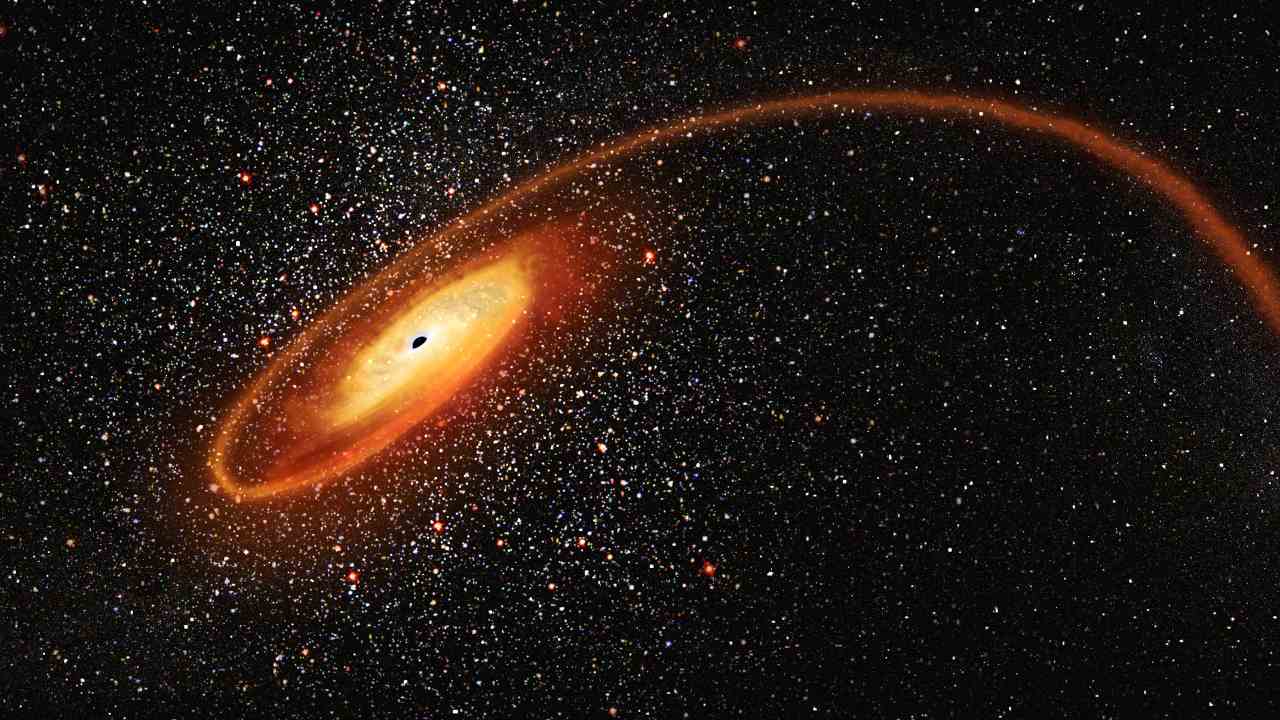
This illustration depicts a cosmic homicide in action. A wayward star is being shredded by the intense gravitational pull of a black hole that contains tens of thousands of solar masses. Image credit: NASA, ESA and D. Player[/caption]A black hole is a region of spacetime where gravity is so strong that nothing—no particles or even electromagnetic radiation such as light—can escape from it. Einstein's theory of general relativity predicts that a sufficiently compact mass can deform spacetime to form a black hole.Singularities are locations in spacetime where the gravitational field of an object is thought to become infinite in a way that is independent of the coordinate systems. Singularities can be found in all the known black-hole spacetimes, which ties them together in the search for answers in astrophysics.The Penrose–Hawking singularity theorems try to explain the conditions under which gravitation produces 'singularities'. The Raychaudhuri Equation is a fundamental lemma for this series of theories on black holes. Penrose, in collaboration with cosmologist Stephen Hawking, used the Raychauduri equation published in the journal Physical Review in 1955, for a mathematical description of black holes in 1969. Even though General Relativity had predicted their existence, Einstein himself did not believe in them.

Careless Whispers: Scientists discover that plants can 'talk' to each other using smells
Life on Mars? European Space Agency’s Orbiter discovers ice water deposits at equator
Microsoft briefly overtakes Apple as the most valuable company, Apple back on top again
Even NASA is facing a tough time, starts layoffs following major budget cuts
ISRO, NASA's NISAR satellite to get ready by Jan-end, will monitor Earth's snow-covered regions