
Advertisement


Sections
New source of neutrinos from the Sun spotted in a first by Borexino collaboration
The study and its findings are still awaiting peer review before the announcement is made official.

In a remarkable experiment designed to bring answers to one of the key mysteries about our Sun, physicists have reported finding evidence for a new source of neutrinos that has been spotted for the first time.Neutrinos are tiny subatomic particles that interact only via the weak force and gravity. What makes neutrinos unique (and a complex subject to study) is, they are electrically neutral and have a mass so little that it was long thought to be zero. The mass of a neutrino is far smaller than any of the other known particles that make up atoms.Solar neutrinos, or neutrinos from the sun, are all around us and passing through us at any given time. Scientists have estimated that 100 billion solar neutrinos pass through just our thumbnail every passing second. Neutrons are of the products in the main reaction that powers the sun and other stars – nuclear fusion.[caption id="attachment_8545431" align="alignnone" width="1280"]![The Sun, captured by NASA's Solar Dynamics Observatory, pointing to]() The Sun, captured by NASA's Solar Dynamics Observatory, pointing to "active regions" on its surface where there are bright spots and illuminated arcs, 20 April 2015. Image credit: NASA/SDO[/caption]Stars are powered for most of their lives by nuclear fusion in its core. The main kind of nuclear fusion that happens in a star's core is protons (charged hydrogen molecules) being converted to helium. That said, depending on the mass of the star itself, this conversion can happen in different ways.In the cores of stars like the Sun, the bulk of energy produced (99%) comes from a process called the proton-proton chain reaction (pp). This process creates helium from the fusion of two protons, releasing a positron and a neutrino in the process. The reaction releases an enormous amount of energy in the form of gamma rays.[caption id="attachment_8545541" align="alignnone" width="1280"]
The Sun, captured by NASA's Solar Dynamics Observatory, pointing to "active regions" on its surface where there are bright spots and illuminated arcs, 20 April 2015. Image credit: NASA/SDO[/caption]Stars are powered for most of their lives by nuclear fusion in its core. The main kind of nuclear fusion that happens in a star's core is protons (charged hydrogen molecules) being converted to helium. That said, depending on the mass of the star itself, this conversion can happen in different ways.In the cores of stars like the Sun, the bulk of energy produced (99%) comes from a process called the proton-proton chain reaction (pp). This process creates helium from the fusion of two protons, releasing a positron and a neutrino in the process. The reaction releases an enormous amount of energy in the form of gamma rays.[caption id="attachment_8545541" align="alignnone" width="1280"]![Photomultiplier tubes on the inside surface of the partly-submerged Kamiokande Neutrino Observatory in Japan. Image: Kamiokande Neutrino Observatory]() Photomultiplier tubes on the inside surface of the partly-submerged Super-Kamiokande Neutrino Observatory in Japan. Image: Kamiokande Neutrino Observatory/University of Tokyo[/caption]However, there has been little proof to explain where the missing energy (the remaining 1%) comes from. Physicists have theorised that it may be produced in another set of nuclear fusion reactions called the CNO chain reactions.The CNO cycle uses carbon, nitrogen, and oxygen as intermediaries to ultimately produce helium, just like in the pp chain. However, there has been no experimental proof of neutrinos from this reaction until now.In stars that are much heavier than our Sun, the CNO cycle is the main source of energy.Scientists had already detected neutrinos in 1956, and established a firm link to the most prevalent fusion process, the pp chain, by 2001.But only now, in a remarkable first, have neutrinos from the second set of reactions – the CNO cycle – been spotted. Researchers from the Borexino experiment have been working to measure low-energy solar neutrinos – a central feature in the story of the missing solar neutrinos – since 2000.The Borexino team announced their findings on 23 June at the Neutrino 2020 virtual meeting, concluding that the "quest (for) the CNO neutrinos has finally produced the first observation of the signal," in their presentation.The study is still awaiting peer review before the announcement is made official.
Photomultiplier tubes on the inside surface of the partly-submerged Super-Kamiokande Neutrino Observatory in Japan. Image: Kamiokande Neutrino Observatory/University of Tokyo[/caption]However, there has been little proof to explain where the missing energy (the remaining 1%) comes from. Physicists have theorised that it may be produced in another set of nuclear fusion reactions called the CNO chain reactions.The CNO cycle uses carbon, nitrogen, and oxygen as intermediaries to ultimately produce helium, just like in the pp chain. However, there has been no experimental proof of neutrinos from this reaction until now.In stars that are much heavier than our Sun, the CNO cycle is the main source of energy.Scientists had already detected neutrinos in 1956, and established a firm link to the most prevalent fusion process, the pp chain, by 2001.But only now, in a remarkable first, have neutrinos from the second set of reactions – the CNO cycle – been spotted. Researchers from the Borexino experiment have been working to measure low-energy solar neutrinos – a central feature in the story of the missing solar neutrinos – since 2000.The Borexino team announced their findings on 23 June at the Neutrino 2020 virtual meeting, concluding that the "quest (for) the CNO neutrinos has finally produced the first observation of the signal," in their presentation.The study is still awaiting peer review before the announcement is made official.
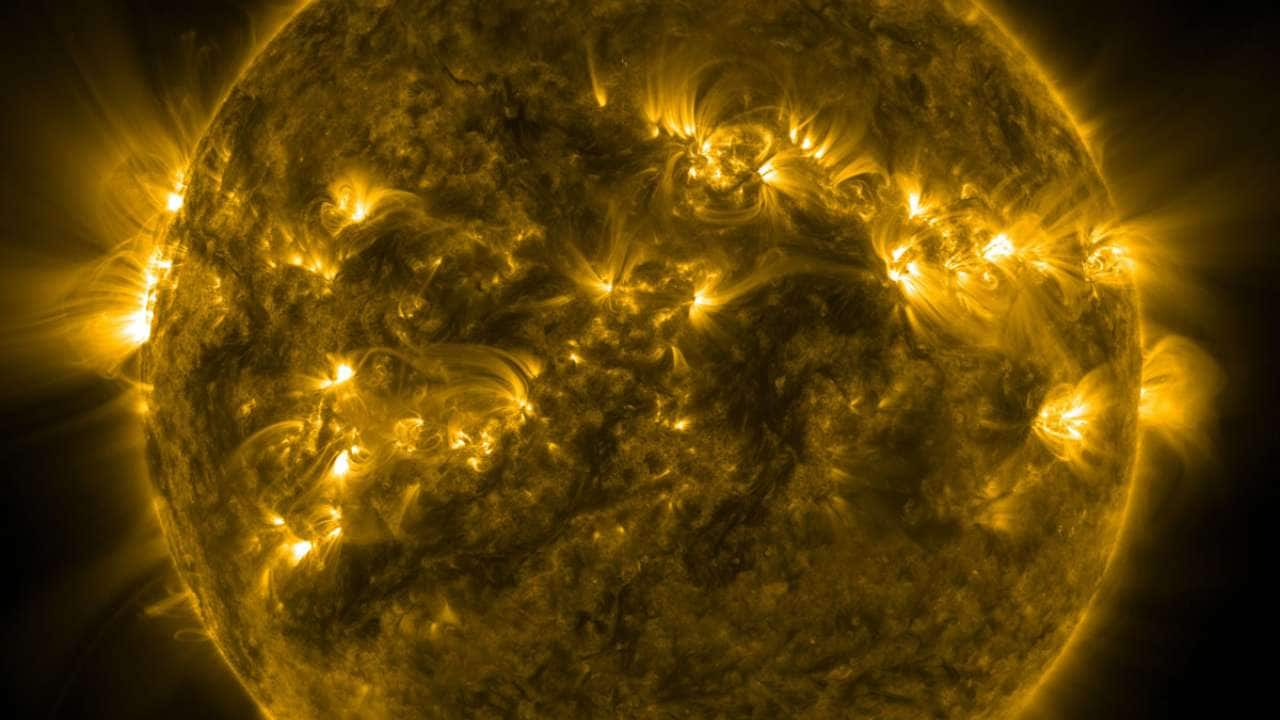 The Sun, captured by NASA's Solar Dynamics Observatory, pointing to "active regions" on its surface where there are bright spots and illuminated arcs, 20 April 2015. Image credit: NASA/SDO[/caption]Stars are powered for most of their lives by nuclear fusion in its core. The main kind of nuclear fusion that happens in a star's core is protons (charged hydrogen molecules) being converted to helium. That said, depending on the mass of the star itself, this conversion can happen in different ways.In the cores of stars like the Sun, the bulk of energy produced (99%) comes from a process called the proton-proton chain reaction (pp). This process creates helium from the fusion of two protons, releasing a positron and a neutrino in the process. The reaction releases an enormous amount of energy in the form of gamma rays.[caption id="attachment_8545541" align="alignnone" width="1280"]
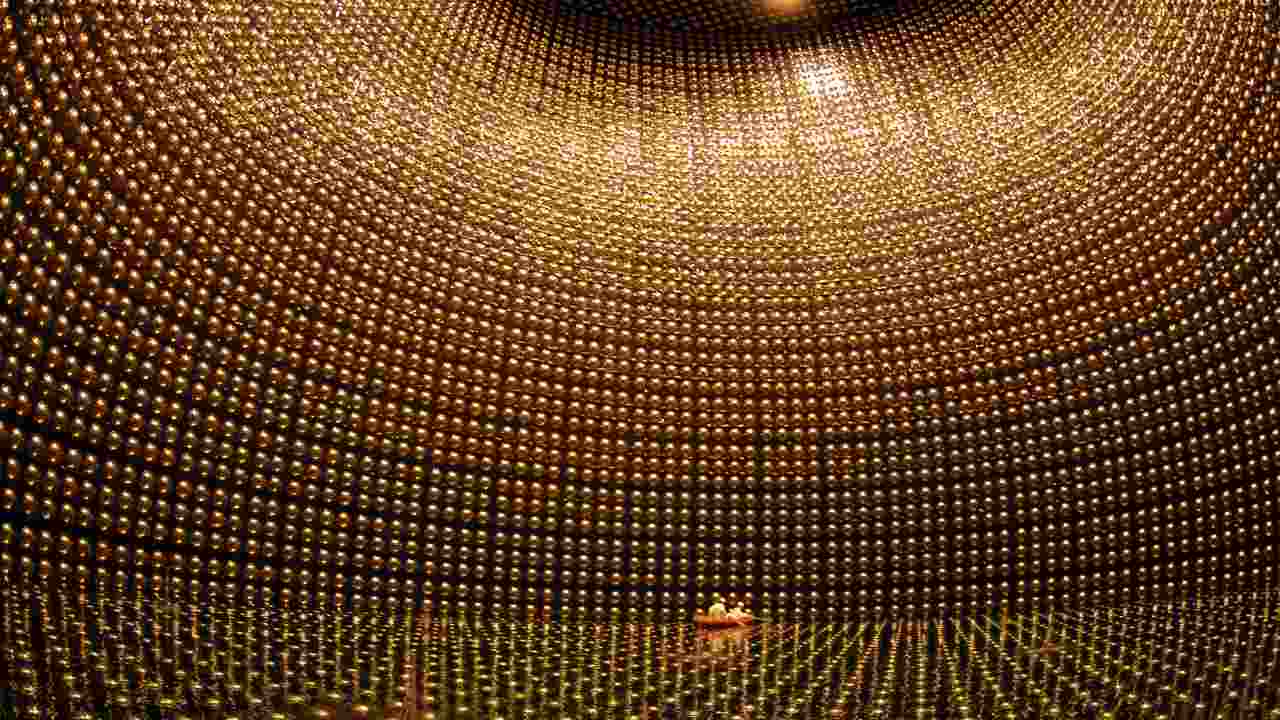 Photomultiplier tubes on the inside surface of the partly-submerged Super-Kamiokande Neutrino Observatory in Japan. Image: Kamiokande Neutrino Observatory/University of Tokyo[/caption]However, there has been little proof to explain where the missing energy (the remaining 1%) comes from. Physicists have theorised that it may be produced in another set of nuclear fusion reactions called the CNO chain reactions.The CNO cycle uses carbon, nitrogen, and oxygen as intermediaries to ultimately produce helium, just like in the pp chain. However, there has been no experimental proof of neutrinos from this reaction until now.In stars that are much heavier than our Sun, the CNO cycle is the main source of energy.
First Published:Jul 01, 2020, 12:58:39 IST
Advertisement
Advertisement

Careless Whispers: Scientists discover that plants can 'talk' to each other using smells
Japanese scientists have recorded a video that shows plants, in certain conditions, communicate with each other using mists that carry smells. The discovery, reveals that plants release a fine mist of airborne compounds, to warn nearby plants of potential dangers
Life on Mars? European Space Agency’s Orbiter discovers ice water deposits at equator
European Space Agency's Mars Express Orbiter has identified massive ice and ice water deposits beneath the surface of Mars. The Mars Express orbiter was also the first to confirmed the presence of ice on Mars in 2004
Microsoft briefly overtakes Apple as the most valuable company, Apple back on top again
At its peak during the session, Microsoft's value reached $2.903 trillion, with a 2% surge. As of writing this article, Apple closed at $2.89 trillion, whereas Microsoft closed at $2.86 trillion
Even NASA is facing a tough time, starts layoffs following major budget cuts
NASA is facing some massive budget cuts, because of which, it has been forced to postpone some upcoming missions. NASA's Jet Propulsion Laboratory has been hit hard by recent federal budget cuts, resulting in the layoff of 100 contractors last week
ISRO, NASA's NISAR satellite to get ready by Jan-end, will monitor Earth's snow-covered regions
The NISAR satellite which has been developed jointly ISRO and NASA, should be ready for launch by the end of January 2024. The collaboration between NASA and ISRO on NISAR is the first time the two agencies have cooperated on hardware development for an Earth-observing mission
Advertisement
Advertisement