
Advertisement


Sections
NASA's time-lapse of the Comet ISON shows it journeying towards the Sun, before it broke apart in 2013
ISON had a tail that was 20 times wider than the full Moon and its head was so bright that it could have been seen in the “pre-dawn eye with the unaided eye”.

The National Aeronautics and Space Administration (NASA) released a time-lapse of the Comet ISON making its way towards the Sun. The video has been made using images captured and sent to the space agency by Hubble Space Telescope back in 2013, just days before it met its end.The small clip posted by NASA on Hubble telescope's official Twitter account featured the comet moving against the stars at great speeds. According to the space agency, when these images were captured, in May 2013, ISON was moving towards the Sun at over 77,000 kilometres per hour.The tweet was shared to give a nod to ISON’s unfortunate fate when it “broke apart” while passing by the Sun in November 2013.[caption id="attachment_9012181" align="alignnone" width="1280"]![This new view of Comet C/2012 S1 (ISON) was taken with the TRAPPIST national telescope at ESO's La Silla Observatory on the morning of Friday 15 November 2013. Image credit; TRAPPIST/E. Jehin/ESO]()
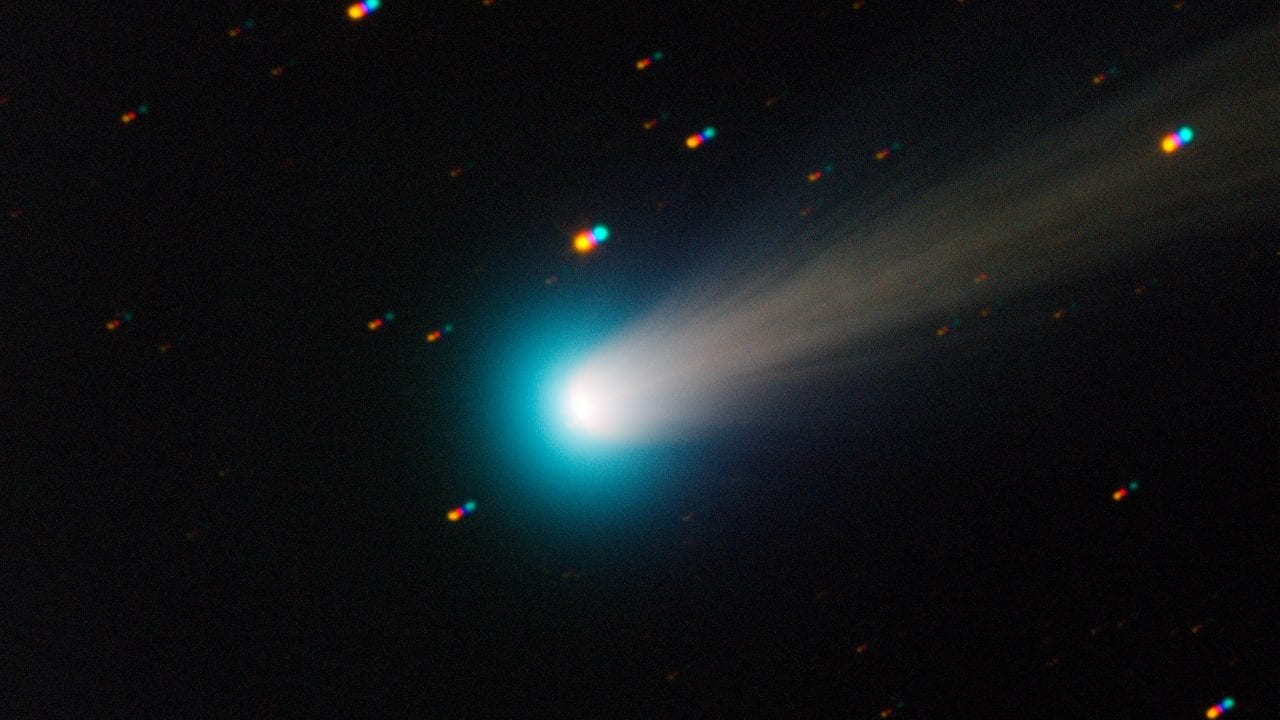
This new view of Comet C/2012 S1 (ISON) was taken with the TRAPPIST national telescope at ESO's La Silla Observatory on the morning of Friday 15 November 2013. Image credit; TRAPPIST/E. Jehin/ESO[/caption]The comet ISON was discovered in September 2012 and has ever since attracted huge fanfare. The reason behind its popularity was that scientists saw it moving towards the Sun and expected the already big comet to become even greater during its closest approach to the Sun.
However, derailing popular opinion, the icy comet could not handle being that close to the Sun and fell apart.According to NASA, ISON had a tail that was 20 times wider than the full Moon and its head was so bright that it could have been seen in the “pre-dawn eye with the unaided eye”. Scientists believed that on 28 November 2013 when ISON neared perihelion, it would gather some solar heat and would become even more magnificent.Karl Battams of NASA's Comet ISON Observing Campaign said that over 32,000 people had joined him and other scientists on a Google Plus Hangout to monitor ISON’s transformation live. However, as the comet neared the Sun, it brightened only to fade away.Several cameras onboard the Solar Dynamics Observatory were recording ISON’s journey but suddenly nothing was being captured. Scientists think that the comet disintegrated during its approach and the fading remains of the comet became too small to be captured by the cameras.So ISON bears testament to a unique specimen in the history of comet astronomy.First Published:Nov 13, 2020, 15:31:37 IST
Advertisement
Advertisement

Careless Whispers: Scientists discover that plants can 'talk' to each other using smells
Japanese scientists have recorded a video that shows plants, in certain conditions, communicate with each other using mists that carry smells. The discovery, reveals that plants release a fine mist of airborne compounds, to warn nearby plants of potential dangers
Life on Mars? European Space Agency’s Orbiter discovers ice water deposits at equator
European Space Agency's Mars Express Orbiter has identified massive ice and ice water deposits beneath the surface of Mars. The Mars Express orbiter was also the first to confirmed the presence of ice on Mars in 2004
Microsoft briefly overtakes Apple as the most valuable company, Apple back on top again
At its peak during the session, Microsoft's value reached $2.903 trillion, with a 2% surge. As of writing this article, Apple closed at $2.89 trillion, whereas Microsoft closed at $2.86 trillion
Even NASA is facing a tough time, starts layoffs following major budget cuts
NASA is facing some massive budget cuts, because of which, it has been forced to postpone some upcoming missions. NASA's Jet Propulsion Laboratory has been hit hard by recent federal budget cuts, resulting in the layoff of 100 contractors last week
ISRO, NASA's NISAR satellite to get ready by Jan-end, will monitor Earth's snow-covered regions
The NISAR satellite which has been developed jointly ISRO and NASA, should be ready for launch by the end of January 2024. The collaboration between NASA and ISRO on NISAR is the first time the two agencies have cooperated on hardware development for an Earth-observing mission
Advertisement
Advertisement