


NASA's OSIRIS-REx finds tiny asteroid Bennu rich in moisture, scattered with rocks
Scientists think Bennu is a leftover from the beginning of the solar system 4.5 billion years ago.

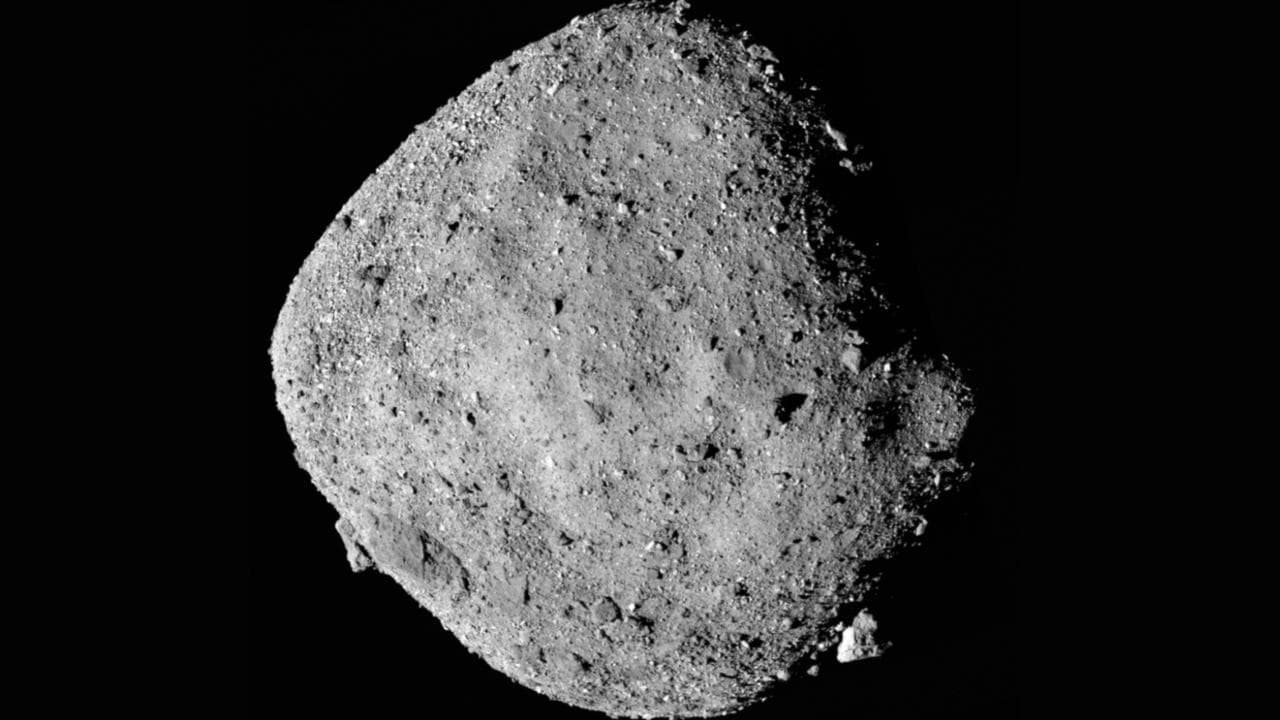
This image of asteroid Bennu is made from 12 PolyCam images collected on 2 December by OSIRIS-REx from a distance of 24 kilometers. Image: University of Arizona[/caption]There’s also a bigger 16-foot (50-meter) boulder on Bennu, which looks like two cones put together with a bulge on its waistline.“There’s evidence of liquid water in Bennu’s past,” said NASA scientist Amy Simon. “This is great news. This is a surprise.”Scientists think Bennu is a leftover from the beginning of the solar system 4.5 billion years ago when planets tried to form and some failed. Lauretta said it looks like Bennu was once a chunk of a bigger asteroid that probably had water in it.When Osiris-Rex starts orbiting Bennu in January — no easy feat since its gravity is 100,000 times less than Earth’s — it will be the smallest object that a human-made spacecraft has circled.Scientists will spend a year scouting the space rock for a good location and then in 2020 it will dive close to the surface and a robotic arm will shoot nitrogen puffs into the soil and collect grains of dirt.Those asteroid bits will be returned to Earth in 2023.The $800 million Osiris-Rex mission began with a 2016 launch from Cape Canaveral, Florida. Its odometer read 1.2 billion miles (2 billion kilometres) as of last week. Both the spacecraft and asteroid’s names come from Egyptian mythology. Osiris is the god of the afterlife, while Bennu represents the heron and creation.

Careless Whispers: Scientists discover that plants can 'talk' to each other using smells
Life on Mars? European Space Agency’s Orbiter discovers ice water deposits at equator
Microsoft briefly overtakes Apple as the most valuable company, Apple back on top again
Even NASA is facing a tough time, starts layoffs following major budget cuts
ISRO, NASA's NISAR satellite to get ready by Jan-end, will monitor Earth's snow-covered regions