


NASA's drone mission Dragonfly to Saturn's moon Titan likely to launch by 2026
The 590 kg drone won't land on Saturn's moon Titan that is 1.6 billion kilometres from Earth, until 2034.

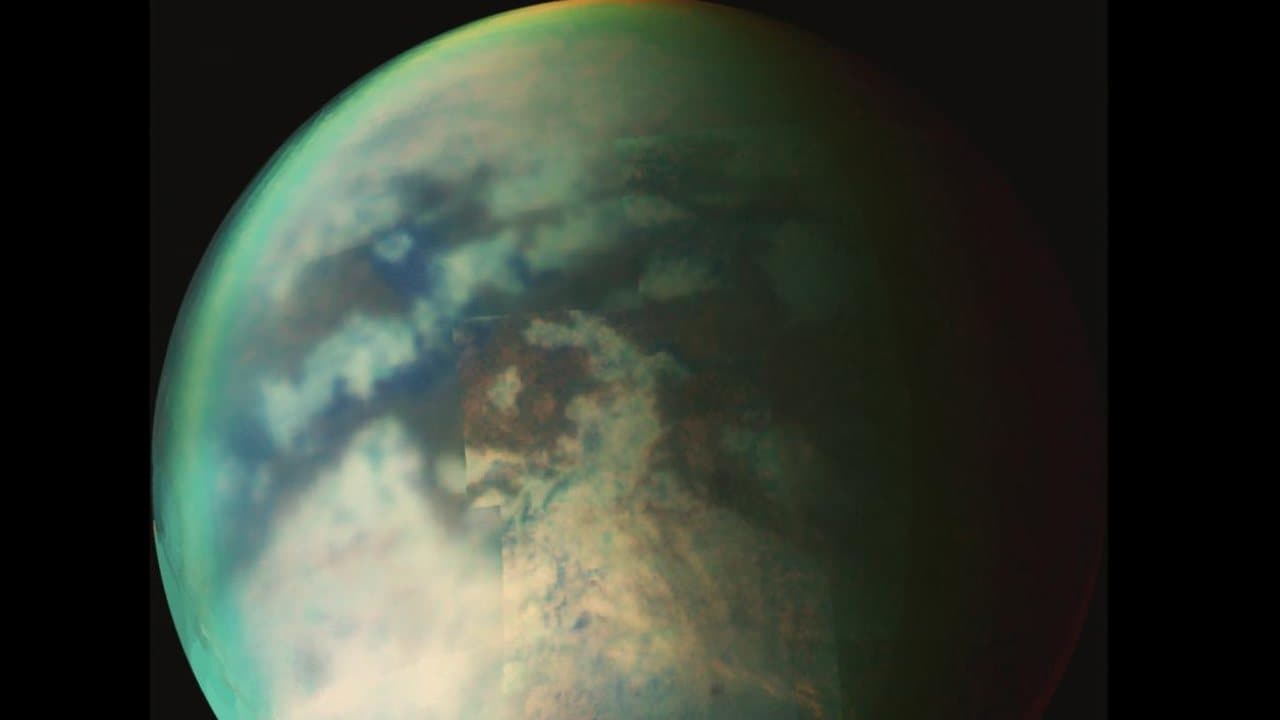
Representational image. Image: NASA/JPL[/caption]"The outer solar system is a distant place," Turtle explains calmly. She seems surprised by the question. "It definitely takes a certain amount of patience to explore the outer solar system."The pace of planetary science is nothing like that of most other scientific disciplines. The distances are so far, and the robots we send so sophisticated, that researchers will generally dedicate their lives to a mere handful of missions.Educated at MIT and the University of Arizona, Turtle remembers the first cursory images of Titan, taken by the Hubble space telescope in the 1990s. The researcher was among the first people to receive closer pictures of Titan sent in 2004 by the Cassini probe — which had itself been launched seven years prior."That was fascinating, to see clouds on another planet," Turtle recalls. "And we had no idea what was on the surface. We could just see dark and bright areas."The European Huygens probe dropped to the surface by Cassini, managed to send some close-up images before dying. The world stared, stupefied, at river channels crossing Titan's surface. "That was a real breakthrough," Turtle adds.Over the next few years, Titan began to take shape: a strange celestial body with surface temperatures of around -290 degrees Fahrenheit (-179 degrees Celsius). It's larger than both Mercury and our Moon, with a crust made of water ice and crossed by rivers and lakes of flowing liquid methane. Winds blow, clouds move, and it rains (methane) over the valleys, dunes and mountains that make up the moon's surface. Cold volcanoes might even spew water as their lava.
A primitive Earth
"That's what so strange, right? Because Titan has such different materials. And yet, it has a very Earth-like geology," Turtle muses.Scientists believe that conditions on Titan are similar to those on the early Earth before the first life forms appeared. They suspect the liquid methane could play the same role as water in making the jump between chemistry and biology.Dragonfly, which will serve as a mini-chemistry laboratory, will fly from one site to another for years, searching for complex carbon-based molecules — what researchers call life's building blocks.The molecules collected from an ancient riverbed may be different from those that never got wet. All traces of Earth's primitive history have been erased. Titan could offer a journey through time.And if Dragonfly finds nothing?[caption id="attachment_6938501" align="alignnone" width="1280"]
Dragonfly. image credit: NASA[/caption]"There's no way we won't learn something from Titan," Turtle replies, without a trace of doubt. "No matter what we find, it will tell us something."Planetary exploration has taught Turtle that "the solar system is more creative than our imaginations.""There are always surprises," she adds.Now her team needs to finish designing and start building Dragonfly: four pairs of rotors, a miniature nuclear generator, a lithium-ion battery, 10 cameras, two sampling drills and four scientific instruments.Hundreds of scientists and engineers from different institutions are involved in the project.Mission systems engineer Ken Hibbard has worked countless nights and weekends for months. He knows he will grow old with the project."You invest so much of your time and energy, a little bit of your soul goes into every one of these concepts," he says. "It's more than two of us. It's hundreds of people that come together and make things happen. And no one wants to let anybody else down."He will probably be in the control center in 2026 for the launch. Turtle, on the other hand, wants to attend the launch in person, to witness the rocket take off with Dragonfly on board."That would be the plan," she says.

Careless Whispers: Scientists discover that plants can 'talk' to each other using smells
Life on Mars? European Space Agency’s Orbiter discovers ice water deposits at equator
Microsoft briefly overtakes Apple as the most valuable company, Apple back on top again
Even NASA is facing a tough time, starts layoffs following major budget cuts
ISRO, NASA's NISAR satellite to get ready by Jan-end, will monitor Earth's snow-covered regions