
Advertisement


Sections
NASA's Curiosity taps Mars' clay mountain, InSight carries on 'mole' troubleshooting
The rock and others near Curiosity's drill site appear to have moved when the drill was retracted.

Seven years after landing on Mars' Gale Crater, NASA's Curiosity rover has crossed a big milestone in its mission to explore the Red Planet — biting into the clay-rich planes of Mount Sharp, a region that scientists suspect was shaped by flowing water.After Curiosity drilled through the bedrock on 6 April, it fed a chunk of the sample to its internal mineralogy lab. Mission engineers at NASA's Jet Propulsion Lab said that the rover "chewed easily" through the soft rock (which was named "Aberlady"), to collect the first sample of the mission that required just a rotating drill to obtain.Unlike tougher targets that Curiosity was up against in the past on the Vera Rubin Ridge, the rock it drilled last week was "so soft, in fact, that the drill didn't need to use its percussive technique, which is helpful for snagging samples from harder rock," the statement said.[caption id="attachment_6449791" align="alignnone" width="1280"]![Seismometer listening for clues as to what is obstructing InSight's mole. Image: NASA-JPL/CalTech]() Seismometer listening for clues as to what is obstructing InSight's mole. Image: NASA-JPL/CalTech[/caption]The five-kilometer tall mountain Curiosity is perched on now is the target of an important scientific study in the mission. The rover began its trek up the mountain in 2013, making it to the mission's target site in September 2014. This was after NASA's Mars Reconnaissance Orbiter (MRO) sniffed out a strong "signal" of clay before Curiosity's 2012 landing.Now that Curiosity has arrived to investigate it, the mission's science team hopes to understand from the samples if there was a time in Mars' past when flowing water shaped this layer of Mount Sharp."Each layer of this mountain is a puzzle piece," Ashwin Vasavada, a Curiosity Project Scientist at JPL said in a statement. With every sampling mission, scientists are expecting to sneak a preview of a different era in Martian history from its mineral composition. We're excited to see what this first sample tells us about the ancient environment, especially about water."[caption id="attachment_6449811" align="alignnone" width="1280"]
Seismometer listening for clues as to what is obstructing InSight's mole. Image: NASA-JPL/CalTech[/caption]The five-kilometer tall mountain Curiosity is perched on now is the target of an important scientific study in the mission. The rover began its trek up the mountain in 2013, making it to the mission's target site in September 2014. This was after NASA's Mars Reconnaissance Orbiter (MRO) sniffed out a strong "signal" of clay before Curiosity's 2012 landing.Now that Curiosity has arrived to investigate it, the mission's science team hopes to understand from the samples if there was a time in Mars' past when flowing water shaped this layer of Mount Sharp."Each layer of this mountain is a puzzle piece," Ashwin Vasavada, a Curiosity Project Scientist at JPL said in a statement. With every sampling mission, scientists are expecting to sneak a preview of a different era in Martian history from its mineral composition. We're excited to see what this first sample tells us about the ancient environment, especially about water."[caption id="attachment_6449811" align="alignnone" width="1280"]![An image taken by the Mastcam on NASA's Mars Curiosity rover. Image: NASA/JPL-Caltech]() An image taken by the Mastcam on NASA's Mars Curiosity rover. Image: NASA/JPL-Caltech[/caption]NASA plans to have Curiosity drill many more times over the course of 2019 and 2020, to understand how this region, with all its diverse rocks, sand (and pebble!) is different from the rover's previous campsite at the Vera Rubin Ridge.Meanwhile, elsewhere on Mars is another NASA mission hammering into rock — the InSight lander. The lander's Heat and Physical Properties (HP3) instrument finished a new round of diagnostic hammering into Mars' surface on 26 March 2019 as another instrument — the quake-detecting seismometer — listened for how sound waves passed through the rock beneath.This test wasn't part of InSight's exploratory missions, but instead some necessary troubleshooting. InSight hit a brick wall in an attempt to drill a hole into a chosen patch of ground to stick its HP3 instrument into. The drill was blocked, and InSight's probe has been hammering the surface and listening in with its seismometer to understand what the obstruction is. The science team thinks it could be a single rock, a layer of gravel or a jammed cable from something getting into the lander's protective housing.The InSight team had hoped that the probe would be in the ground within a few months of InSight's landing. But even if it takes a little longer, the mission can go on unchanged if InSight manages to dig 3 meters underground.Over the remaining days of April, NASA plans to conduct 10-to-15-minute hammering tests as part of the troubleshooting. InSight's seismometer will "listen" to the hammer (called the "mole") striking whatever obstacle is in its path with the hope of shedding some clues as to what may be blocking it.The camera on InSight's robotic arm will also capture photographs of the mole's support structure in the hopes of catching any possible movement induced by the mole as it hammers away.
An image taken by the Mastcam on NASA's Mars Curiosity rover. Image: NASA/JPL-Caltech[/caption]NASA plans to have Curiosity drill many more times over the course of 2019 and 2020, to understand how this region, with all its diverse rocks, sand (and pebble!) is different from the rover's previous campsite at the Vera Rubin Ridge.Meanwhile, elsewhere on Mars is another NASA mission hammering into rock — the InSight lander. The lander's Heat and Physical Properties (HP3) instrument finished a new round of diagnostic hammering into Mars' surface on 26 March 2019 as another instrument — the quake-detecting seismometer — listened for how sound waves passed through the rock beneath.This test wasn't part of InSight's exploratory missions, but instead some necessary troubleshooting. InSight hit a brick wall in an attempt to drill a hole into a chosen patch of ground to stick its HP3 instrument into. The drill was blocked, and InSight's probe has been hammering the surface and listening in with its seismometer to understand what the obstruction is. The science team thinks it could be a single rock, a layer of gravel or a jammed cable from something getting into the lander's protective housing.The InSight team had hoped that the probe would be in the ground within a few months of InSight's landing. But even if it takes a little longer, the mission can go on unchanged if InSight manages to dig 3 meters underground.Over the remaining days of April, NASA plans to conduct 10-to-15-minute hammering tests as part of the troubleshooting. InSight's seismometer will "listen" to the hammer (called the "mole") striking whatever obstacle is in its path with the hope of shedding some clues as to what may be blocking it.The camera on InSight's robotic arm will also capture photographs of the mole's support structure in the hopes of catching any possible movement induced by the mole as it hammers away.
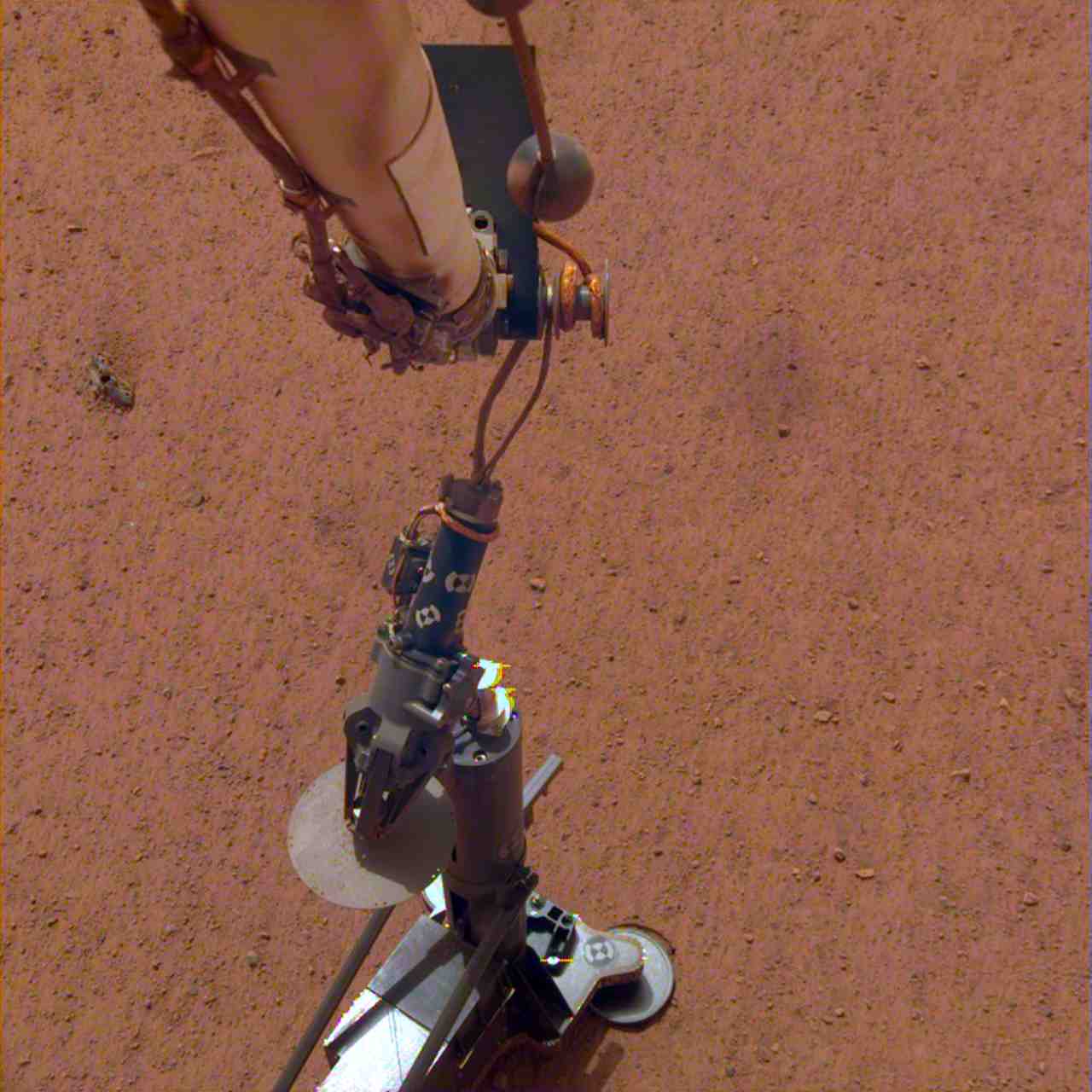 Seismometer listening for clues as to what is obstructing InSight's mole. Image: NASA-JPL/CalTech[/caption]The five-kilometer tall mountain Curiosity is perched on now is the target of an important scientific study in the mission. The rover began its trek up the mountain in 2013, making it to the mission's target site in September 2014. This was after NASA's Mars Reconnaissance Orbiter (MRO) sniffed out a strong "signal" of clay before Curiosity's 2012 landing.Now that Curiosity has arrived to investigate it, the mission's science team hopes to understand from the samples if there was a time in Mars' past when flowing water shaped this layer of Mount Sharp."Each layer of this mountain is a puzzle piece," Ashwin Vasavada, a Curiosity Project Scientist at JPL said in a statement. With every sampling mission, scientists are expecting to sneak a preview of a different era in Martian history from its mineral composition. We're excited to see what this first sample tells us about the ancient environment, especially about water."[caption id="attachment_6449811" align="alignnone" width="1280"]
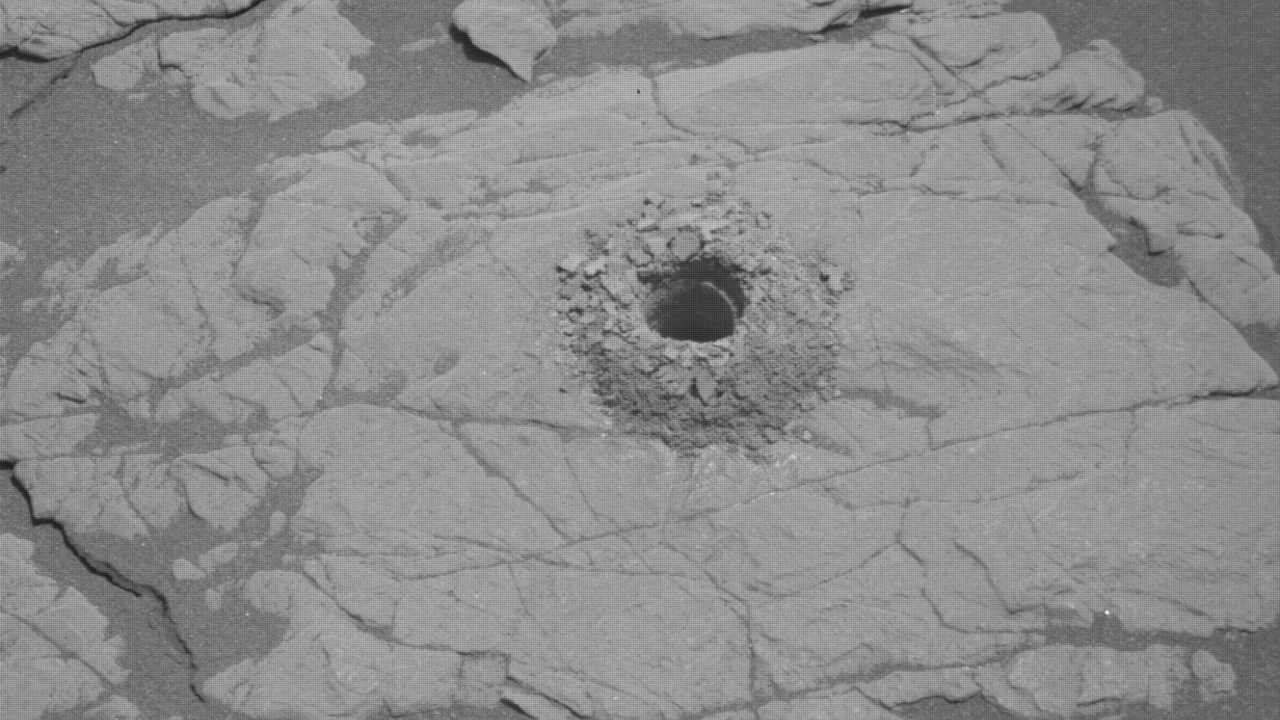 An image taken by the Mastcam on NASA's Mars Curiosity rover. Image: NASA/JPL-Caltech[/caption]NASA plans to have Curiosity drill many more times over the course of 2019 and 2020, to understand how this region, with all its diverse rocks, sand (and pebble!) is different from the rover's previous campsite at the Vera Rubin Ridge.Meanwhile, elsewhere on Mars is another NASA mission hammering into rock — the InSight lander. The lander's Heat and Physical Properties (HP3) instrument finished a new round of diagnostic hammering into Mars' surface on 26 March 2019 as another instrument — the quake-detecting seismometer — listened for how sound waves passed through the rock beneath.This test wasn't part of InSight's exploratory missions, but instead some necessary troubleshooting. InSight hit a brick wall in an attempt to drill a hole into a chosen patch of ground to stick its HP3 instrument into. The drill was blocked, and InSight's probe has been hammering the surface and listening in with its seismometer to understand what the obstruction is. The science team thinks it could be a single rock, a layer of gravel or a jammed cable from something getting into the lander's protective housing.
First Published:Apr 15, 2019, 13:11:25 IST
Advertisement
Advertisement

Careless Whispers: Scientists discover that plants can 'talk' to each other using smells
Japanese scientists have recorded a video that shows plants, in certain conditions, communicate with each other using mists that carry smells. The discovery, reveals that plants release a fine mist of airborne compounds, to warn nearby plants of potential dangers
Life on Mars? European Space Agency’s Orbiter discovers ice water deposits at equator
European Space Agency's Mars Express Orbiter has identified massive ice and ice water deposits beneath the surface of Mars. The Mars Express orbiter was also the first to confirmed the presence of ice on Mars in 2004
Microsoft briefly overtakes Apple as the most valuable company, Apple back on top again
At its peak during the session, Microsoft's value reached $2.903 trillion, with a 2% surge. As of writing this article, Apple closed at $2.89 trillion, whereas Microsoft closed at $2.86 trillion
Even NASA is facing a tough time, starts layoffs following major budget cuts
NASA is facing some massive budget cuts, because of which, it has been forced to postpone some upcoming missions. NASA's Jet Propulsion Laboratory has been hit hard by recent federal budget cuts, resulting in the layoff of 100 contractors last week
ISRO, NASA's NISAR satellite to get ready by Jan-end, will monitor Earth's snow-covered regions
The NISAR satellite which has been developed jointly ISRO and NASA, should be ready for launch by the end of January 2024. The collaboration between NASA and ISRO on NISAR is the first time the two agencies have cooperated on hardware development for an Earth-observing mission
Advertisement
Advertisement