


NASA wants to make GPS for space, will guide astronauts and spacecraft on the Moon
The Global Positioning System is made up of three parts: satellites, ground stations, and receivers.

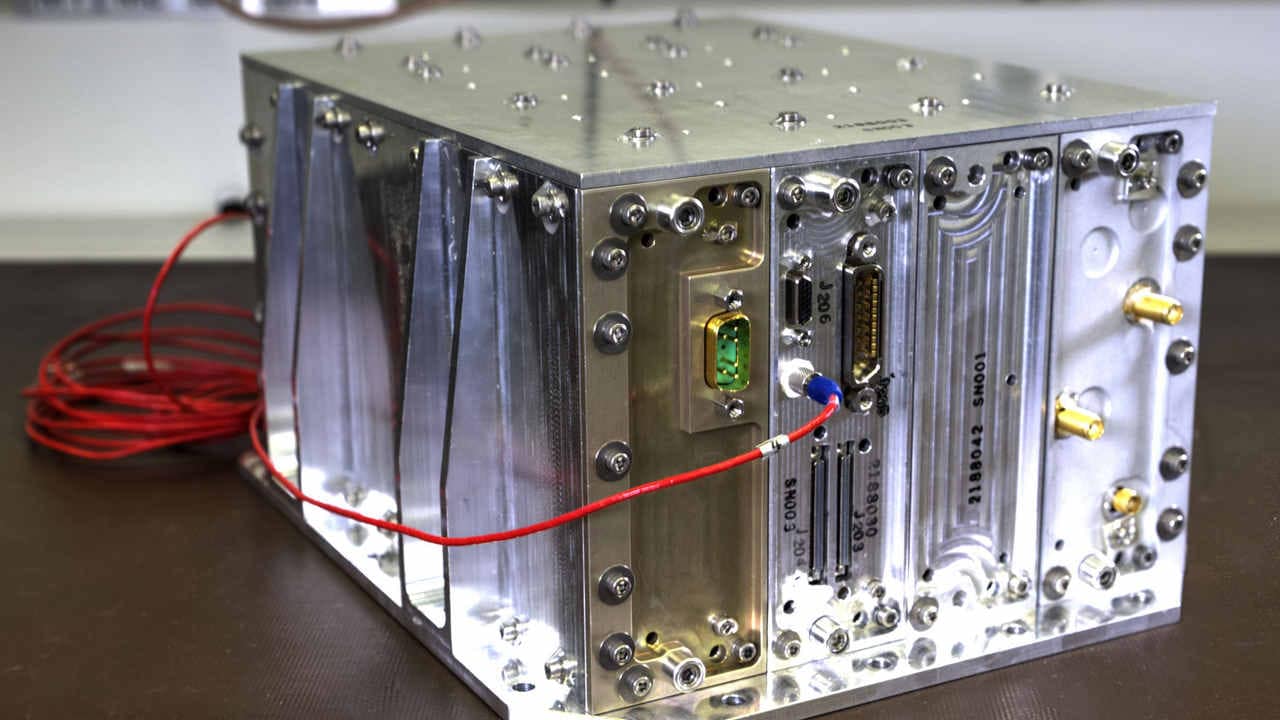
NavCube, which will be tested aboard the International Space Station later this year, is being used as a baseline for a lunar GPS receiver.
Credits: NASA/W. Hrybyk[/caption]The spacecraft that is fitted with this GPS receiver will be paired with precise mapping data that will enable astronauts to track their locations in space or on the Moon’s surface.The GPS receiver is based on the Goddard-developed Navigator GPS, which engineers began developing in the early 2000s specifically for NASA’s Magnetospheric Multiscale mission (MMS) mission, which was NASA's unpiloted space mission to study the Earth's magnetosphere, and used four identical spacecraft flying in a triangular pyramid formation.“We’re using infrastructure that was built for surface navigation on Earth for applications beyond Earth,” said Jason Mitchell, chief technologist for Goddard’s Mission Engineering and Systems Analysis Division, in a press release. “Its use for higher-altitude navigation has now been firmly established with the success of missions like Magnetospheric Multiscale mission and the Geostationary Operational Environmental Satellites (GOES). In fact, with MMS, we’re already nearly halfway to the Moon.”[caption id="attachment_6931511" align="alignnone" width="1280"]
The team developing a GPS receiver for use in and around lunar orbit are from (left to right): Jason Mitchell, Luke Winternitz, Luke Thomas, Munther Hassouneh, and Sam Price.
Credits: NASA/T. Mickal[/caption]To make this GPS a reality, the old MMS's GPS will need some upgrades, like a high-gain antenna, an enhanced clock, and updated electronics.The team’s current lunar GPS receiver concept is based on NavCube, a new capability developed from the merger of MMS’s Navigator GPS and SpaceCube, a reconfigurable, very fast flight computer platform.

Careless Whispers: Scientists discover that plants can 'talk' to each other using smells
Life on Mars? European Space Agency’s Orbiter discovers ice water deposits at equator
Microsoft briefly overtakes Apple as the most valuable company, Apple back on top again
Even NASA is facing a tough time, starts layoffs following major budget cuts
ISRO, NASA's NISAR satellite to get ready by Jan-end, will monitor Earth's snow-covered regions