
Advertisement


Sections
NASA studying potential risks of long-duration spaceflight with astronaut twins
Scott Kelly, one of the astronaut test subjects, spent 340 days in the International Space Station.

From his eyes to his immune system, astronaut Scott Kelly’s body sometimes reacted strangely to nearly a year in orbit, at least compared to his Earth-bound identical twin — but newly published research shows nothing that would cancel even longer space treks, like to Mars.[caption id="attachment_6436911" align="alignnone" width="1280"]![NASA twins – Scott and Mark Kelly.]() NASA twins – Scott and Mark Kelly.[/caption]The good news: Kelly largely bounced back after returning home, say scientists who released final results from NASA’s “twins study,” a never-before opportunity to track the biological consequences of spaceflight in genetic doubles.It marks “the dawn of human genomics in space,” said Dr. Andrew Feinberg of Johns Hopkins University. He led one of 10 teams of researchers that scrutinized the twins’ health down to the molecular level before, during and after Kelly’s 340-day stay at the International Space Station.More importantly, the study “represents more than one small step for mankind” by pointing out potential risks of longer-duration spaceflight that need study in more astronauts, said Markus Lobrich of Germany’s Darmstadt University and Penny Jeggo of the University of Sussex, who weren’t involved in the work.The findings were published in Friday’s edition of the journal Science, on some notable space anniversaries — when Soviet cosmonaut Yuri Gagarin became the first person in space in 1961, and the first launch of the space shuttle in 1981.Key findingsNASA already knew some of the toll of space travel, such as bone loss that requires exercise to counter. This time, NASA-funded scientists looked for a gamut of physiologic and genomic changes that Scott Kelly experienced in space, comparing them to his DNA double on the ground, former astronaut Mark Kelly. Some results had been reported in February.Possibly the weirdest finding had to do with something called telomeres, the protective ends of chromosomes. Those tips gradually shorten as we get older, and are thought to be linked to age-related diseases including some cancers.But in space, Scott Kelly’s telomeres got longer. “We were surprised,” said Colorado State University telomere expert Susan Bailey. She can’t explain it although it doesn’t mean Kelly got younger. Back on Earth, his telomeres mostly returned to preflight average although he did have more short telomeres than before.Next, Kelly’s DNA wasn’t mutated in space but the activity of many of his genes — how they switch on and off — did change, especially in the last half of the voyage, which ended in March 2016.Immune system genes especially were affected, putting it “almost on high alert as a way to try and understand this new environment,” said study co-author Christopher Mason, a Weill Cornell Medicine geneticist in New York.Again, most gene expression returned to normal back home, but some of the immune-related genes were hyperactive six months later.“We learned that the human body is pretty resilient and we can survive and to some extent maybe even thrive on these long-duration flights,” Mark Kelly said.Other findings:
NASA twins – Scott and Mark Kelly.[/caption]The good news: Kelly largely bounced back after returning home, say scientists who released final results from NASA’s “twins study,” a never-before opportunity to track the biological consequences of spaceflight in genetic doubles.It marks “the dawn of human genomics in space,” said Dr. Andrew Feinberg of Johns Hopkins University. He led one of 10 teams of researchers that scrutinized the twins’ health down to the molecular level before, during and after Kelly’s 340-day stay at the International Space Station.More importantly, the study “represents more than one small step for mankind” by pointing out potential risks of longer-duration spaceflight that need study in more astronauts, said Markus Lobrich of Germany’s Darmstadt University and Penny Jeggo of the University of Sussex, who weren’t involved in the work.The findings were published in Friday’s edition of the journal Science, on some notable space anniversaries — when Soviet cosmonaut Yuri Gagarin became the first person in space in 1961, and the first launch of the space shuttle in 1981.Key findingsNASA already knew some of the toll of space travel, such as bone loss that requires exercise to counter. This time, NASA-funded scientists looked for a gamut of physiologic and genomic changes that Scott Kelly experienced in space, comparing them to his DNA double on the ground, former astronaut Mark Kelly. Some results had been reported in February.Possibly the weirdest finding had to do with something called telomeres, the protective ends of chromosomes. Those tips gradually shorten as we get older, and are thought to be linked to age-related diseases including some cancers.But in space, Scott Kelly’s telomeres got longer. “We were surprised,” said Colorado State University telomere expert Susan Bailey. She can’t explain it although it doesn’t mean Kelly got younger. Back on Earth, his telomeres mostly returned to preflight average although he did have more short telomeres than before.Next, Kelly’s DNA wasn’t mutated in space but the activity of many of his genes — how they switch on and off — did change, especially in the last half of the voyage, which ended in March 2016.Immune system genes especially were affected, putting it “almost on high alert as a way to try and understand this new environment,” said study co-author Christopher Mason, a Weill Cornell Medicine geneticist in New York.Again, most gene expression returned to normal back home, but some of the immune-related genes were hyperactive six months later.“We learned that the human body is pretty resilient and we can survive and to some extent maybe even thrive on these long-duration flights,” Mark Kelly said.Other findings:
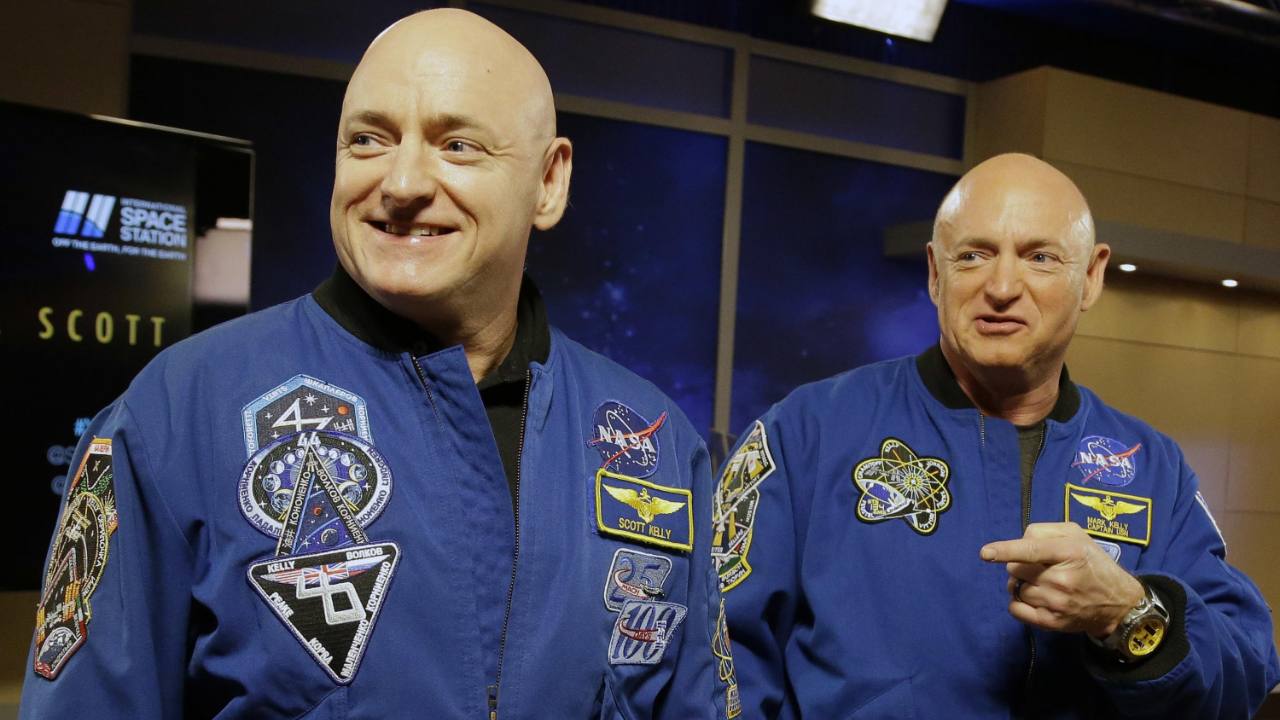 NASA twins – Scott and Mark Kelly.[/caption]The good news: Kelly largely bounced back after returning home, say scientists who released final results from NASA’s “twins study,” a never-before opportunity to track the biological consequences of spaceflight in genetic doubles.It marks “the dawn of human genomics in space,” said Dr. Andrew Feinberg of Johns Hopkins University. He led one of 10 teams of researchers that scrutinized the twins’ health down to the molecular level before, during and after Kelly’s 340-day stay at the International Space Station.More importantly, the study “represents more than one small step for mankind” by pointing out potential risks of longer-duration spaceflight that need study in more astronauts, said Markus Lobrich of Germany’s Darmstadt University and Penny Jeggo of the University of Sussex, who weren’t involved in the work.The findings were published in Friday’s edition of the journal Science, on some notable space anniversaries — when Soviet cosmonaut Yuri Gagarin became the first person in space in 1961, and the first launch of the space shuttle in 1981.Key findingsNASA already knew some of the toll of space travel, such as bone loss that requires exercise to counter. This time, NASA-funded scientists looked for a gamut of physiologic and genomic changes that Scott Kelly experienced in space, comparing them to his DNA double on the ground, former astronaut Mark Kelly. Some results had been reported in February.Possibly the weirdest finding had to do with something called telomeres, the protective ends of chromosomes. Those tips gradually shorten as we get older, and are thought to be linked to age-related diseases including some cancers.But in space, Scott Kelly’s telomeres got longer. “We were surprised,” said Colorado State University telomere expert Susan Bailey. She can’t explain it although it doesn’t mean Kelly got younger. Back on Earth, his telomeres mostly returned to preflight average although he did have more short telomeres than before.Next, Kelly’s DNA wasn’t mutated in space but the activity of many of his genes — how they switch on and off — did change, especially in the last half of the voyage, which ended in March 2016.Immune system genes especially were affected, putting it “almost on high alert as a way to try and understand this new environment,” said study co-author Christopher Mason, a Weill Cornell Medicine geneticist in New York.Again, most gene expression returned to normal back home, but some of the immune-related genes were hyperactive six months later.“We learned that the human body is pretty resilient and we can survive and to some extent maybe even thrive on these long-duration flights,” Mark Kelly said.Other findings:
- Some changes in the structure of Kelly’s eye and thickening of his retina suggested that, like about 40% of astronauts, he experienced symptoms of “spaceflight-associated neuro-ocular syndrome.” It may be caused by fluids shifting in the absence of gravity.
- He experienced some chromosomal instability that might reflect radiation exposure in space.
- A flu shot given in space worked as well as one on Earth.
- Kelly aced cognitive tests in space but slowed down after his return, maybe as more things competed for his attention.
First Published:Apr 12, 2019, 14:11:47 IST
Advertisement
Advertisement

Careless Whispers: Scientists discover that plants can 'talk' to each other using smells
Japanese scientists have recorded a video that shows plants, in certain conditions, communicate with each other using mists that carry smells. The discovery, reveals that plants release a fine mist of airborne compounds, to warn nearby plants of potential dangers
Life on Mars? European Space Agency’s Orbiter discovers ice water deposits at equator
European Space Agency's Mars Express Orbiter has identified massive ice and ice water deposits beneath the surface of Mars. The Mars Express orbiter was also the first to confirmed the presence of ice on Mars in 2004
Microsoft briefly overtakes Apple as the most valuable company, Apple back on top again
At its peak during the session, Microsoft's value reached $2.903 trillion, with a 2% surge. As of writing this article, Apple closed at $2.89 trillion, whereas Microsoft closed at $2.86 trillion
Even NASA is facing a tough time, starts layoffs following major budget cuts
NASA is facing some massive budget cuts, because of which, it has been forced to postpone some upcoming missions. NASA's Jet Propulsion Laboratory has been hit hard by recent federal budget cuts, resulting in the layoff of 100 contractors last week
ISRO, NASA's NISAR satellite to get ready by Jan-end, will monitor Earth's snow-covered regions
The NISAR satellite which has been developed jointly ISRO and NASA, should be ready for launch by the end of January 2024. The collaboration between NASA and ISRO on NISAR is the first time the two agencies have cooperated on hardware development for an Earth-observing mission
Advertisement
Advertisement