


NASA spacecraft shows how 'stolen' electrons enable rare aurora on Mars
NASA’s MAVEN spacecraft just reported a new type of Martian aurora — a very rare phenomenon anyway.

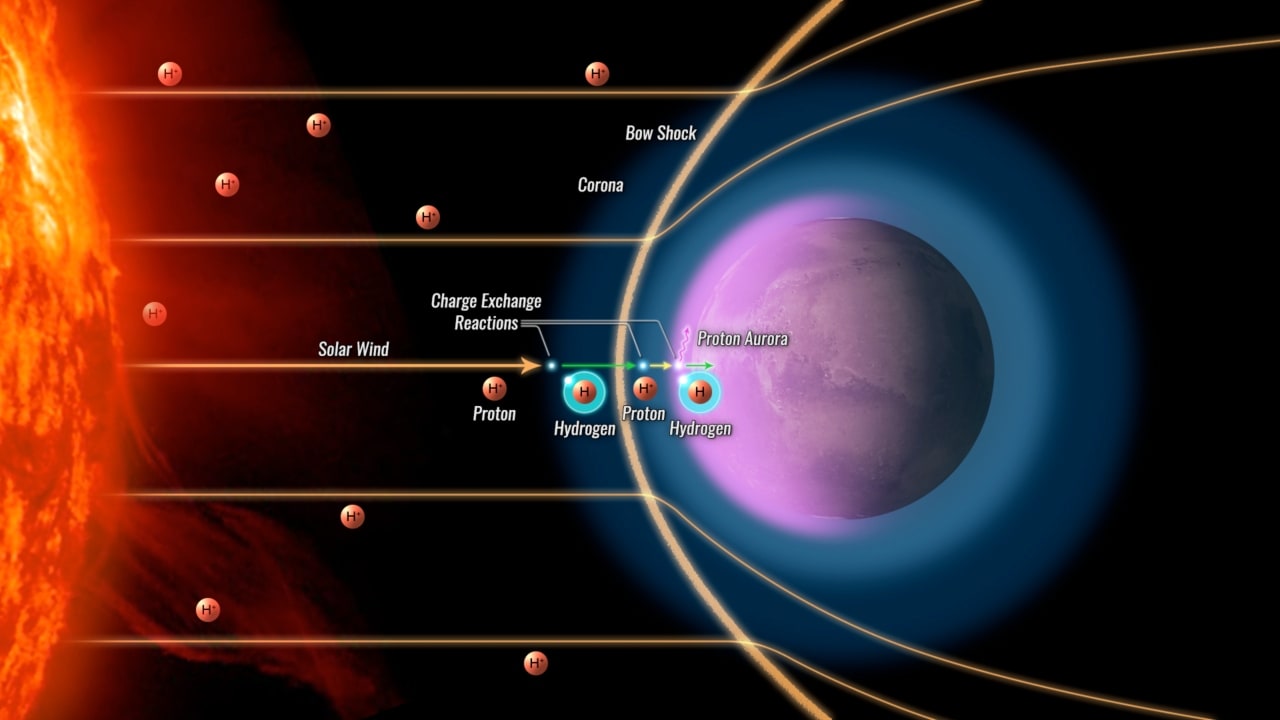
First, a solar wind proton approaches Mars at high speed and encounters a cloud of hydrogen surrounding the planet. The proton steals an electron from a Martian hydrogen atom, thereby becoming a neutral atom. The atom passes through the bow shock, a magnetic obstacle surrounding Mars because neutral particles are not affected by magnetic fields. Finally, the hydrogen atom enters Mars' atmosphere and collides with gas molecules, causing the atom to emit ultraviolet light. Image courtesy: NASA[/caption]"Auroras flare up when energetic particles plunge into a planet’s atmosphere, bombarding gases and making them glow. While electrons generally cause this natural phenomenon, sometime protons can elicit the same response, although it’s rarer. Now, the MAVEN team has learned that protons were doing at Mars the same thing as electrons usually do at Earth — create aurora," a NASA statement said.NASA's MAVEN team observed that on occasion, the ultraviolet light coming from hydrogen gas in Mars' upper atmosphere would mysteriously and suddenly brighten for a few hours. Then, it was seen that the brightening events occurred when a MAVEN instrument, the Solar Wind Ion Analyser (SWIA), measured enhanced solar wind protons. What does that mean, you ask?A solar wind is an erratic flow of protons that the Sun ejects at speeds of over 3 million kilometres per hour. These protons are essentially hydrogen atoms stripped of their lone electrons by intense heat (check the illustration above for the detailed process).But this is where scientists encountered two major puzzles, according to NASA: How did these protons get past the planet’s 'bow shock' — a magnetic obstacle which diverts the solar wind’s charged particles around the planet? And how could the protons give off a light, since atoms need electrons to do so?"The answer was thievery," said Justin Deighan, lead author of a paper on this research appearing 23 July in Nature Astronomy. "As they approach Mars, the protons coming in with the solar wind transform into neutral atoms by stealing electrons from the outer edge of the huge cloud of hydrogen surrounding the planet. The bow shock can only divert charged particles, so these neutral atoms continue right on through."

Careless Whispers: Scientists discover that plants can 'talk' to each other using smells
Life on Mars? European Space Agency’s Orbiter discovers ice water deposits at equator
Microsoft briefly overtakes Apple as the most valuable company, Apple back on top again
Even NASA is facing a tough time, starts layoffs following major budget cuts
ISRO, NASA's NISAR satellite to get ready by Jan-end, will monitor Earth's snow-covered regions