
Advertisement


Sections
NASA OSIRIS-REx captures Earth, moon, asteroid Bennu in a single frame
The picture was taken days before the NASA probe zoomed in to the asteroid's orbit on New Year’s Eve.

NASA’s OSIRIS-REx spacecraft took a picture of Earth just days before zooming in to asteroid Bennu's orbit on New Year’s Eve.The small asteroid Bennu, which is barely 500 meters wide, looks like a huge, bright blob in the long-exposure photo released by NASA on 19 December.[caption id="attachment_5861861" align="alignnone" width="1280"]![This image captured on 19 December, 2018 by a camera on the OSIRIS-REx spacecraft shows the asteroid Bennu, top right, about 43 kilometers away, and the Earth and moon, bottom left, over 110 million kilometers in the distance. Bennu at just 500 meters wide, is the smallest celestial body ever to be orbited by a spacecraft. Image courtesy: NASA Goddard]() This image captured on 19 December, 2018 by a camera on the OSIRIS-REx spacecraft shows the asteroid Bennu, top right, about 43 kilometers away, and the Earth and moon, bottom left, over 110 million kilometers in the distance. Bennu at just 500 meters wide, is the smallest celestial body ever to be orbited by a spacecraft. Image courtesy: NASA Goddard[/caption]On the left, and in the far distance (110 million kilometers away), Earth appears as a white dot with the moon even tinier but both clearly visible in the image.OSIRIS-REx is the first spacecraft to orbit a celestial object so small and from such close proximity — just 1,600 meters from its surface.Next year, the OSIRIS-REx spacecraft will try to gather some samples from the asteroid to return to Earth by 2023.A winning gamble with BennuNASA was quite pleased with its choice of rock for the mission, which the agency's first-ever asteroid-sampling project so far.The OSIRIS-REx probe, in a few days after its arrival at Bennu in early December 2018, found evidence of water-rich minerals on the asteroid, a NASA statement said.The discovery indicated that water in its liquid form was abundant in the interior of the celestial body Bennu was once part of. Astronomers studying the space rock think that this parent rock was a 100-kilometre-wide member of the main asteroid belt that falls between Mars and Jupiter.One of the key objectives from the mission is to give scientists a window into understanding the early evolution of our solar system and what asteroids like Bennu may have contributed to the presence of primitive life or water on Earth.This made the discovery of water traces a huge deal for the OSIRIS-REx team.[caption id="attachment_5706841" align="alignnone" width="1280"]
This image captured on 19 December, 2018 by a camera on the OSIRIS-REx spacecraft shows the asteroid Bennu, top right, about 43 kilometers away, and the Earth and moon, bottom left, over 110 million kilometers in the distance. Bennu at just 500 meters wide, is the smallest celestial body ever to be orbited by a spacecraft. Image courtesy: NASA Goddard[/caption]On the left, and in the far distance (110 million kilometers away), Earth appears as a white dot with the moon even tinier but both clearly visible in the image.OSIRIS-REx is the first spacecraft to orbit a celestial object so small and from such close proximity — just 1,600 meters from its surface.Next year, the OSIRIS-REx spacecraft will try to gather some samples from the asteroid to return to Earth by 2023.A winning gamble with BennuNASA was quite pleased with its choice of rock for the mission, which the agency's first-ever asteroid-sampling project so far.The OSIRIS-REx probe, in a few days after its arrival at Bennu in early December 2018, found evidence of water-rich minerals on the asteroid, a NASA statement said.The discovery indicated that water in its liquid form was abundant in the interior of the celestial body Bennu was once part of. Astronomers studying the space rock think that this parent rock was a 100-kilometre-wide member of the main asteroid belt that falls between Mars and Jupiter.One of the key objectives from the mission is to give scientists a window into understanding the early evolution of our solar system and what asteroids like Bennu may have contributed to the presence of primitive life or water on Earth.This made the discovery of water traces a huge deal for the OSIRIS-REx team.[caption id="attachment_5706841" align="alignnone" width="1280"]![This image of asteroid Bennu is made from 12 PolyCam images collected on 2 December by OSIRIS-REx from a distance of 24 kilometers. Image: University of Arizona]() This image of asteroid Bennu is made from 12 PolyCam images collected on 2 December by OSIRIS-REx from a distance of 24 kilometers. Image: University of Arizona[/caption]The $800-million-OSIRIS-REx mission launched in 2016, and only began its approach towards the asteroid in August this year. Over the weeks since then, OSIRIS-REx's onboard instruments picked up signatures of hydroxyl groups — molecules that have hydrogen and oxygen in them — which are a key indicator of moisture. Researchers think these hydroxyls are abundant on Bennu, locked in the form of clay minerals, and also a good sign to dig deeper for organic compounds. Organics would be a clear indicator of life anywhere in the solar system.NASA also released images of the best glimpses OSIRIS-REx has gotten so far of Bennu, which were taken as the spacecraft made its approach to the asteroid's orbit. Looking at the images further revealed that Bennu's surface was rugged and full of boulders. This could complicate the probe's ultimate mission: a sample-grab from Bennu's surface.The mission's scientists are quite sure they will find a suitable sampling site by July 2020, until which OSIRIS-REx will keep busy collecting data and measurements at a distance from the asteroid.
This image of asteroid Bennu is made from 12 PolyCam images collected on 2 December by OSIRIS-REx from a distance of 24 kilometers. Image: University of Arizona[/caption]The $800-million-OSIRIS-REx mission launched in 2016, and only began its approach towards the asteroid in August this year. Over the weeks since then, OSIRIS-REx's onboard instruments picked up signatures of hydroxyl groups — molecules that have hydrogen and oxygen in them — which are a key indicator of moisture. Researchers think these hydroxyls are abundant on Bennu, locked in the form of clay minerals, and also a good sign to dig deeper for organic compounds. Organics would be a clear indicator of life anywhere in the solar system.NASA also released images of the best glimpses OSIRIS-REx has gotten so far of Bennu, which were taken as the spacecraft made its approach to the asteroid's orbit. Looking at the images further revealed that Bennu's surface was rugged and full of boulders. This could complicate the probe's ultimate mission: a sample-grab from Bennu's surface.The mission's scientists are quite sure they will find a suitable sampling site by July 2020, until which OSIRIS-REx will keep busy collecting data and measurements at a distance from the asteroid.
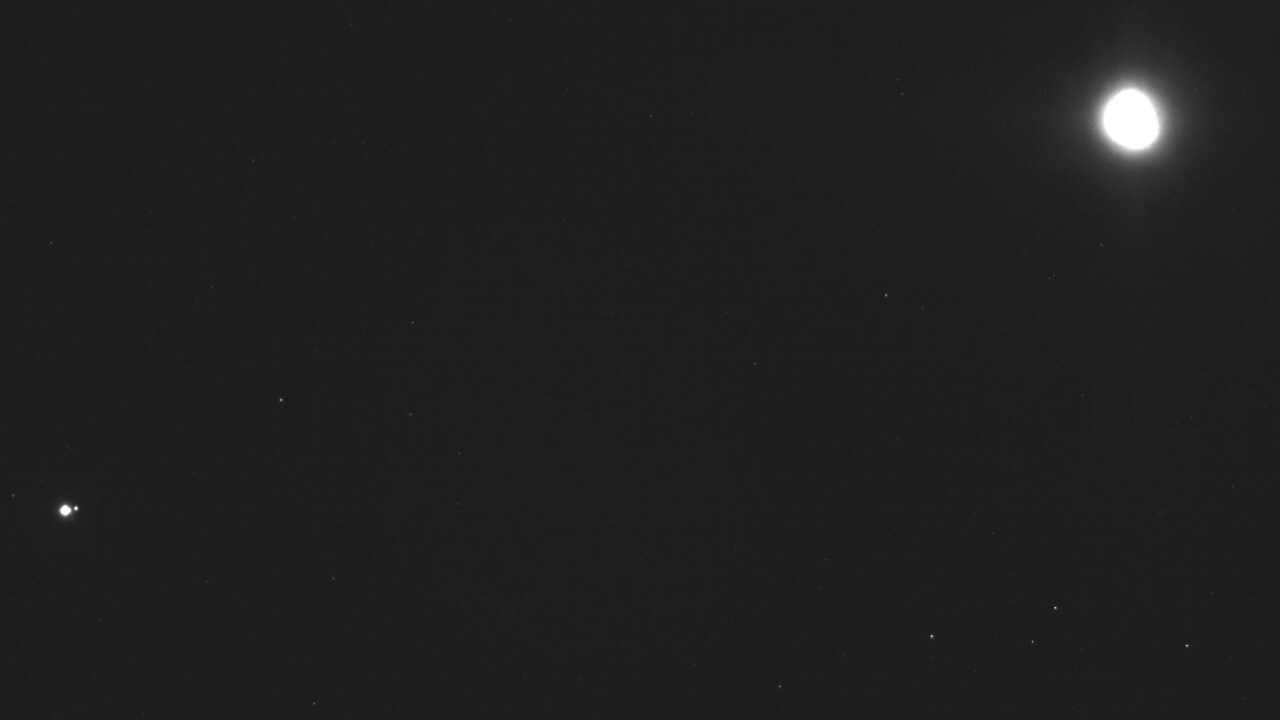 This image captured on 19 December, 2018 by a camera on the OSIRIS-REx spacecraft shows the asteroid Bennu, top right, about 43 kilometers away, and the Earth and moon, bottom left, over 110 million kilometers in the distance. Bennu at just 500 meters wide, is the smallest celestial body ever to be orbited by a spacecraft. Image courtesy: NASA Goddard[/caption]On the left, and in the far distance (110 million kilometers away), Earth appears as a white dot with the moon even tinier but both clearly visible in the image.OSIRIS-REx is the first spacecraft to orbit a celestial object so small and from such close proximity — just 1,600 meters from its surface.Next year, the OSIRIS-REx spacecraft will try to gather some samples from the asteroid to return to Earth by 2023.A winning gamble with BennuNASA was quite pleased with its choice of rock for the mission, which the agency's first-ever asteroid-sampling project so far.The OSIRIS-REx probe, in a few days after its arrival at Bennu in early December 2018, found evidence of water-rich minerals on the asteroid, a NASA statement said.
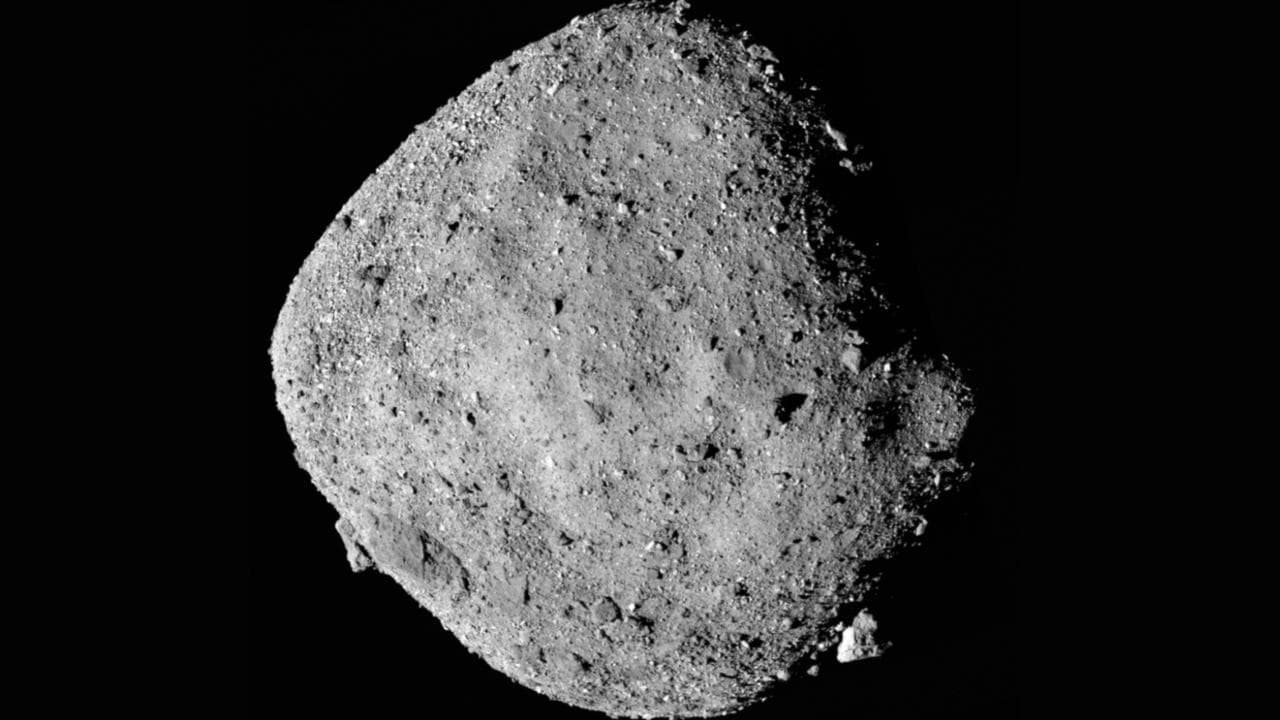 This image of asteroid Bennu is made from 12 PolyCam images collected on 2 December by OSIRIS-REx from a distance of 24 kilometers. Image: University of Arizona[/caption]The $800-million-OSIRIS-REx mission launched in 2016, and only began its approach towards the asteroid in August this year. Over the weeks since then, OSIRIS-REx's onboard instruments picked up signatures of hydroxyl groups — molecules that have hydrogen and oxygen in them — which are a key indicator of moisture. Researchers think these hydroxyls are abundant on Bennu, locked in the form of clay minerals, and also a good sign to dig deeper for organic compounds. Organics would be a clear indicator of life anywhere in the solar system.NASA also released images of the best glimpses OSIRIS-REx has gotten so far of Bennu, which were taken as the spacecraft made its approach to the asteroid's orbit. Looking at the images further revealed that Bennu's surface was rugged and full of boulders. This could complicate the probe's ultimate mission: a sample-grab from Bennu's surface.The mission's scientists are quite sure they will find a suitable sampling site by July 2020, until which OSIRIS-REx will keep busy collecting data and measurements at a distance from the asteroid.
First Published:Jan 09, 2019, 10:47:54 IST
Advertisement
Advertisement

Careless Whispers: Scientists discover that plants can 'talk' to each other using smells
Japanese scientists have recorded a video that shows plants, in certain conditions, communicate with each other using mists that carry smells. The discovery, reveals that plants release a fine mist of airborne compounds, to warn nearby plants of potential dangers
Life on Mars? European Space Agency’s Orbiter discovers ice water deposits at equator
European Space Agency's Mars Express Orbiter has identified massive ice and ice water deposits beneath the surface of Mars. The Mars Express orbiter was also the first to confirmed the presence of ice on Mars in 2004
Microsoft briefly overtakes Apple as the most valuable company, Apple back on top again
At its peak during the session, Microsoft's value reached $2.903 trillion, with a 2% surge. As of writing this article, Apple closed at $2.89 trillion, whereas Microsoft closed at $2.86 trillion
Even NASA is facing a tough time, starts layoffs following major budget cuts
NASA is facing some massive budget cuts, because of which, it has been forced to postpone some upcoming missions. NASA's Jet Propulsion Laboratory has been hit hard by recent federal budget cuts, resulting in the layoff of 100 contractors last week
ISRO, NASA's NISAR satellite to get ready by Jan-end, will monitor Earth's snow-covered regions
The NISAR satellite which has been developed jointly ISRO and NASA, should be ready for launch by the end of January 2024. The collaboration between NASA and ISRO on NISAR is the first time the two agencies have cooperated on hardware development for an Earth-observing mission
Advertisement
Advertisement