


Mars has multiple pools of liquid water around a main reservoir, astronomers argue in new study
The area in question is the closest 'habitable' place on Mars that has been found so far, the study authors said.

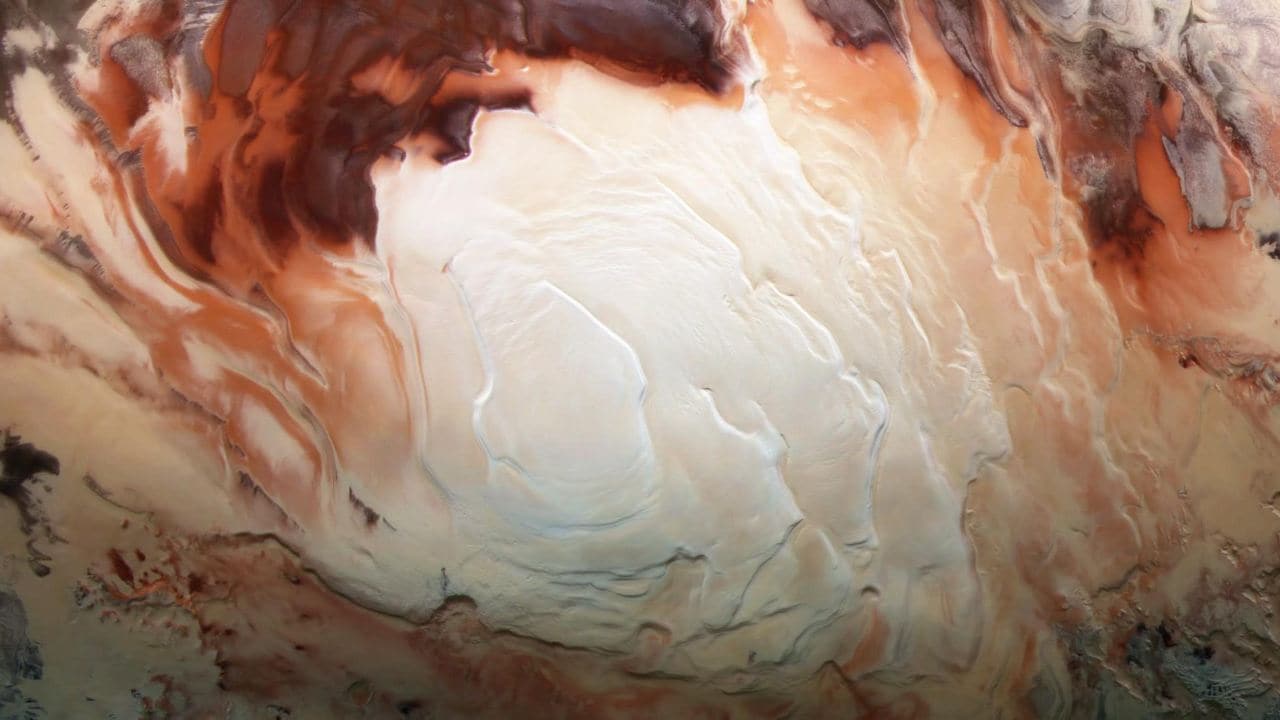
The South Pole on Mars. Image Credit: ESA/DLR/FU Berlin/Bill Dunford[/caption]However, one question plaguing many is that how could the water stay in the liquid state. Isaac Smith, a scientist with the Planetary Science Institute says the community is divided regarding it, even though he is more towards believing.According to Smith, as recently as 50,000 years ago, the Martian south pole was warmer because the planet’s tilt is constantly changing. Warmer temperatures could have propagated through the ice to create pockets of salty liquid. Alternatively, the ponds may have been there before the ice cap formed. Study authors say that at very high salt concentrations, once water has melted, it is hard to get it to freeze again.According to Orosei while they do not know the concentration of salts, which could be deadly to life, but if life forms did evolve on Mars, these lakes could have been "providing a Noah’s Ark that could have allowed life to survive even in present conditions.”The results of the study was released online in Nature Astronomy on 28 September.

Careless Whispers: Scientists discover that plants can 'talk' to each other using smells
Life on Mars? European Space Agency’s Orbiter discovers ice water deposits at equator
Microsoft briefly overtakes Apple as the most valuable company, Apple back on top again
Even NASA is facing a tough time, starts layoffs following major budget cuts
ISRO, NASA's NISAR satellite to get ready by Jan-end, will monitor Earth's snow-covered regions