
Advertisement


Sections
Last Royal Bengal tigers native to the Sunderbans may not survive climate change
Climate change will affect tiger habitats more dramatically than sea level rise in the Sunderbans.

 Representational image. Reuters[/caption]The researchers used detailed simulation models for the two scenarios of climate change that were developed by the Intergovernmental Panel on Climate Change (IPCC), along with projected sea level rise in the region to arrive at an assessment about how sustainable the region is for its tigers."While this is preliminary analysis, we can conclude that the largest population of Bengal tigers is in an area where a combination of actors including climate change and human encroachment could both contribute to the decimation of habitats," William Laurence, co-author of the study from James Cook University, told IndiaSpend.Also read: Understanding Project tiger, a homegrown tiger conservation success storyWith both temperatures and sea levels on the rise, the amount of salinated seawater flowing into land can change the soil's composition, making it harder for some plants to grow. With choices of available food on the decline, Sunderbans' population of spotted-deer, the foremost prey of the Bengal tiger, will be affected severely as the leaves and trees they feed on gradually disappear. With natural resources on the decline, tigers are also more likely to stray into settlements with people, on the lookout for food. Tiger-human conflict is also predicted to increase in this scenario, according to the study.[caption id="attachment_6252831" align="alignnone" width="1024"]
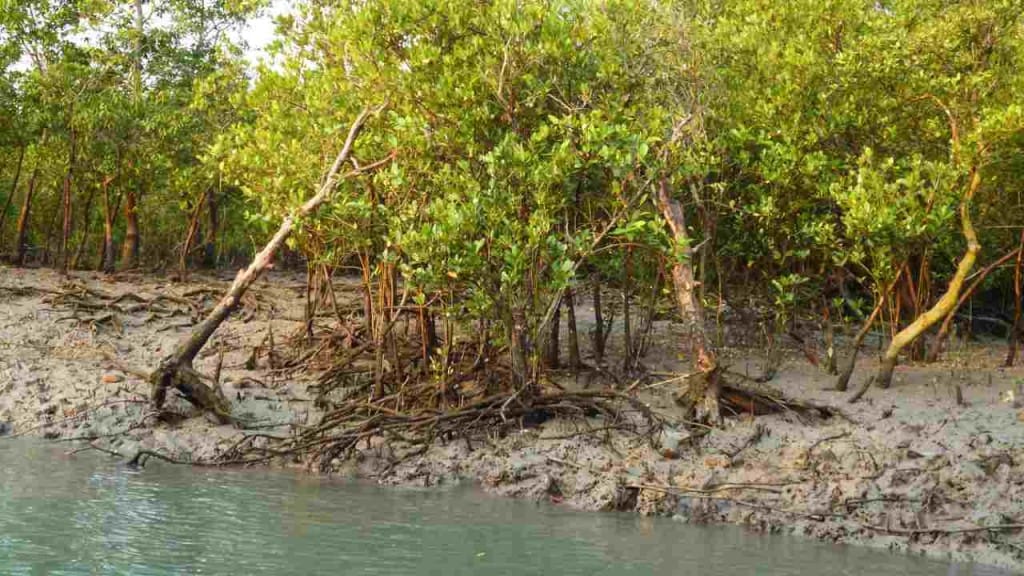 Mangrove forests in the Sundarbans. Image: Wikimedia Commons[/caption]The mangroves at the heart of the Sundarbans, themselves, are critically endangered, as per the IUCN Red List. Mangroves are trees that are salt tolerant, with roots that submerged under water and act as a nursery and nest for marine life. These young ones eventually migrate to reefs, which many of these creatures call home for a significant period of their lives.The collective ecosystem of mangroves, seagrass and corals are of huge importance to ocean health for many reasons — they trap and produce food for marine life, protect coasts from the impact of storms, help filter out pollutants in run-off water from land, and make for habitats to turtles, seahorses, manatees, fish and foraging sea life like urchins and sea cucumbers.
As for the Bengal tigers, researchers believe the population could still survive in the region if conservation of tigers and the local ecosystem is made a priority. The study calls on the government of Bangladesh to make accommodations – designate larger areas for tiger conservation, make more corridors for tigers to move around safely, and remain vigilant about poaching and hunting in the area to avoid any further decline in their population.While the study claims that tigers could be wiped out from the Sunderbans in 50 years, not all experts share the same opinion.Sugata Hazra, an oceanographer at Jadavpur University, Kolkata says that she doesn’t subscribe to the same "doomsday view"."When we conducted our 2016 study, we accounted for a 'sediment attrition rate', since mangroves are also building land in the area as they attract sediment," Hazra told Indiaspend. After they adjusted the sea level rise after sedimentation, the land loss was roughly 17 percent.[caption id="attachment_6252871" align="alignnone" width="1024"]
 Habitat loss in the Sunderbans is a serious, immediate threat. Image credit: Elsevier/Laurance et al[/caption]The Sunderbans Tiger Reserve was found to be home to at least 103 tigers in the 2013 census. Of its entire land area, around 40 percent – an area the size of Goa – falls under West Bengal. Some conservationists believe that this division of Sunderbans (as well its tiger population) between efforts from both, the Bangladeshi and Indian side, is a hindrance."Tigers can cross easily between India and Bangladesh so the tiger population is not a separate one; they live in a trans-national ecosystem," Hazra told Indiaspend. An approach with closer cooperation on sharing the forest resources, tiger habitat and upkeep of freshwater supply in the area is important, she adds.But any big effort needs time, and there's one thing that the study and Professor Hazra are in agreement about: the fight against habitat loss in the Sunderbans needs to begin immediately. It could take 20 years or more for these efforts to even begin showing results, but there won't be a forest or tigers to save in 50 years if action isn't taken soon.
First Published:May 09, 2019, 09:08:28 IST
Advertisement
Advertisement

Careless Whispers: Scientists discover that plants can 'talk' to each other using smells
Japanese scientists have recorded a video that shows plants, in certain conditions, communicate with each other using mists that carry smells. The discovery, reveals that plants release a fine mist of airborne compounds, to warn nearby plants of potential dangers
Life on Mars? European Space Agency’s Orbiter discovers ice water deposits at equator
European Space Agency's Mars Express Orbiter has identified massive ice and ice water deposits beneath the surface of Mars. The Mars Express orbiter was also the first to confirmed the presence of ice on Mars in 2004
Microsoft briefly overtakes Apple as the most valuable company, Apple back on top again
At its peak during the session, Microsoft's value reached $2.903 trillion, with a 2% surge. As of writing this article, Apple closed at $2.89 trillion, whereas Microsoft closed at $2.86 trillion
Even NASA is facing a tough time, starts layoffs following major budget cuts
NASA is facing some massive budget cuts, because of which, it has been forced to postpone some upcoming missions. NASA's Jet Propulsion Laboratory has been hit hard by recent federal budget cuts, resulting in the layoff of 100 contractors last week
ISRO, NASA's NISAR satellite to get ready by Jan-end, will monitor Earth's snow-covered regions
The NISAR satellite which has been developed jointly ISRO and NASA, should be ready for launch by the end of January 2024. The collaboration between NASA and ISRO on NISAR is the first time the two agencies have cooperated on hardware development for an Earth-observing mission
Advertisement
Advertisement