


Jupiter’s moon Europa glows in the dark because it is bombarded by radiation
Most of the observations using a spectrometer on a moon-like Europa are taken using sunlight, however, the latest results show how Europa would look in the dark.

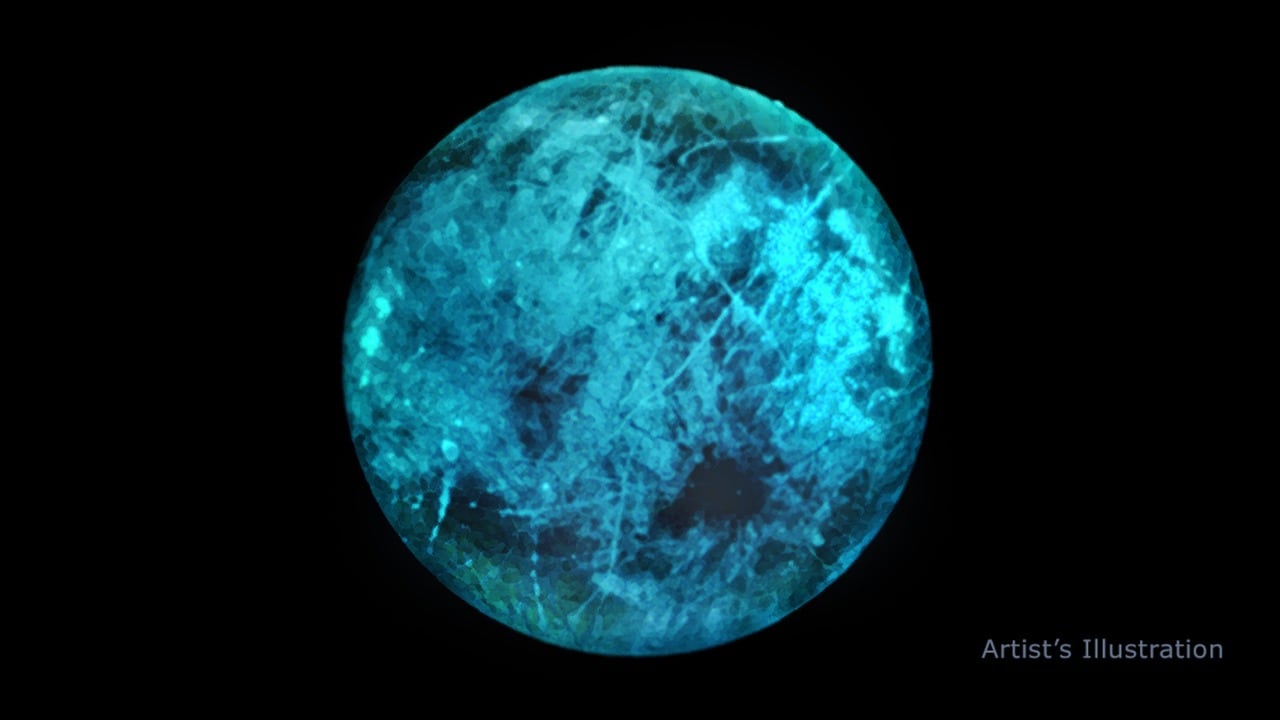
This illustration of Jupiter's moon Europa shows how the icy surface may glow on its nightside, the side facing away from the Sun. Variations in the glow and the color of the glow itself could reveal information about the composition of ice on Europa's surface. Image credit: NASA/JPL-Caltech[/caption]According to researchers, different salt compounds react differently to the radiation and emit their own glimmer. Researchers made use of a spectrometer to separate light into two wavelengths and connect the distinct signatures to different compositions of ice.Most of the observations using a spectrometer on a moon-like Europa are taken using sunlight that is reflected on the moon's dayside, however, the latest results illuminate what Europa would look like in the dark.Speaking about their observations, Murthy Gudipati, lead author of the work stated that they were able to predict that the nightside ice glow could provide more information on Europa's surface composition. According to Gudipati, how that composition varies could give scientists clues about whether Europa has conditions that are suitable for life.Since Europa harbours a massive interior ocean, by analysing the surface, scientists can learn more about what lies beneath.Scientists have earlier discovered that Europa's surface could be a mix of ice and common salts such as magnesium sulphate and sodium chloride.Researchers incorporated those salts into water ice under Europa-like conditions and blasted it with radiation to produce a glow. While that was not a surprise, JPL's Bryana Henderson, who co-authored the research added that when they tried new ice compositions, the glow looked different. They pointed a spectrometer at it and each type of ice had a different spectrum.According to researchers, Europa's glow is caused by an entirely different mechanism.Gudipati said that if Europa was not under radiation, it would look like our moon, dark on the shadowed side. However, because it is bombarded by radiation, it glows in the dark.The findings were published in the journal Nature Astronomy.

Careless Whispers: Scientists discover that plants can 'talk' to each other using smells
Life on Mars? European Space Agency’s Orbiter discovers ice water deposits at equator
Microsoft briefly overtakes Apple as the most valuable company, Apple back on top again
Even NASA is facing a tough time, starts layoffs following major budget cuts
ISRO, NASA's NISAR satellite to get ready by Jan-end, will monitor Earth's snow-covered regions