


Japan’s Hayabusa 2 to land on Earth, with asteroid by 5 December: Here’s all you need to know
By studying the soil samples sent by the shoebox-sized probe, JAXA scientists aim to study the formation of organic material in the ancient time.

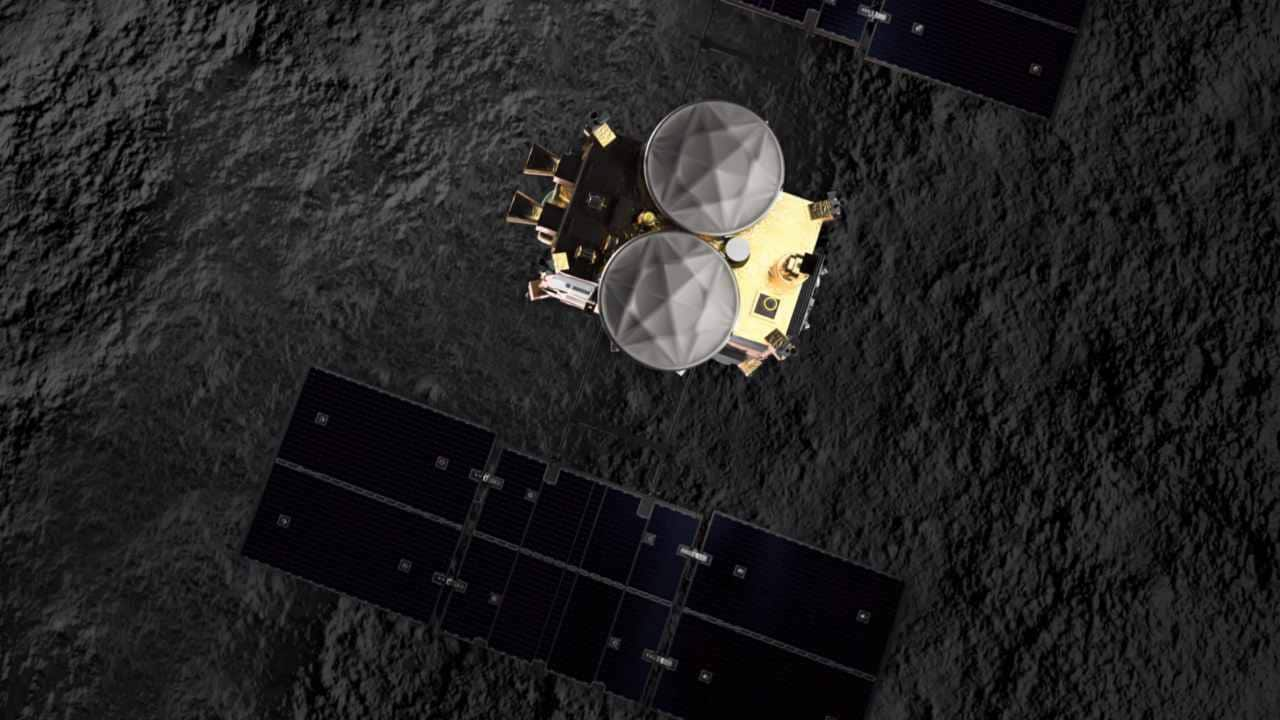
Hayabusa-2 attempting to touchdown on Ryugu. Image credit: DLR[/caption]https://twitter.com/haya2e_jaxa/status/1331073517538820098?s=20It was on 25 November that the Japanese space agency received all the requisite permissions from the Commonwealth Return Safety Officer (CRSO) to transition Hayabusa 2 onto a re-entry trajectory.https://twitter.com/haya2e_jaxa/status/1331597709032050691?s=20The CMRO gave the green signal after securing that there were no issues with the “navigation, guidance, plan, spacecraft or ground systems”.The next day, the TCM-3 or the third trajectory correction manoeuvre operation was rolled out. The thruster injection for fine-tuning adjustment was performed, speed and trajectory were adjusted and confirmed.https://twitter.com/haya2e_jaxa/status/1331798101422575616?s=20Finally, the space agency successfully completed the manoeuvre. Reporting the condition of the spacecraft to be “normal”, the tweet said that the “orbit will be decided in the future, and the re-entry time is planned to be calculated around November 30”.https://twitter.com/haya2e_jaxa/status/1331915531566256130?s=20By studying the soil samples sent by the shoebox-sized probe, JAXA scientists aim to study the formation of organic material in the ancient time. Researchers look forward to knowing how the planets were created by studying primitive small bodies like Ryugu.

Careless Whispers: Scientists discover that plants can 'talk' to each other using smells
Life on Mars? European Space Agency’s Orbiter discovers ice water deposits at equator
Microsoft briefly overtakes Apple as the most valuable company, Apple back on top again
Even NASA is facing a tough time, starts layoffs following major budget cuts
ISRO, NASA's NISAR satellite to get ready by Jan-end, will monitor Earth's snow-covered regions