


Introducing Australotitan: Australia's largest dinosaur was as big as two buses combined
Nicknamed Cooper, it lived in southwest Queensland between 92–96 million years ago, when Australia was attached to Antarctica.

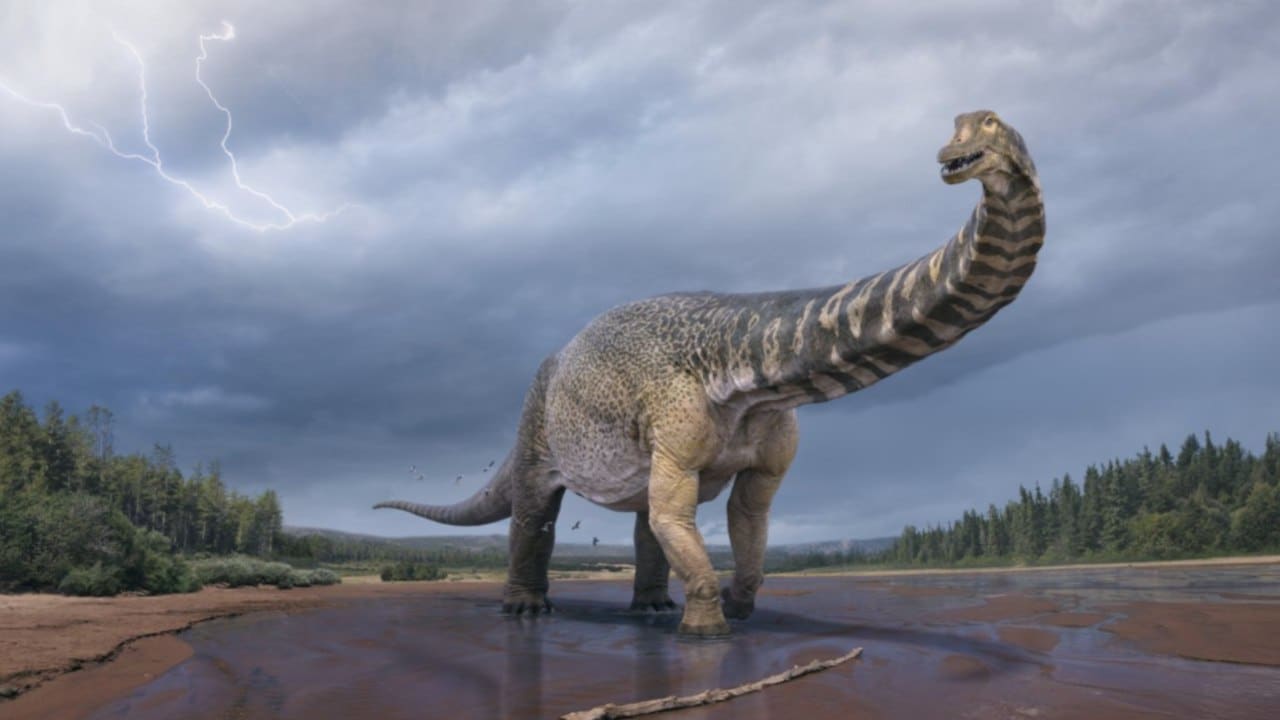
The researchers nicknamed this individual “Cooper” after the nearby freshwater lifeline, Cooper Creek. Image Credit: Vlad Konstantinov,
@Aussiedinosaurs/Twitter[/caption]It lived in southwest Queensland between 92–96 million years ago, when Australia was attached to Antarctica, and the last vestiges of a once-great inland sea had disappeared.The discovery of Australotitan is a major new addition to the “terrible lizards” of Oz.
Like finding needles in haystack
Finding dinosaurs in Australia has been labelled an incredibly difficult task.In outback Queensland, dinosaur sites are featureless plains. Compare that to many sites overseas, where mountain ranges, deep canyons or exposed badlands of heavily-eroded terrain can help reveal the ancient layers of preserved fossilised bones.Today, the area where Australotitan lived is oil, gas and grazing country. Our study represents the first major step in documenting the dinosaurs from this fossil field.The first bones of Australotitan were excavated in 2006 and 2007 by Queensland Museum and Eromanga Natural History Museum palaeontologists and volunteers. We nicknamed this individual “Cooper” after the nearby freshwater lifeline, Cooper Creek.After the excavation, we embarked on the long and painstaking removal of the rock that entombed Cooper’s bones. This was necessary for us to properly identify and compare each bone.
Thousands of kilograms bones in a backpack
We needed to compare Cooper’s bones to all other species of sauropod dinosaur known from both Australia and overseas, to confirm our suspicions of a new species.But travelling from collection to collection at various museums to compare hundreds of kilograms of fragile dinosaur bones was simply not possible. So instead, we used 3D digital scanning technology which allowed us to virtually carry thousands of kilograms of dinosaur bones in one seven kilogram laptop.These kinds of research projects have created a new opportunity for museums and researchers to share their amazing collections globally, with researchers and the public.And thanks to two decades of effort by palaeontologists, citizen scientists, regional not-for-profit museums and local landowners, there has been a recent boom in Australian dinosaur discoveries.
 More from Science
We are family
Trampling through the Cretaceous
 Scott Hocknull, Senior Curator of Geosciences, Queensland Museum, and Honorary Research Fellow, The University of MelbourneThis article is republished from The Conversation under a Creative Commons license. Read the original article.
Careless Whispers: Scientists discover that plants can 'talk' to each other using smells
Life on Mars? European Space Agency’s Orbiter discovers ice water deposits at equator
Microsoft briefly overtakes Apple as the most valuable company, Apple back on top again
Even NASA is facing a tough time, starts layoffs following major budget cuts
ISRO, NASA's NISAR satellite to get ready by Jan-end, will monitor Earth's snow-covered regions