
Advertisement


Sections
Incoming! NASA's DART mission will deliberately smash into an asteroid in 2022
DART will knock into one of the smaller 'moonlets' in a near-Earth asteroid system called Didymos.

Giant asteroids ramming into the Earth are a common plot point in doomsday sci-fi. The threat of an asteroid impact, however, is only too real.After wrecking the French Riviera in 2013, destroying Dhaka in 2015 and sparing Tokyo in 2017, an international team of scientists and disaster response experts took to New York in 2019 to gauge how prepared humanity is to deal with a killer asteroid heading the way of our planet. Eight simulated years of preparation weren't enough for scientists and engineers to deflect the killer asteroid successfully. For now, it's clear that we'd be as lucky as the dinosaurs were if an asteroid really did hit Earth.Luckily for us, space scientists do have a few ideas to up our odds of survival. For one, if the threat of a killer asteroid was found early enough, it may be possible to nudge it off course and change its direction away from Earth. NASA's Double Asteroid Redirection Test (DART) is designed to do just that: go on a suicide mission to smash itself into an asteroid to test the "planetary defense" strategy.In the first-ever asteroid deflection test, DART will knock into one of the smaller members in a near-Earth asteroid system called Didymos. The "moonlets" of the Didymos asteroid system are typically the size of asteroids that pose a threat to Earth.How the impact will play out and the momentum that DART transfers to the asteroid when it strikes it depends on many factors — the strength and core of the asteroid, most importantly.[caption id="attachment_6601801" align="alignnone" width="1280"]![An artist's impression of NASA's DART mission. Image: NASA]() DART will travel at a speed of 22,530 km per hour when it crashes into the moonlet, after which scientists expect the asteroid to change its velocity by a millimeter per second. It may not sound like much, but if done years before a predicted impact, it can be the difference between extinction and survival.Much of the work on DART so far has been in modeling and simulations, but parts of the spacecraft have begun to take shape, according to NASA.NASA has also confirmed that SpaceX's Falcon 9 rocket will be used to launch DART up and away on its first and final mission.
DART will travel at a speed of 22,530 km per hour when it crashes into the moonlet, after which scientists expect the asteroid to change its velocity by a millimeter per second. It may not sound like much, but if done years before a predicted impact, it can be the difference between extinction and survival.Much of the work on DART so far has been in modeling and simulations, but parts of the spacecraft have begun to take shape, according to NASA.NASA has also confirmed that SpaceX's Falcon 9 rocket will be used to launch DART up and away on its first and final mission.
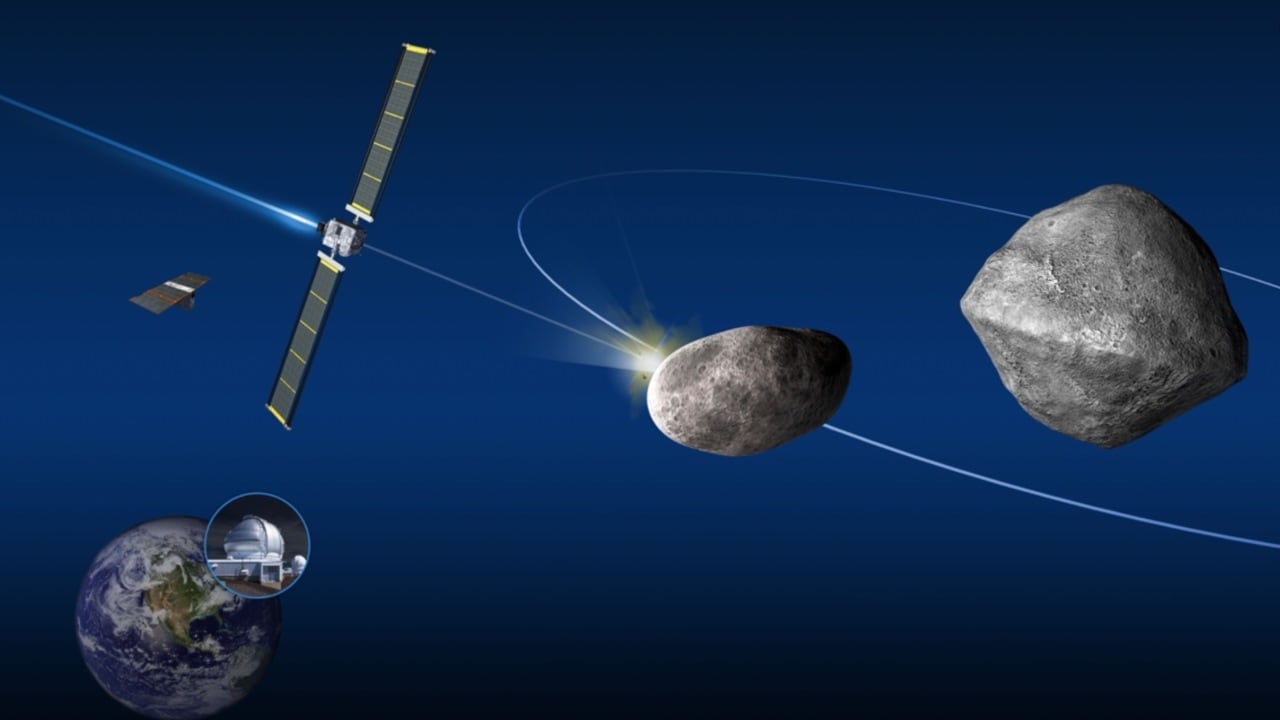
An artist's impression of NASA's DART mission. Image: NASA[/caption]"We're trying to anticipate how much we can actually deflect the Didymos asteroid, and that’s quite challenging because we don’t know what the asteroid is made of," Sabina Raducan, a planetary scientist at Imperial College London working on simulating the impact scenario, told Astronomy.The team is hoping it has a weak and porous body. A hard rock won't budge as much since it can absorb the impact, making the entire exercise a pointless one.
First Published:May 09, 2019, 16:21:21 IST
Advertisement
Advertisement

Careless Whispers: Scientists discover that plants can 'talk' to each other using smells
Japanese scientists have recorded a video that shows plants, in certain conditions, communicate with each other using mists that carry smells. The discovery, reveals that plants release a fine mist of airborne compounds, to warn nearby plants of potential dangers
Life on Mars? European Space Agency’s Orbiter discovers ice water deposits at equator
European Space Agency's Mars Express Orbiter has identified massive ice and ice water deposits beneath the surface of Mars. The Mars Express orbiter was also the first to confirmed the presence of ice on Mars in 2004
Microsoft briefly overtakes Apple as the most valuable company, Apple back on top again
At its peak during the session, Microsoft's value reached $2.903 trillion, with a 2% surge. As of writing this article, Apple closed at $2.89 trillion, whereas Microsoft closed at $2.86 trillion
Even NASA is facing a tough time, starts layoffs following major budget cuts
NASA is facing some massive budget cuts, because of which, it has been forced to postpone some upcoming missions. NASA's Jet Propulsion Laboratory has been hit hard by recent federal budget cuts, resulting in the layoff of 100 contractors last week
ISRO, NASA's NISAR satellite to get ready by Jan-end, will monitor Earth's snow-covered regions
The NISAR satellite which has been developed jointly ISRO and NASA, should be ready for launch by the end of January 2024. The collaboration between NASA and ISRO on NISAR is the first time the two agencies have cooperated on hardware development for an Earth-observing mission
Advertisement
Advertisement