


Hubble telescope finds crucial clues about planet formation by studying star cluster Westerlund 2
Stars that reside in the centre of a cluster would have lesser chances of forming planets while the chances of planet formation are higher in the outer layers.

The Hubble space telescope was used by scientists to study a dense star cluster for three years to find out which environment suits planet formation.
In the period between 2016 and 2019, the massive young star cluster ‘Westerlund 2’ in the Milky Way was studied. This was the first time that astronomers analysed an extremely dense star cluster to see which environments were “favourable to planet formation”.
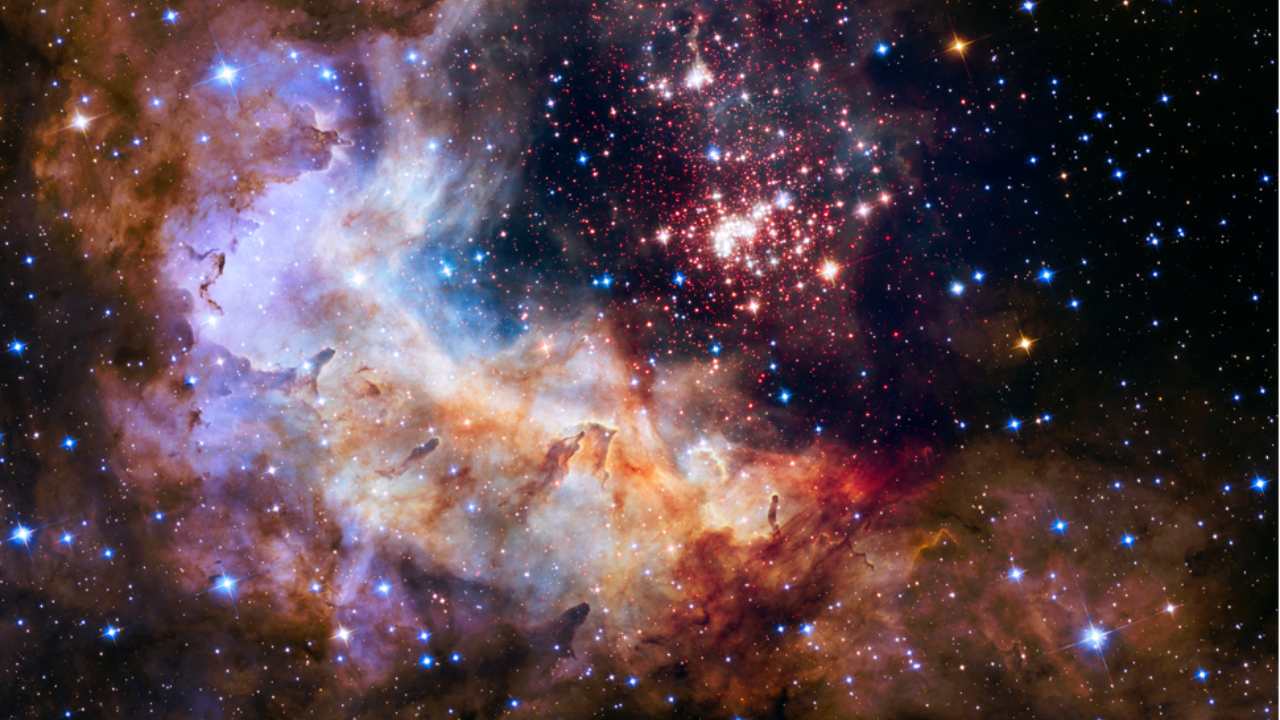
The brilliant tapestry of young stars flaring to life resemble a glittering fireworks display in this Hubble Space Telescope archival image. Image credit: NASA, ESA, the Hubble Heritage Team, A. Nota, and the Westerlund 2 Science Team[/caption]Hence, scientists found that stars which reside in the central portion of a cluster would face a “rough and tumble” neighbourhood which “suppresses” planets from forming. However, chances of planet formation are much higher for stars in the outer layers of the cluster. This is possible because they do not have to face the “blistering” ultraviolet light and hurricane.
Westerlund 2 was studied for the “stellar evolutionary processes” because of its high density of stellar population and young age. Located 20,000 light-years away, the cluster is showing similar patterns which our solar system did about 4.6 billion years ago, during its formation years.
Explaining the phenomenon, Elena Sabbi of the Space Telescope Science Institute in Baltimore, lead researcher of the Hubble study, said, “Basically, if you have monster stars, their energy is going to alter the properties of the disks around nearby, less massive stars.”
 More from Science
“You may still have a disk, but the stars change the composition of the dust in the disks, so it's harder to create stable structures that will eventually lead to planets. We think the dust either evaporates away in 1 million years, or it changes in composition and size so dramatically that planets don't have the building blocks to form,” she added.

Careless Whispers: Scientists discover that plants can 'talk' to each other using smells
Life on Mars? European Space Agency’s Orbiter discovers ice water deposits at equator
Microsoft briefly overtakes Apple as the most valuable company, Apple back on top again
Even NASA is facing a tough time, starts layoffs following major budget cuts
ISRO, NASA's NISAR satellite to get ready by Jan-end, will monitor Earth's snow-covered regions