
Advertisement


Sections
Hubble celebrates 31st anniversary with image of one of the largest stars in the Milky Way
AG Carinae is a few million years old and has been existing some 20,000 light-years away inside the Milky Way.

For the Hubble Space Telescope's 31st Anniversary, it captured an image of one of the brightest stars seen in our galaxy. Called the celebrity star, because of its brightness, the star is surrounded by a glowing halo of gas and dust making it look larger than it is supposed to be. However, the star is paying a high price for its opulence as it lives on the edge, fighting gravity and radiation to avoid self-destruction. According to an ESA report, this star is fighting the radiation pressure from within itself pushing outward and gravity pressing inward.Named AG Carinae, it is a few million years old and has been existing some 20,000 light-years away inside the Milky Way. This big star is up to 70 times larger than our Sun and shines with the brilliance of one million suns.[caption id="attachment_9568391" align="alignnone" width="1280"]![In celebration of the 31st anniversary of the launching of NASA's Hubble Space Telescope, astronomers aimed the renowned observatory at a brilliant]()
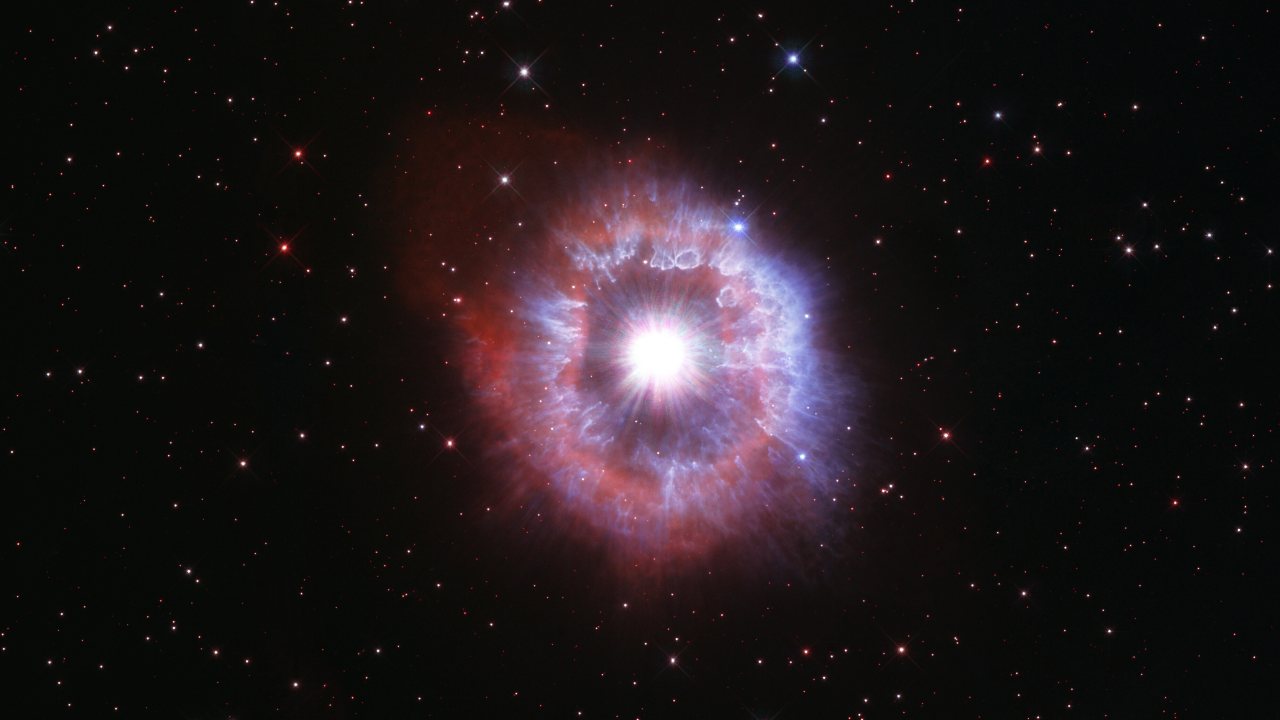
In celebration of the 31st anniversary of the launching of NASA's Hubble Space Telescope, astronomers aimed the renowned observatory at a brilliant "celebrity star," one of the brightest stars seen in our galaxy, surrounded by a glowing halo of gas and dust.
Credits: NASA, ESA, STScI[/caption]"I like studying these kinds of stars because I am fascinated by their instability. They are doing something weird," said Kerstin Weis, a luminous blue variable expert at Ruhr University in Bochum, Germany.The star structure was created about 10,000 years ago from one or more giant eruptions. The outer layer was blown into space like a hot teapot exploding its lid. These eruptions are the typical life of a star called a luminous blue variable. These stars are among the most enormous and brightest stars ever.A luminous blue variable star or an LBV star only casts off material when it is in danger of self-destruction says ESA.These star are rare with fewer than 50 LBV's known among the galaxies. They spend tens of thousands of years in this phase. When they die, they are supposed to end their life in a titanic supernova blast, which will enrich the Universe with the heavier elements beyond iron.Here are some of the most prominent features of this star:
- It is highlighted in blue
- They are filamentary structures that are shaped like tadpoles and lopsided bubbles
- These huge and massive structures are dust clumps illuminated by the star's reflected light
- Looking into the tadpole-shaped features, they are denser dust clumps that have been sculpted by the stellar wind
First Published:Apr 26, 2021, 21:13:57 IST
Advertisement
Advertisement

Careless Whispers: Scientists discover that plants can 'talk' to each other using smells
Japanese scientists have recorded a video that shows plants, in certain conditions, communicate with each other using mists that carry smells. The discovery, reveals that plants release a fine mist of airborne compounds, to warn nearby plants of potential dangers
Life on Mars? European Space Agency’s Orbiter discovers ice water deposits at equator
European Space Agency's Mars Express Orbiter has identified massive ice and ice water deposits beneath the surface of Mars. The Mars Express orbiter was also the first to confirmed the presence of ice on Mars in 2004
Microsoft briefly overtakes Apple as the most valuable company, Apple back on top again
At its peak during the session, Microsoft's value reached $2.903 trillion, with a 2% surge. As of writing this article, Apple closed at $2.89 trillion, whereas Microsoft closed at $2.86 trillion
Even NASA is facing a tough time, starts layoffs following major budget cuts
NASA is facing some massive budget cuts, because of which, it has been forced to postpone some upcoming missions. NASA's Jet Propulsion Laboratory has been hit hard by recent federal budget cuts, resulting in the layoff of 100 contractors last week
ISRO, NASA's NISAR satellite to get ready by Jan-end, will monitor Earth's snow-covered regions
The NISAR satellite which has been developed jointly ISRO and NASA, should be ready for launch by the end of January 2024. The collaboration between NASA and ISRO on NISAR is the first time the two agencies have cooperated on hardware development for an Earth-observing mission
Advertisement
Advertisement