


Giant, weird-looking coelacanth fish lived for up to 100 years, finds study
The females don’t hit sexual maturity until their late 50s and one pregnancy lasted five years.

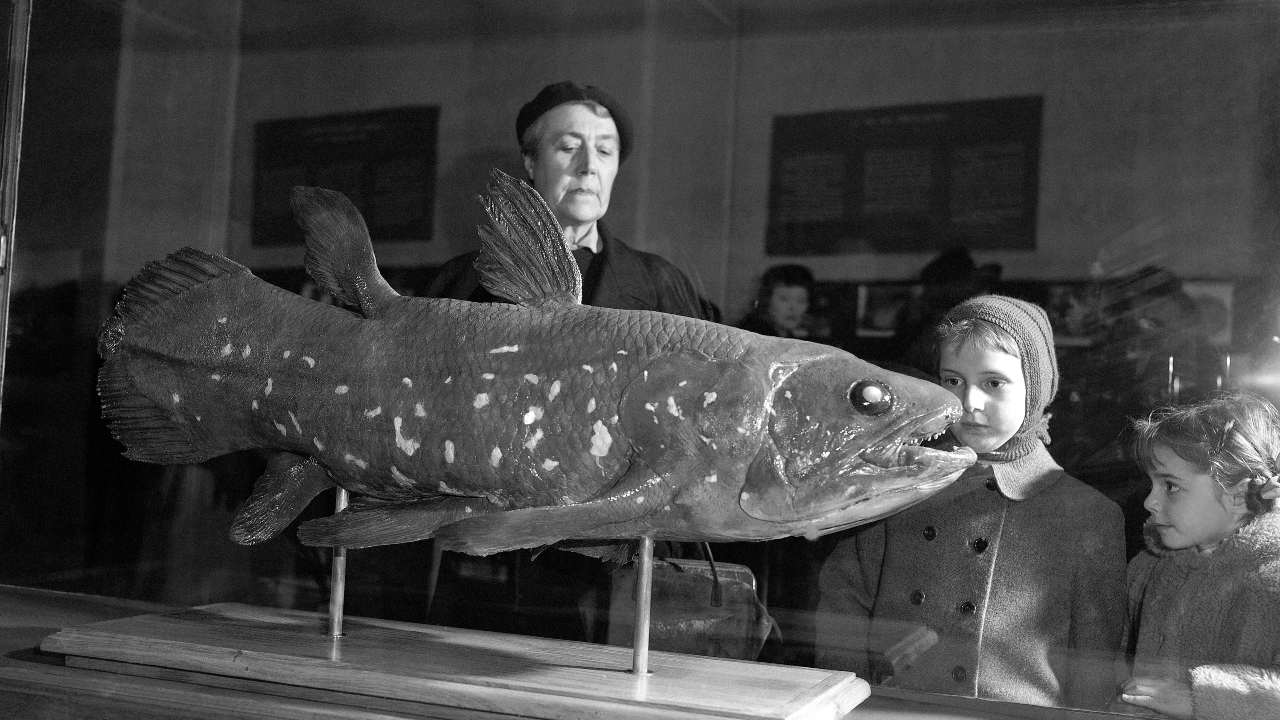
This is a file photo from 1954 that shows visitors to the Natural History Museum in Paris look at a coelacanth exhibit. Image credit: AP Photo/Pierre Godot[/caption]Coelacanths, which have been around for 400 million years, were thought extinct until they were found alive in 1938 off South Africa. Scientists long believed coelacanths live about 20 years. But by applying a standard technique for dating commercial fish, French scientists calculated they actually live close to a century, according to a study in Thursday’s Current Biology.Coelacanths are so endangered that scientists can only study specimens already caught and dead.In the past, scientists calculated fish ages by counting big lines on a specific coelacanth scale. But the French scientists found they were missing smaller lines that could only be seen using polarized light — the technique used to figure out the age of commercial fish.Study co-author Bruno Ernande, a marine evolutionary ecologist at France’s marine research institute, said polarized light revealed five smaller lines for every big one. The researchers concluded the smaller lines better correlated to a year of coelacanth age — and that indicated their oldest specimen was 84 years old.Using the technique, the scientists studied two embryos and calculated the largest was five years old and the youngest was nine years old. So, Ernande said, they figured pregnancy lasts at least five years in coelacanths, which have live births.That five-year gestation is “very strange” for fish or any animal, said Scripps Institution of Oceanography’s Harold Walker, who wasn’t part of the research.Even though coelacanths are unrelated genetically and show wide evolutionary differences, they age slowly like other dwellers of the deep, sharks and rays, Ernande said. “They might have evolved similar life histories because they are sharing similar type habitats,” he said.
Tags

Careless Whispers: Scientists discover that plants can 'talk' to each other using smells
Life on Mars? European Space Agency’s Orbiter discovers ice water deposits at equator
Microsoft briefly overtakes Apple as the most valuable company, Apple back on top again
Even NASA is facing a tough time, starts layoffs following major budget cuts
ISRO, NASA's NISAR satellite to get ready by Jan-end, will monitor Earth's snow-covered regions