


Freezing Super Earth just six light years away could harbour alien life: Study
The exoplanet Barnard b was confirmed as existing just recently after 20 years of observations.

Just a mere six light-years away from Earth, a frozen exoplanet discovered recently by scientists, could harbour alien life, a new study suggests.The planet – called 'Barnard b' – was confirmed as really existing after nearly 20 years of observations only recently. Barnard b is thought to be freezing cold, with surface temperatures around -150ºC and a molten core made of iron or nickel.[caption id="attachment_5554011" align="alignnone" width="1280"]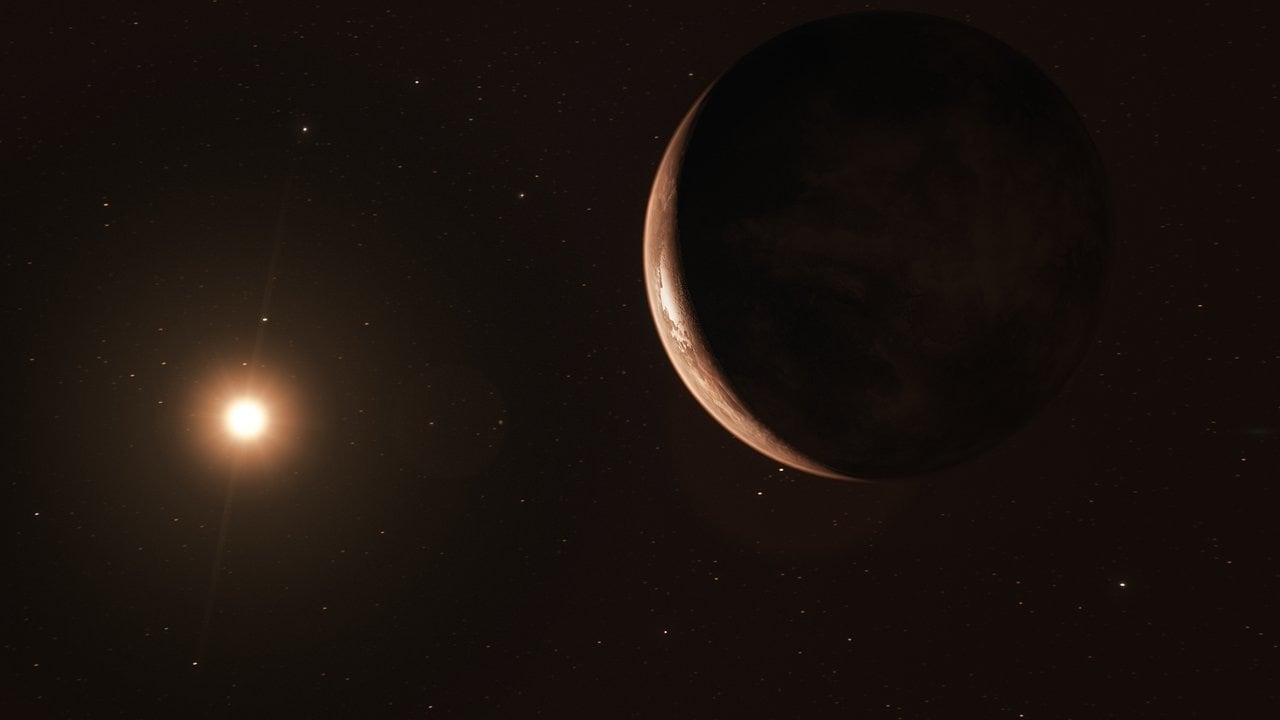 This image shows an artist’s impression of the exoplanet viewed from space. Image courtesy: ESO[/caption]The feature of Barnard b that shows promise to support life, though, is its geothermal activity. The 'Super Earth' Barnard b orbits Bernard's Star within the range that indicates to astronomers that it might support life.More importantly, the planet also appears to have high levels of geothermic heating and geochemical activity under its surface – similar to lakes found under Antarctic ice shelves. The surface temperatures on Bernard b and Jupiter's moon Europa are very similar, researchers think, as both are influenced by the same phenomenon of 'tidal heating', where liquid oceans under their icy surfaces influence the temperatures on its surface.Bernard's Star is roughly 9 billion years old, scientists estimate – twice as old as our Sun.[caption id="attachment_5554001" align="alignnone" width="1280"]
 Artist’s impression of the surface of the Super Earth Barnard b. The newly discovered planet is the second-closest known exoplanet to the Earth and orbits the fastest moving star in the night sky. Image courtesy: ESO[/caption]The Super-Earth Bernard b orbiting the star could be observed someday using 'very large telescopes' to study its atmosphere, surface and geothermal activity.When these observations are finally made, the researchers hope to find more clarity on whether the Super-Earth really does support life.Until then, chance-discoveries of mysterious radio wave signals from outer space will have to do.

Careless Whispers: Scientists discover that plants can 'talk' to each other using smells
Life on Mars? European Space Agency’s Orbiter discovers ice water deposits at equator
Microsoft briefly overtakes Apple as the most valuable company, Apple back on top again
Even NASA is facing a tough time, starts layoffs following major budget cuts
ISRO, NASA's NISAR satellite to get ready by Jan-end, will monitor Earth's snow-covered regions