


Fossil of bat-winged dinosaur points to early era of prehistoric flight in animals
Feathers and wins similar to those of a bat, these creatures were nature's experiment in aviation.

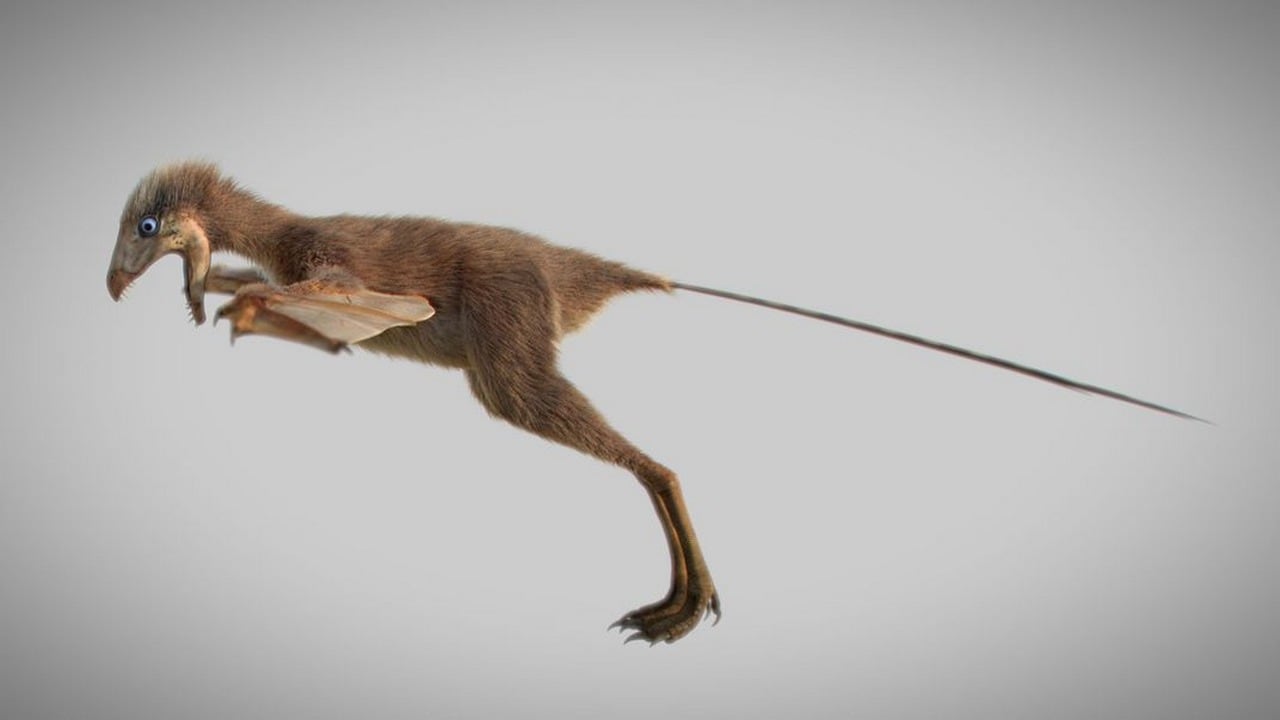
3D reconstruction of Ambopteryx longibrachium. Image credit: Min Wang / Institute of Vertebrate Paleontology and Paleoanthropology / Chinese Academy of Sciences.[/caption]Its fossil, found in 2017 by a local farmer in Liaoning Province, was well preserved, boasting details of soft tissue like the wing membranes, bristly body feathers, stomach contents of its last meal and gizzard stones. It lacked the long, strong flight feathers characteristic of birds.Ambopteryx is the second-known dinosaur with membranous wings, joining Yi qi, which lived 2-3 million years later. Yi’s fossil, published in 2015, was found 50 miles (80 km) away.“The discoveries of Ambopteryx and Yi completely change our view about the origin of avian flight,” said palaeontologist Min Wang of the Institute of Vertebrate Paleontology and Paleoanthropology, Chinese Academy of Sciences.“For a long time, we thought feathered wings were the only flight apparatus” in the evolution of birds, Wang added. “However, these new discoveries clearly exhibit that membranous wings also evolved in some dinosaurs closely related to birds. Put together, the breadth and richness of the experimentation pertaining to flight is greater than was previously thought during the dinosaur-bird transition. And we may be seeing just the tip of the iceberg.”Membranous wings in dinosaurs appear to have been short-lived experimentation, added Wang who led the research was published in the journal Nature.Wang said Ambopteryx, about 13 inches (32 cm) long and about 11 ounces (306 grams) in weight, was certainly capable of gliding but it is difficult to know whether it could achieve powered flight. Likely omnivorous, Ambopteryx lived an arboreal lifestyle in a forested environment.

Careless Whispers: Scientists discover that plants can 'talk' to each other using smells
Life on Mars? European Space Agency’s Orbiter discovers ice water deposits at equator
Microsoft briefly overtakes Apple as the most valuable company, Apple back on top again
Even NASA is facing a tough time, starts layoffs following major budget cuts
ISRO, NASA's NISAR satellite to get ready by Jan-end, will monitor Earth's snow-covered regions