
Advertisement

Five planets and a crescent moon will line up in a rare pre-dawn spectacle today, 20 July

The planets would look to a human eye like extraordinarily bright stars, unlike the familiar photos we've seen captured by a spacecraft.

Advertisement
FP Trending|Jul 20, 2020, 11:46:00 IST
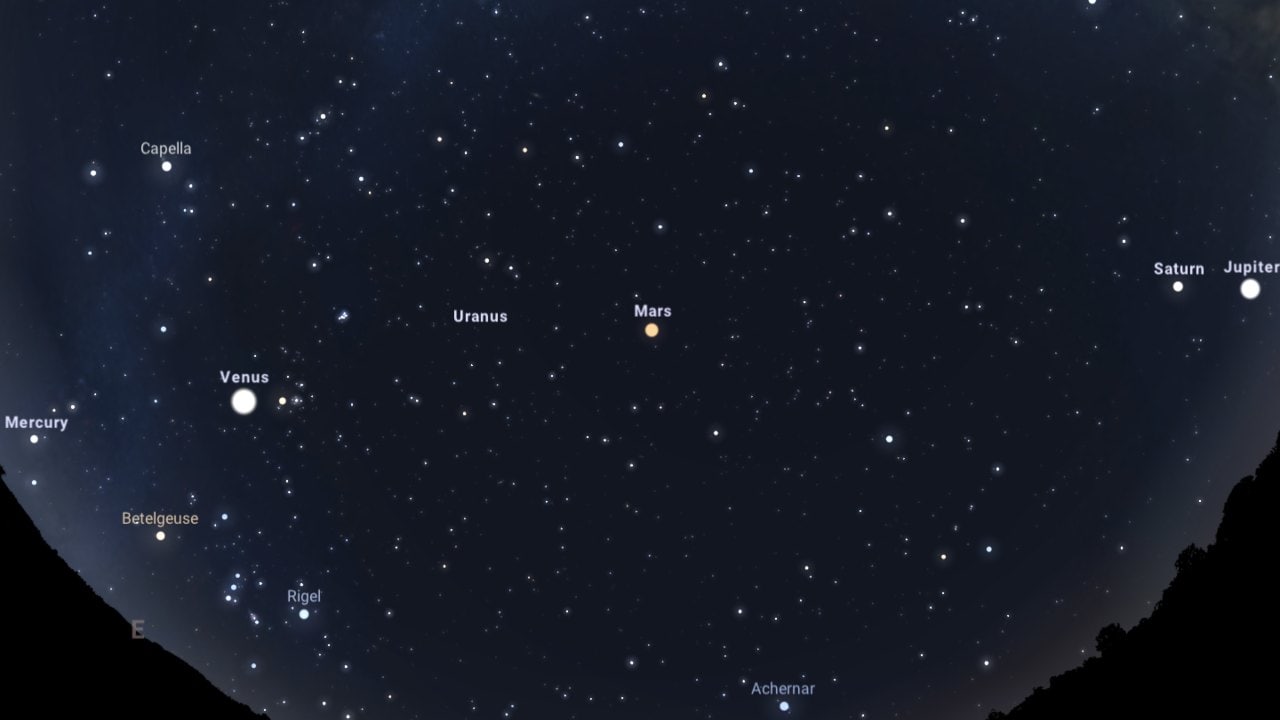
On 19 July, people world over will be able to see five planets – Mercury, Venus, Mars, Jupiter and Saturn – without the need for a telescope. Apart from the unusual sighting of five planets in the night sky, a crescent moon will also be visible.IBTimes reported that the planets and the moon are likely to appear in the sky around an hour before sunrise on Sunday.Jeffrey Hunt, an astronomy educator and former planetarium director, has advised on how to spot the planets in his blog.“Step outside early in the morning, at least an hour before sunrise. Find the four bright planets – Venus, Mars, Saturn and Jupiter. They look like overly bright stars. Brilliant Venus is low in the east-northeast. Mars is the lone 'star' in the southeast, and Jupiter and Saturn are the stars in the southwest,” Hunt says.[caption id="attachment_8611221" align="alignnone" width="1280"]A simulation of the South East horizon in the pre-dawn hours of 20 July. Image: Stellarium

A simulation of the South East horizon in the pre-dawn hours of 20 July (view from Mumbai). Image courtesy: Stellarium Web[/caption]The planets to a human eye would look like just extraordinarily bright stars, unlike the familiar photos we've seen captured by a spacecraft.Mercury, however, will be a little more challenging to spot, Hunt said, since the planet will be just a few degrees to the right of the bright crescent moon. This will dim its visibility with the naked eye.According to Science TimesUranus, Neptune, and Pluto can also be seen between Venus and Jupiter this month, but people might have to use a telescope for that.

Quoting NASA, the report advises that Jupiter's moons – Europa, Ganymede, Io, and Callisto – could be best viewed using binoculars.As per the website, another spectacular event called the "Great Solstice Conjunction" will take place on the night of the winter solstice in the Northern Hemisphere (on 21 December) this year. This event involves only two planets, Jupiter and Saturn.While the conjunction happens every 19.6 years, the planets are going to align in their closest distances to Earth since 1623.

Handpicked stories, in your inbox
Global stories. Indian perspective. Zero noise.
No Spam. Unsubscribe Any Time.
First Published:Jul 20, 2020, 10:00:03 IST
Advertisement
Advertisement
Trending Stories

Microsoft briefly overtakes Apple as the most valuable company, Apple back on top again

At its peak during the session, Microsoft's value reached $2.903 trillion, with a 2% surge. As of writing this article, Apple closed at $2.89 trillion, whereas Microsoft closed at $2.86 trillion
Advertisement
Advertisement
Up Next