
Advertisement


Sections
First SpaceX launch of 2019 completes network of 75 Iridium satellites in orbit
The 8th & final launch of the $3 billion-Iridium NEXT project completed the delivery of 75 new satellites to orbit.

A SpaceX rocket carried ten satellites to low-Earth orbit on Friday, completing a 2-year campaign by Iridium Communications Inc to replace its original fleet of with a new generation of communication satellites for added aircraft tracking capability.The Falcon 9 rocket blasted off from Vandenberg Air Force Base at 7.31 am and arced over the Pacific west of Los Angeles.[caption id="attachment_5666831" align="alignnone" width="1280"]![Space X Falcon 9 lifts off. Image: SpaceX]() Space X Falcon 9 lifts off. Image: SpaceX[/caption]The previously used first stage was recovered again with a bullseye landing on a “droneship” in the ocean while the upper stage continued on to orbit.The eighth and final launch of the $3 billion Iridium NEXT project completed delivery of 75 new satellites to orbit for the McLean, Virginia, company. Sixty-six will be operational and nine will serve as in-orbit spares. Six other satellites remain on the ground as spares.All 10 newly launched satellites communicated with Iridium’s network operations center and were being readied for testing, the company said.Iridium has been moving its new satellites into positions that were held by the old ones, which are lowered until they burn up in the atmosphere. So far, 60 new satellites are in operation.The first Iridium satellites were launched in the 1990s to offer voice, data, fax and paging services to customers with Iridium handheld telephones and pagers.Among new capabilities enabled by the fleet upgrade is Iridium Certus, described as a broadband solution for purposes ranging from life-safety services to command-and-control of unmanned aircraft systems and tracking.The Iridium NEXT satellites also carry a system by Aireon LLC for space-based air traffic surveillance over 100 percent of the globe.[caption id="attachment_5890671" align="alignnone" width="1280"]
Space X Falcon 9 lifts off. Image: SpaceX[/caption]The previously used first stage was recovered again with a bullseye landing on a “droneship” in the ocean while the upper stage continued on to orbit.The eighth and final launch of the $3 billion Iridium NEXT project completed delivery of 75 new satellites to orbit for the McLean, Virginia, company. Sixty-six will be operational and nine will serve as in-orbit spares. Six other satellites remain on the ground as spares.All 10 newly launched satellites communicated with Iridium’s network operations center and were being readied for testing, the company said.Iridium has been moving its new satellites into positions that were held by the old ones, which are lowered until they burn up in the atmosphere. So far, 60 new satellites are in operation.The first Iridium satellites were launched in the 1990s to offer voice, data, fax and paging services to customers with Iridium handheld telephones and pagers.Among new capabilities enabled by the fleet upgrade is Iridium Certus, described as a broadband solution for purposes ranging from life-safety services to command-and-control of unmanned aircraft systems and tracking.The Iridium NEXT satellites also carry a system by Aireon LLC for space-based air traffic surveillance over 100 percent of the globe.[caption id="attachment_5890671" align="alignnone" width="1280"]![The 10 Iridium NEXT satellites that will launch on the fifth Iridium NEXT mission. Image courtesy: Iridium Communications]() The 10 Iridium NEXT satellites that will launch on the fifth Iridium NEXT mission. Image courtesy: Iridium Communications[/caption]The Aireon system collects what is known as Automatic Dependent Surveillance-Broadcast data automatically and in real time, even from remote areas over the world’s oceans.“Today we passed a major milestone on our journey to revolutionize air traffic surveillance and are just weeks away from a fully operational system,” Don Thoma, CEO of Aireon, said in a statement. “Now that the launches are complete, final integration and testing of the recently launched payloads can commence, after which the world’s first, real-time, truly global view of air traffic will be a reality.”Aireon said it is already processing more than 13 billion ADS-B messages per month.Another difference with the new satellites is of note to skywatchers: no “Iridium flares.” The new satellites do not reflect sunlight the way the old ones did.
The 10 Iridium NEXT satellites that will launch on the fifth Iridium NEXT mission. Image courtesy: Iridium Communications[/caption]The Aireon system collects what is known as Automatic Dependent Surveillance-Broadcast data automatically and in real time, even from remote areas over the world’s oceans.“Today we passed a major milestone on our journey to revolutionize air traffic surveillance and are just weeks away from a fully operational system,” Don Thoma, CEO of Aireon, said in a statement. “Now that the launches are complete, final integration and testing of the recently launched payloads can commence, after which the world’s first, real-time, truly global view of air traffic will be a reality.”Aireon said it is already processing more than 13 billion ADS-B messages per month.Another difference with the new satellites is of note to skywatchers: no “Iridium flares.” The new satellites do not reflect sunlight the way the old ones did.
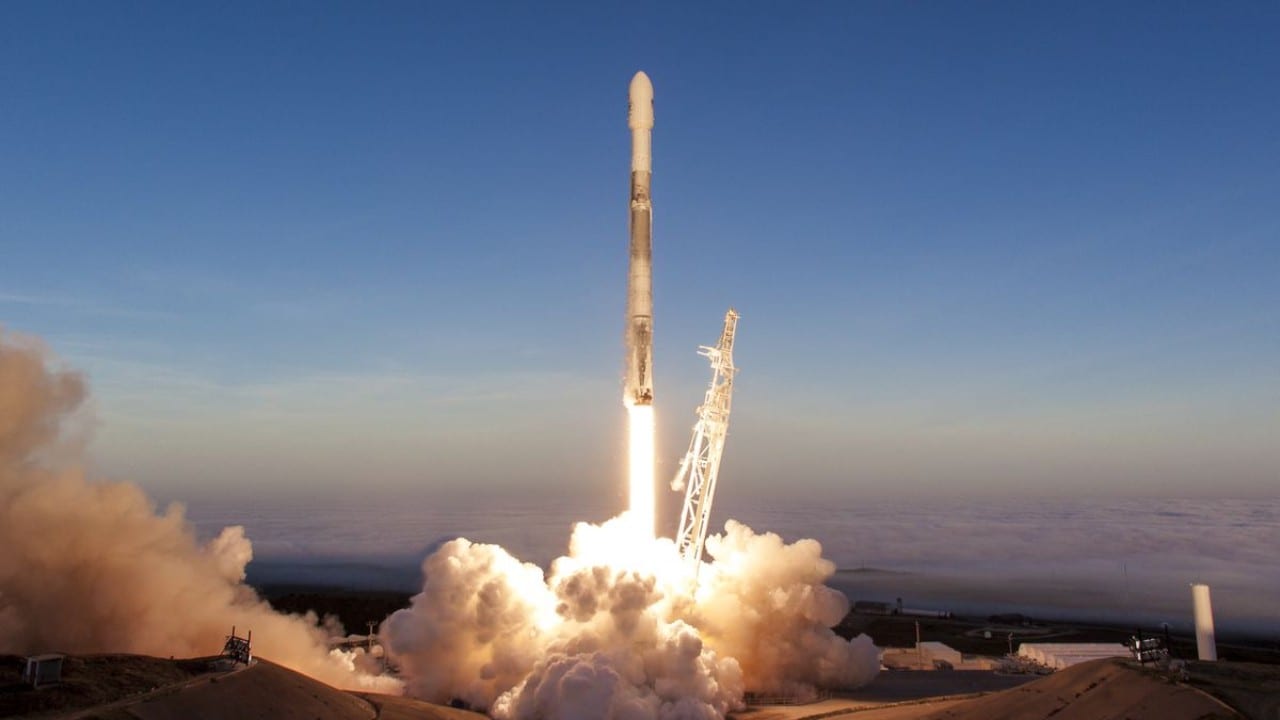 Space X Falcon 9 lifts off. Image: SpaceX[/caption]The previously used first stage was recovered again with a bullseye landing on a “droneship” in the ocean while the upper stage continued on to orbit.The eighth and final launch of the $3 billion Iridium NEXT project completed delivery of 75 new satellites to orbit for the McLean, Virginia, company. Sixty-six will be operational and nine will serve as in-orbit spares. Six other satellites remain on the ground as spares.
 The 10 Iridium NEXT satellites that will launch on the fifth Iridium NEXT mission. Image courtesy: Iridium Communications[/caption]The Aireon system collects what is known as Automatic Dependent Surveillance-Broadcast data automatically and in real time, even from remote areas over the world’s oceans.“Today we passed a major milestone on our journey to revolutionize air traffic surveillance and are just weeks away from a fully operational system,” Don Thoma, CEO of Aireon, said in a statement. “Now that the launches are complete, final integration and testing of the recently launched payloads can commence, after which the world’s first, real-time, truly global view of air traffic will be a reality.”Aireon said it is already processing more than 13 billion ADS-B messages per month.Another difference with the new satellites is of note to skywatchers: no “Iridium flares.” The new satellites do not reflect sunlight the way the old ones did.
First Published:Jan 14, 2019, 12:50:11 IST
Advertisement
Advertisement

Careless Whispers: Scientists discover that plants can 'talk' to each other using smells
Japanese scientists have recorded a video that shows plants, in certain conditions, communicate with each other using mists that carry smells. The discovery, reveals that plants release a fine mist of airborne compounds, to warn nearby plants of potential dangers
Life on Mars? European Space Agency’s Orbiter discovers ice water deposits at equator
European Space Agency's Mars Express Orbiter has identified massive ice and ice water deposits beneath the surface of Mars. The Mars Express orbiter was also the first to confirmed the presence of ice on Mars in 2004
Microsoft briefly overtakes Apple as the most valuable company, Apple back on top again
At its peak during the session, Microsoft's value reached $2.903 trillion, with a 2% surge. As of writing this article, Apple closed at $2.89 trillion, whereas Microsoft closed at $2.86 trillion
Even NASA is facing a tough time, starts layoffs following major budget cuts
NASA is facing some massive budget cuts, because of which, it has been forced to postpone some upcoming missions. NASA's Jet Propulsion Laboratory has been hit hard by recent federal budget cuts, resulting in the layoff of 100 contractors last week
ISRO, NASA's NISAR satellite to get ready by Jan-end, will monitor Earth's snow-covered regions
The NISAR satellite which has been developed jointly ISRO and NASA, should be ready for launch by the end of January 2024. The collaboration between NASA and ISRO on NISAR is the first time the two agencies have cooperated on hardware development for an Earth-observing mission
Advertisement
Advertisement