


First Australian evidence of big shift in Earth’s magnetic poles found, might help predict the next
Different from a reversal of magnetic poles, this 'excursion' happens irregularly, in response to dynamics of Earth’s molten outer core.

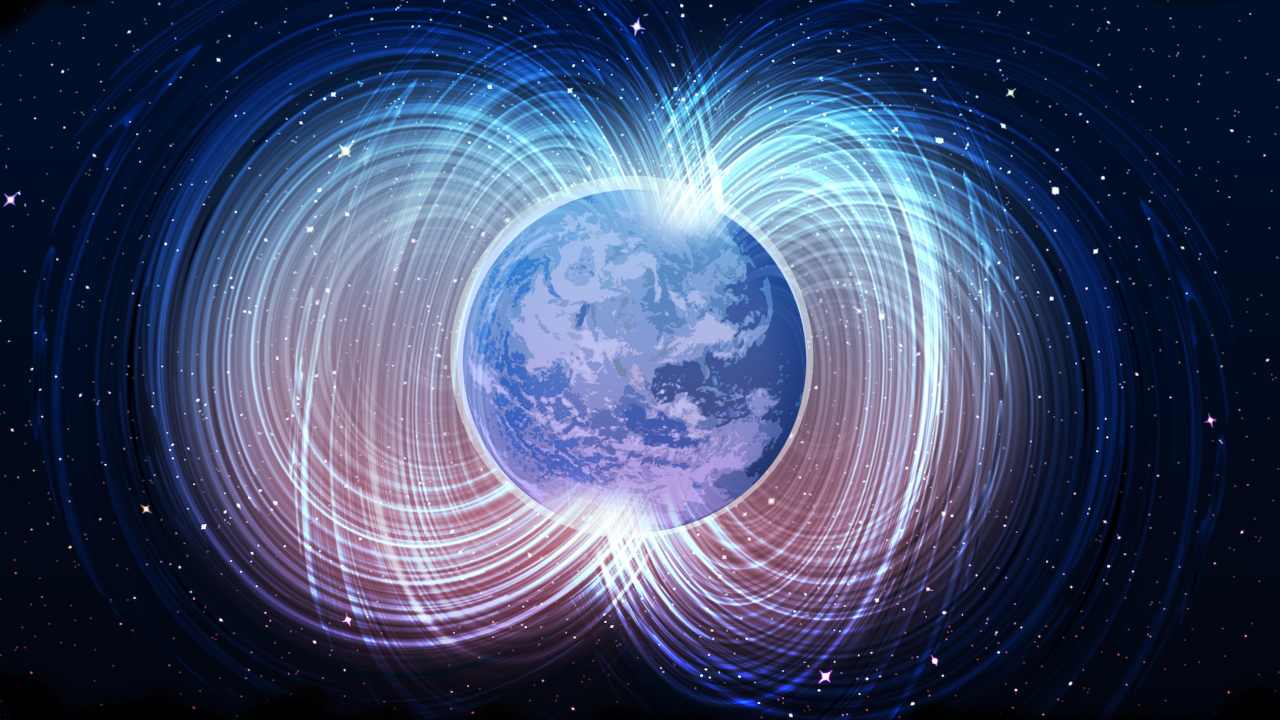
An illustration of Earth's magnetic field lines.[/caption]
How sediment can record Earth’s magnetic field
Rock and soil can naturally contain magnetic particles, such as the iron mineral magnetite. These magnetic particles are like tiny compass needles aligned with Earth’s magnetic field.They can be carried from the landscape into lakes through rainfall and wind. They eventually accumulate on the lake’s bottom, becoming buried and locking in place. They effectively become a fossil record of Earth’s magnetic field.Scientists can then drill into lake beds and use a device called a magnetometer to recover the information held by the lake sediment. The deeper we drill, the further back in time we go.In 2014 my colleagues and I travelled to Lake Selina in Tasmania with the goal of extracting the area’s climate, vegetation and “paleomagnetic” record, which is the record of Earth’s magnetic field stored in rocks, sediment and other materials.Led by University of Melbourne Associate Professor Michael-Shawn Fletcher, we drilled into the lake floor from a makeshift floating platform rigged to two inflatable rafts.
The first Australian evidence of Laschamp
Building on work from the 1980s
Only two other lakes in Australia — Lake Barrine and Lake Eacham in Queensland — have provided a “full-vector” record, wherein both the past directions and past intensity of the magnetic field are obtained from the same core.But at 14,000 years old, the records from these lakes are much younger than the Laschamp excursion. Four decades later, our work at Lake Selina with modern techniques has revealed the exciting potential for similar research at other Australian lakes.Currently, Australia is considered a paleomagnetic “blind spot”.More data from lake sediments, archaeological artefacts, lava flows and mineral cave formations, including stalagmites and stalactites, could greatly improve our understanding of Earth’s magnetic field.With this knowledge, we may one day potentially be able to predict the next geomagnetic excursion, before our phones stop working and the birds overhead veer off-course and crash into windows.Our dating of the Lake Selina core is just the start. We’re sure there are more secrets embedded beneath, waiting to be found. And so we continue our search.This work was carried out in collaboration with La Trobe University, the Australian National University, The University of Wollongong, the Australian Nuclear Science and Technology Organisation and the European Centre for Research and Teaching in Environmental Geosciences (CEREGE).Agathe Lise-Pronovost, McKenzie Research Fellow in Earth Sciences, University of MelbourneThis article is republished from The Conversation under a Creative Commons license. Read the original article.
 More from Science
Careless Whispers: Scientists discover that plants can 'talk' to each other using smells
Life on Mars? European Space Agency’s Orbiter discovers ice water deposits at equator
Microsoft briefly overtakes Apple as the most valuable company, Apple back on top again
Even NASA is facing a tough time, starts layoffs following major budget cuts
ISRO, NASA's NISAR satellite to get ready by Jan-end, will monitor Earth's snow-covered regions