


Exoplanet twice the size of Jupiter has most outrageous monsoons with scaldingly hot liquid iron
This exoplanet resides outstandingly close to its parent star, which is almost twice as big as the sun.

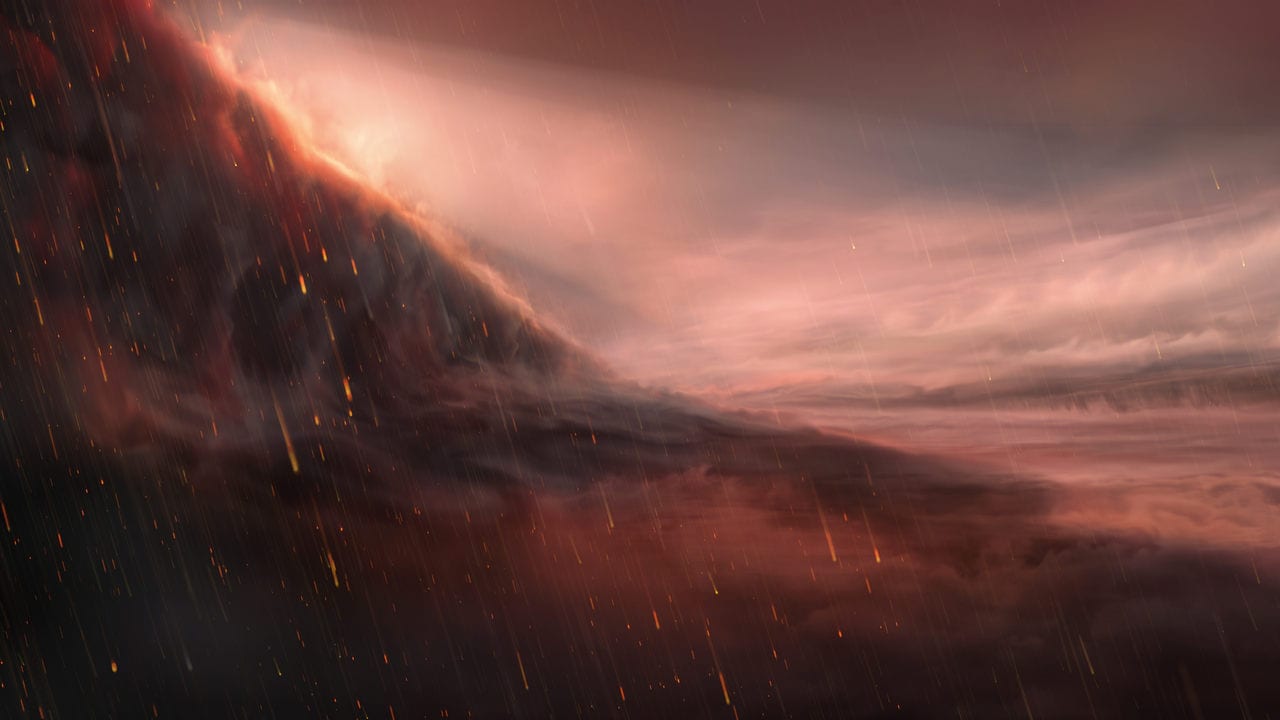
Artist illustration shows the night-side view of the exoplanet WASP-76b. To the left of the image, we see the evening border of the exoplanet, where it transitions from day to night. Image credit: ESO[/caption]It resides outstandingly close to its parent star, which is almost twice as big as the sun. WASP-76b orbits at only three times the radius of that star, much closer than our solar system’s innermost planet Mercury orbits the sun. The same side of WASP-76b always faces its star, much as the same side of our moon always faces Earth.WASP-76b receives 4,000 times the solar radiation that Earth gets from the sun, and its “dayside” is baked, broiled and barbecued, reaching 4,350 degrees Fahrenheit (2,400 degrees Celsius). This ferocious heat vaporizes metals present in the planet, with strong winds then carrying iron vapor to the planet’s cooler night side where it condenses into liquid iron droplets.Molten iron rain may be a unique feature of these “ultra-hot” exoplanets, according to University of Geneva astronomer David Ehrenreich, lead author of the study published in the journal Nature.WASP-76b illustrates the exotic nature of some exoplanets and shows that much remains to be learned about alien planetary systems.“The extreme atmospheric conditions met in WASP-76b and its siblings, other ‘ultra-hot’ gas giants, are not found anywhere in our solar system and would be very difficult to reproduce in a lab,” Ehrenreich said. “Therefore, these exotic objects are unique laboratories to crash-test our climate models and understand the most extreme forms of atmospheric evolution.”“The ‘zoo’ of planetary systems is far beyond our expectations,” added astrophysicist and study co-author Maria Rosa Zapatero Osorio of the Center for Astrobiology in Madrid, coordinator of the ESPRESSO science team.WASP-76b appears to be the only planet orbiting its star. While its diameter of approximately 266,000 km is about 1.9 times bigger than Jupiter, WASP-76b is actually slightly less massive than Jupiter. This may be the result of perpetually being heated up by the star or never having the chance to cool down and shrink after the planet’s formation because of its position so close to the star.“In other words, it is very much puffed up,” Ehrenreich said.

Careless Whispers: Scientists discover that plants can 'talk' to each other using smells
Life on Mars? European Space Agency’s Orbiter discovers ice water deposits at equator
Microsoft briefly overtakes Apple as the most valuable company, Apple back on top again
Even NASA is facing a tough time, starts layoffs following major budget cuts
ISRO, NASA's NISAR satellite to get ready by Jan-end, will monitor Earth's snow-covered regions