


ESA's Gaia telescope reveals unexpected turbulence in our galaxy's past
The discovery was made from Gaia's analysis of movement patterns of stars in the Milky Way disc.

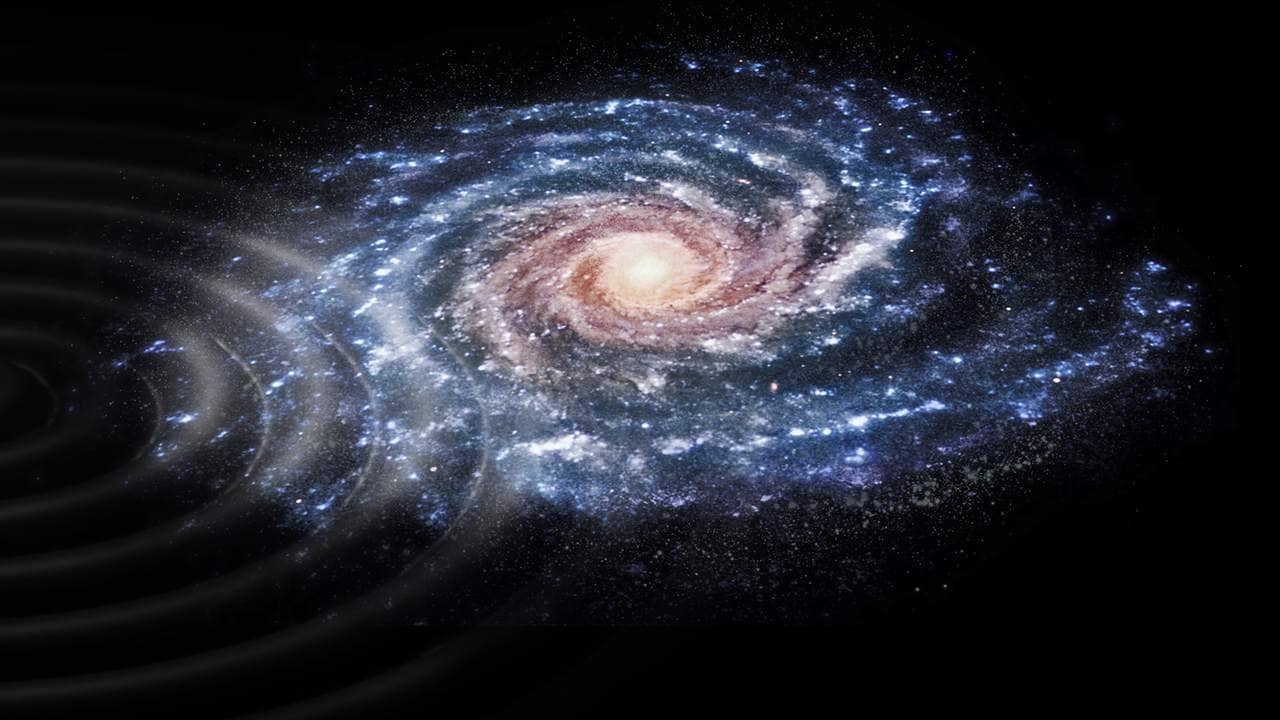
An artist's representation of the perturbation discovered from ESA Gaia's data. Image courtesy: ESA[/caption]"I was a bit shocked and I thought there could be a problem with the data because the shapes are so clear," she added.In the study, appearing in the journal Nature, Antoja and her team investigated what had "hit" the Milky Way to cause this behaviour in the stars.They found that the unexpected rippling movements of stars in the Milky Way took place when the Sagittarius dwarf galaxy sailed past it between 300 and 900 million years ago.This small galaxy contains a few tens of millions of stars and is currently in the process of being cannibalised by the Milky Way.Its gravity, when passing closely by our Galaxy, would have perturbed some stars in our Galaxy like a stone dropping into water, Antoja said.Gaia is one of ESA's cornerstone missions and was designed primarily to investigate the origin, evolution and structure of the Milky Way.

Careless Whispers: Scientists discover that plants can 'talk' to each other using smells
Life on Mars? European Space Agency’s Orbiter discovers ice water deposits at equator
Microsoft briefly overtakes Apple as the most valuable company, Apple back on top again
Even NASA is facing a tough time, starts layoffs following major budget cuts
ISRO, NASA's NISAR satellite to get ready by Jan-end, will monitor Earth's snow-covered regions