
Advertisement


Sections
Diamonds are cooked up as Earth recycles minerals below the ocean floor: Study
Some diamonds, despite being far less appealing to jewelers, reveal a lot about the environment they are formed in.

Diamonds are likely cooked up from minerals in the seabed, well below the Earth's surface.Many of these stones have traces of salts typically found in the ancient seabeds that were buried over many millions of years under the crust, according to new research led by geoscientists at the Macquarie University in Sydney.While most diamonds are formed this way, there's also another way in which they are created — volcanic melts that crystallise while still in the Earth's depths. Researchers recreated the extreme conditions at those depths — 200 kilometres below ground.[caption id="attachment_6724751" align="alignnone" width="1280"]![Diamonds can form with the help of ancient saltwater, say researchers who have identified the gems from oceanic crust dating back as far as 200 million years ago. Image credit: Anetta Banas]() Diamonds can form with the help of ancient saltwater, say researchers who have identified the gems from oceanic crust dating back as far as 200 million years ago. Image credit: Anetta Banas[/caption]A team of researchers led by Dr Michael Förster, Professor Stephen Foley and Dr Olivier Alard at the Goethe Universität and Johannes Gutenberg Universität in Germany has demonstrated how seawater trapped in seabed sediments can react to produce the same composition of salts found in diamonds.This demonstration puts an end to a long-standing question about how diamonds may have formed in nature."There was a theory that the salts trapped inside diamonds came from marine seawater, but couldn't be tested," Förster, the study's lead author, told the University press. "Our research showed that they came from marine sediment."[caption id="attachment_6724761" align="alignnone" width="1280"]
Diamonds can form with the help of ancient saltwater, say researchers who have identified the gems from oceanic crust dating back as far as 200 million years ago. Image credit: Anetta Banas[/caption]A team of researchers led by Dr Michael Förster, Professor Stephen Foley and Dr Olivier Alard at the Goethe Universität and Johannes Gutenberg Universität in Germany has demonstrated how seawater trapped in seabed sediments can react to produce the same composition of salts found in diamonds.This demonstration puts an end to a long-standing question about how diamonds may have formed in nature."There was a theory that the salts trapped inside diamonds came from marine seawater, but couldn't be tested," Förster, the study's lead author, told the University press. "Our research showed that they came from marine sediment."[caption id="attachment_6724761" align="alignnone" width="1280"]![A blue, boron-bearing diamond with dark inclusions of a mineral called ferropericlase. Image: Carnegie Science]() A blue, boron-bearing diamond with dark inclusions of a mineral called ferropericlase. Image: Carnegie Science[/caption]Put simply, diamonds are pretty-looking crystals of pure carbon. They are formed at depths beyond the Earth's crust in ancient parts of the planet's middle layer, the mantle. Every few million years in Earth's history, volcanic eruptions have carried up minerals (in the form of molten rocks) to the crust by a special kind of magma known as kimberlite. The last eruption of kimberlite minerals is thought to have occurred over 25 million years ago.While diamonds that are carved into gemstones are mostly pure-carbon in their composition, there are other kinds. Fibrous diamonds, for instance, are cloudy and far less appealing to jewellers. This rock comes with small traces of sodium, potassium or other minerals that reveal information about the environment where they formed.Fibrous diamonds find less visible, more technical applications like in drill bits. They also grow more quickly than gem diamonds do, by trapping tiny volumes of fluid around them as they crystallise and grow larger."We knew that some sort of salty fluid must be around while the diamonds are growing, and now we have confirmed that marine sediment fits the bill. We demonstrated that the processes that lead to diamond growth are driven by the recycling of oceanic sediments in subduction zones," Förster told the University press.Some products that came up during their experiment were also key ingredients in the making of kimberlite magmas, which bring diamonds to the surface.The new research and its findings were published in Science Advances on 29 May.
A blue, boron-bearing diamond with dark inclusions of a mineral called ferropericlase. Image: Carnegie Science[/caption]Put simply, diamonds are pretty-looking crystals of pure carbon. They are formed at depths beyond the Earth's crust in ancient parts of the planet's middle layer, the mantle. Every few million years in Earth's history, volcanic eruptions have carried up minerals (in the form of molten rocks) to the crust by a special kind of magma known as kimberlite. The last eruption of kimberlite minerals is thought to have occurred over 25 million years ago.While diamonds that are carved into gemstones are mostly pure-carbon in their composition, there are other kinds. Fibrous diamonds, for instance, are cloudy and far less appealing to jewellers. This rock comes with small traces of sodium, potassium or other minerals that reveal information about the environment where they formed.Fibrous diamonds find less visible, more technical applications like in drill bits. They also grow more quickly than gem diamonds do, by trapping tiny volumes of fluid around them as they crystallise and grow larger."We knew that some sort of salty fluid must be around while the diamonds are growing, and now we have confirmed that marine sediment fits the bill. We demonstrated that the processes that lead to diamond growth are driven by the recycling of oceanic sediments in subduction zones," Förster told the University press.Some products that came up during their experiment were also key ingredients in the making of kimberlite magmas, which bring diamonds to the surface.The new research and its findings were published in Science Advances on 29 May.
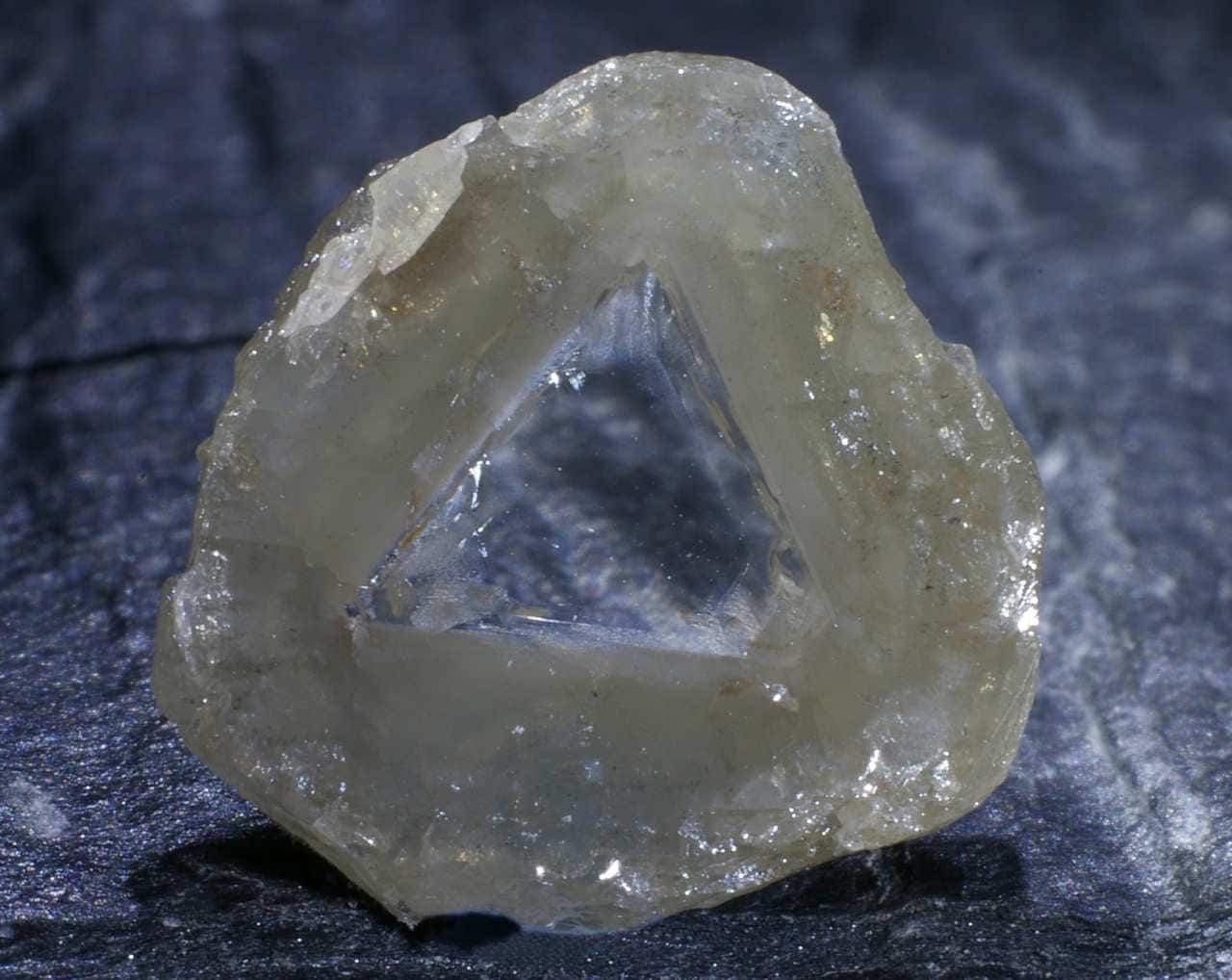 Diamonds can form with the help of ancient saltwater, say researchers who have identified the gems from oceanic crust dating back as far as 200 million years ago. Image credit: Anetta Banas[/caption]A team of researchers led by Dr Michael Förster, Professor Stephen Foley and Dr Olivier Alard at the Goethe Universität and Johannes Gutenberg Universität in Germany has demonstrated how seawater trapped in seabed sediments can react to produce the same composition of salts found in diamonds.This demonstration puts an end to a long-standing question about how diamonds may have formed in nature."There was a theory that the salts trapped inside diamonds came from marine seawater, but couldn't be tested," Förster, the study's lead author, told the University press. "Our research showed that they came from marine sediment."[caption id="attachment_6724761" align="alignnone" width="1280"]
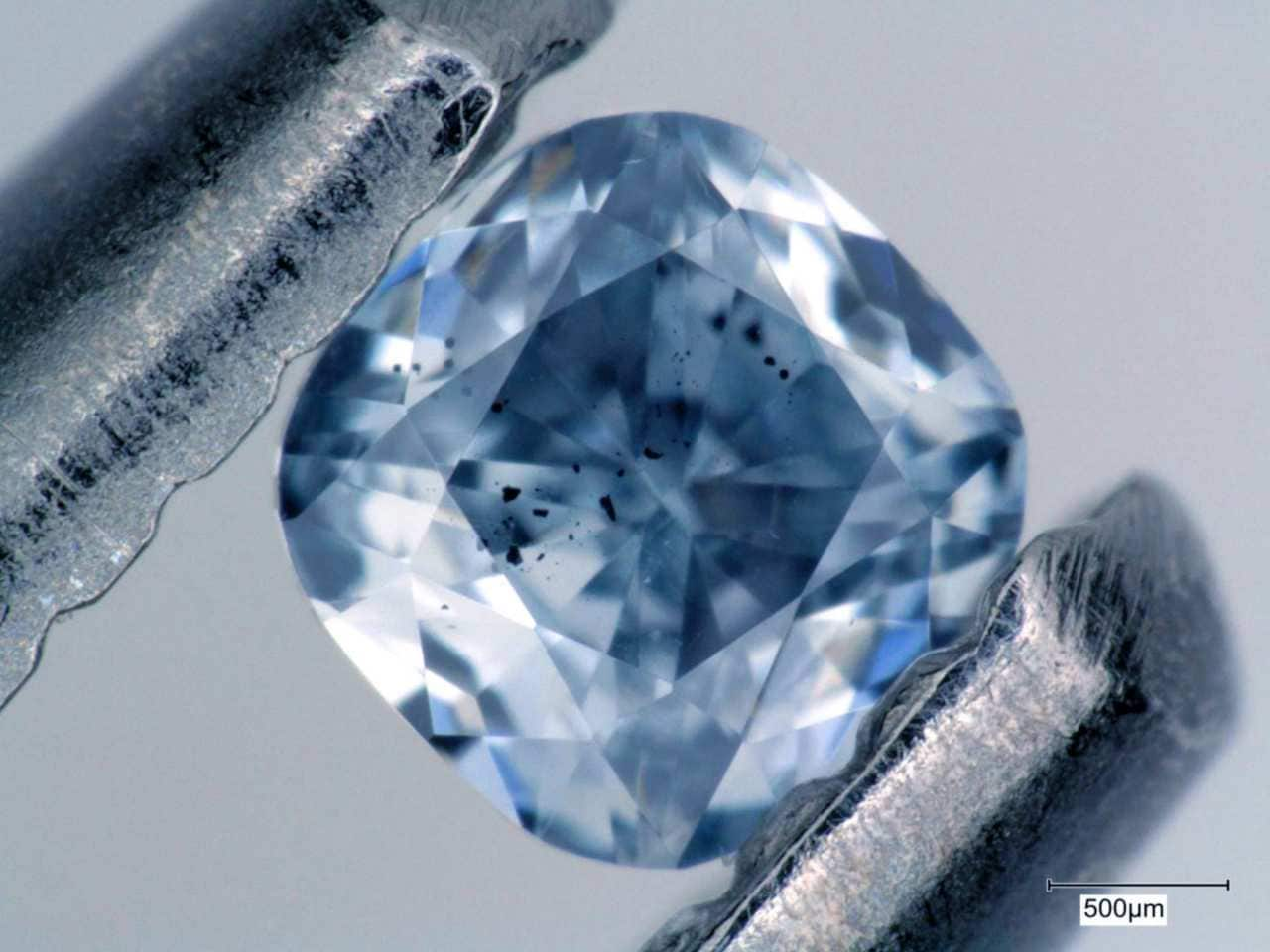 A blue, boron-bearing diamond with dark inclusions of a mineral called ferropericlase. Image: Carnegie Science[/caption]Put simply, diamonds are pretty-looking crystals of pure carbon. They are formed at depths beyond the Earth's crust in ancient parts of the planet's middle layer, the mantle. Every few million years in Earth's history, volcanic eruptions have carried up minerals (in the form of molten rocks) to the crust by a special kind of magma known as kimberlite. The last eruption of kimberlite minerals is thought to have occurred over 25 million years ago.While diamonds that are carved into gemstones are mostly pure-carbon in their composition, there are other kinds. Fibrous diamonds, for instance, are cloudy and far less appealing to jewellers. This rock comes with small traces of sodium, potassium or other minerals that reveal information about the environment where they formed.
First Published:May 30, 2019, 11:18:27 IST
Advertisement
Advertisement

Careless Whispers: Scientists discover that plants can 'talk' to each other using smells
Japanese scientists have recorded a video that shows plants, in certain conditions, communicate with each other using mists that carry smells. The discovery, reveals that plants release a fine mist of airborne compounds, to warn nearby plants of potential dangers
Life on Mars? European Space Agency’s Orbiter discovers ice water deposits at equator
European Space Agency's Mars Express Orbiter has identified massive ice and ice water deposits beneath the surface of Mars. The Mars Express orbiter was also the first to confirmed the presence of ice on Mars in 2004
Microsoft briefly overtakes Apple as the most valuable company, Apple back on top again
At its peak during the session, Microsoft's value reached $2.903 trillion, with a 2% surge. As of writing this article, Apple closed at $2.89 trillion, whereas Microsoft closed at $2.86 trillion
Even NASA is facing a tough time, starts layoffs following major budget cuts
NASA is facing some massive budget cuts, because of which, it has been forced to postpone some upcoming missions. NASA's Jet Propulsion Laboratory has been hit hard by recent federal budget cuts, resulting in the layoff of 100 contractors last week
ISRO, NASA's NISAR satellite to get ready by Jan-end, will monitor Earth's snow-covered regions
The NISAR satellite which has been developed jointly ISRO and NASA, should be ready for launch by the end of January 2024. The collaboration between NASA and ISRO on NISAR is the first time the two agencies have cooperated on hardware development for an Earth-observing mission
Advertisement
Advertisement