


Debris from China's Long March 5B rocket is hurtling towards Earth, expected to crash next week
It could land anywhere from New York, Madrid and Beijing and as far south as southern Chile and Wellington, New Zealand.

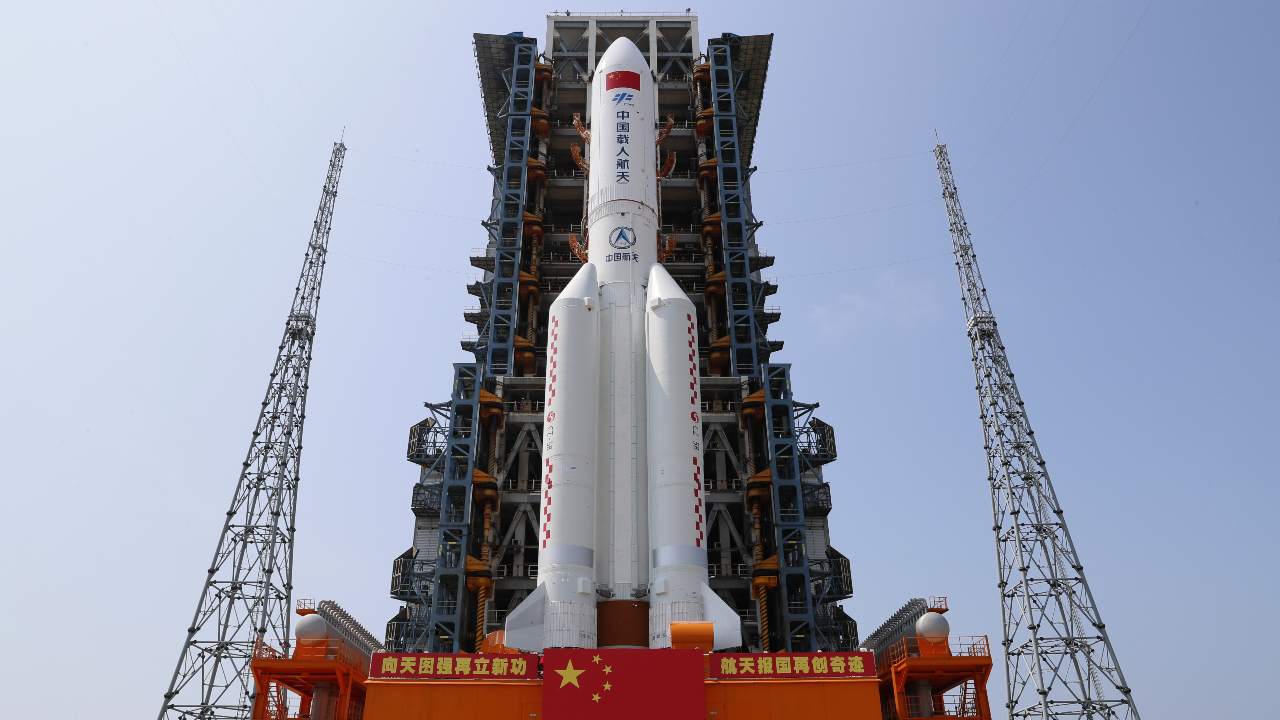
In this photo released by Xinhua News Agency, the core module of China's space station, Tianhe, on the the Long March-5B Y2 rocket is moved to the launching area of the Wenchang Spacecraft Launch Site in southern China's Hainan Province on April 23, 2021. China plans to launch the core module for its first permanent space station this week in the latest big step forward for the country’s space exploration program. Image credit: Guo Wenbin/Xinhua via AP[/caption]The debris is part of the Long March 5B rocket that recently successfully launched China’s first module for its proposed space station. The incident comes roughly a year after another similar Chinese rocket fell to Earth, landing in the Atlantic Ocean but not before it reportedly left a trail of debris in the African nation of Cote D'Ivoire.At the time, experts noted this was one of the largest pieces of human-made debris ever to fall to Earth. We cannot say with certainty what fate awaits this latest piece of space junk.
Litter from space
Who pays to clean up the mess, anyway?
International law sets out a compensation regime that would apply in many circumstances of damage on Earth, as well as when satellites collide in space. The 1972 Liability Convention, a UN treaty, imposes liability on “launching states” for damage caused by their space objects, which includes an absolute liability regime when they crash to Earth as debris.In the case of the Long March 5B, this would impose potential liability on China. The treaty has only been invoked once before (for the Cosmos 954 incident) and therefore may not be regarded as a powerful disincentive. However, it is likely to come into play in the future in a more crowded space environment, and with more uncontrolled reentries. Of course, this legal framework applies only after the damage occurs.Other international guidelines regarding debris mitigation and long-term sustainability of space activities set out voluntary standards intended to limit the probability of collisions in space, and minimise the breakup of satellites either during or after their missions.Some satellites can be moved into a graveyard orbit at the end of their operational life. While this works well for certain specific orbits at a relatively high altitude, it is impractical and hazardous to start moving the vast majority of satellites around between orbital planes. Most of the millions of pieces of space junk are destined either to orbit in an uncontrollable manner for many years or, if they are in low Earth orbit, to gradually descend towards the Earth, hopefully burning up in the atmosphere before contact with terra firma.A globally coordinated space traffic management system will be vital to avoid collisions that would result in loss of control of satellites, leaving them to tumble helplessly in orbit or fall back to Earth.Comprehensively tracking every satellite’s movement and functionality is even harder than it sounds, because it would inevitably require countries to be willing to share information they often currently regard as confidential matters of national security.But, ultimately, global cooperation is essential if we are to avoid an unsustainable future for our space activities. In the meantime, don’t forget to gaze upwards every now and then — you might spot some of the most spectacular litter on the planet. Steven Freeland, Professorial Fellow, Bond University / Emeritus Professor of International Law, Western Sydney University, Western Sydney UniversityThis article is republished from The Conversation under a Creative Commons license. Read the original article.

Careless Whispers: Scientists discover that plants can 'talk' to each other using smells
Life on Mars? European Space Agency’s Orbiter discovers ice water deposits at equator
Microsoft briefly overtakes Apple as the most valuable company, Apple back on top again
Even NASA is facing a tough time, starts layoffs following major budget cuts
ISRO, NASA's NISAR satellite to get ready by Jan-end, will monitor Earth's snow-covered regions