
Advertisement


Sections
Colbert and DeGrasse drive a 'Mars Rover' around New York and talk science
They discuss the rover's features, their plans to colonise Mars and potatoes grown from poop.

America’s Late Night Show host Stephen Colbert and popular astrophysicist Neil deGrasse Tyson took what Colbert coins as the ‘new Mars Rover’ on a test ride in Manhattan, New York.![Colbert and DeGrasse talking rover specs. Image courtesy: Screengrab from YouTube_Late Night Show with Stepehen Colbert]() Colbert and DeGrasse talking rover specs.Image courtesy: Screengrab from YouTube_Late Night Show with Stephen Colbert“They (NASA) let me test drive the prototype of their new Mars rover,” Colbert says.“Before they send it to Mars, they want to see if it can withstand New York’s inhospitable atmosphere of urine-based humidity,” he jokes.The pair discusses the many features of the rover – which looks more like a Bat-mobile than any of NASA’s rovers present stationed on Mars.DeGrasse points out that the rover’s top speed, close to 3 mph, is still an ambitious target for actual mobile rovers studying the Red Planet.[caption id="attachment_5280271" align="alignnone" width="1280"]
Colbert and DeGrasse talking rover specs.Image courtesy: Screengrab from YouTube_Late Night Show with Stephen Colbert“They (NASA) let me test drive the prototype of their new Mars rover,” Colbert says.“Before they send it to Mars, they want to see if it can withstand New York’s inhospitable atmosphere of urine-based humidity,” he jokes.The pair discusses the many features of the rover – which looks more like a Bat-mobile than any of NASA’s rovers present stationed on Mars.DeGrasse points out that the rover’s top speed, close to 3 mph, is still an ambitious target for actual mobile rovers studying the Red Planet.[caption id="attachment_5280271" align="alignnone" width="1280"]![A sign on the rover. Image courtesy: Screengrab from YouTube/Late Night with Stephen Colbert]() A sign on the rover. Image courtesy: Screengrab from YouTube/Late Night with Stephen Colbert[/caption]They also discussed the challenges of interstellar space travel, the best chances of our survival over generations on such a journey. All this while driving the Mars-mobile on Manhattan streets and shopping for 'supplies' a hypothetical might need.Among the duo’s banter are plans to colonise Mars, potatoes grown from poop, how having a rover like the Mars-mobile might affect one's dating life and the nuances of travelling to and on Mars.
A sign on the rover. Image courtesy: Screengrab from YouTube/Late Night with Stephen Colbert[/caption]They also discussed the challenges of interstellar space travel, the best chances of our survival over generations on such a journey. All this while driving the Mars-mobile on Manhattan streets and shopping for 'supplies' a hypothetical might need.Among the duo’s banter are plans to colonise Mars, potatoes grown from poop, how having a rover like the Mars-mobile might affect one's dating life and the nuances of travelling to and on Mars.
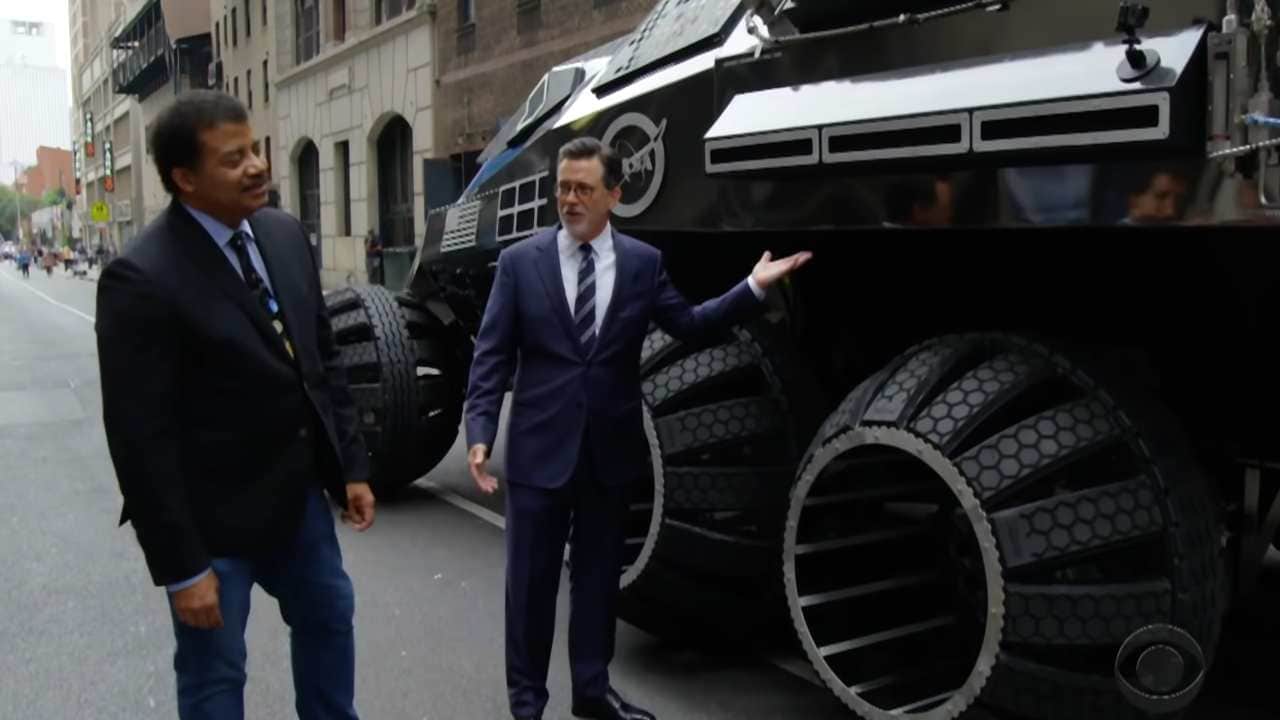 Colbert and DeGrasse talking rover specs.Image courtesy: Screengrab from YouTube_Late Night Show with Stephen Colbert“They (NASA) let me test drive the prototype of their new Mars rover,” Colbert says.“Before they send it to Mars, they want to see if it can withstand New York’s inhospitable atmosphere of urine-based humidity,” he jokes.
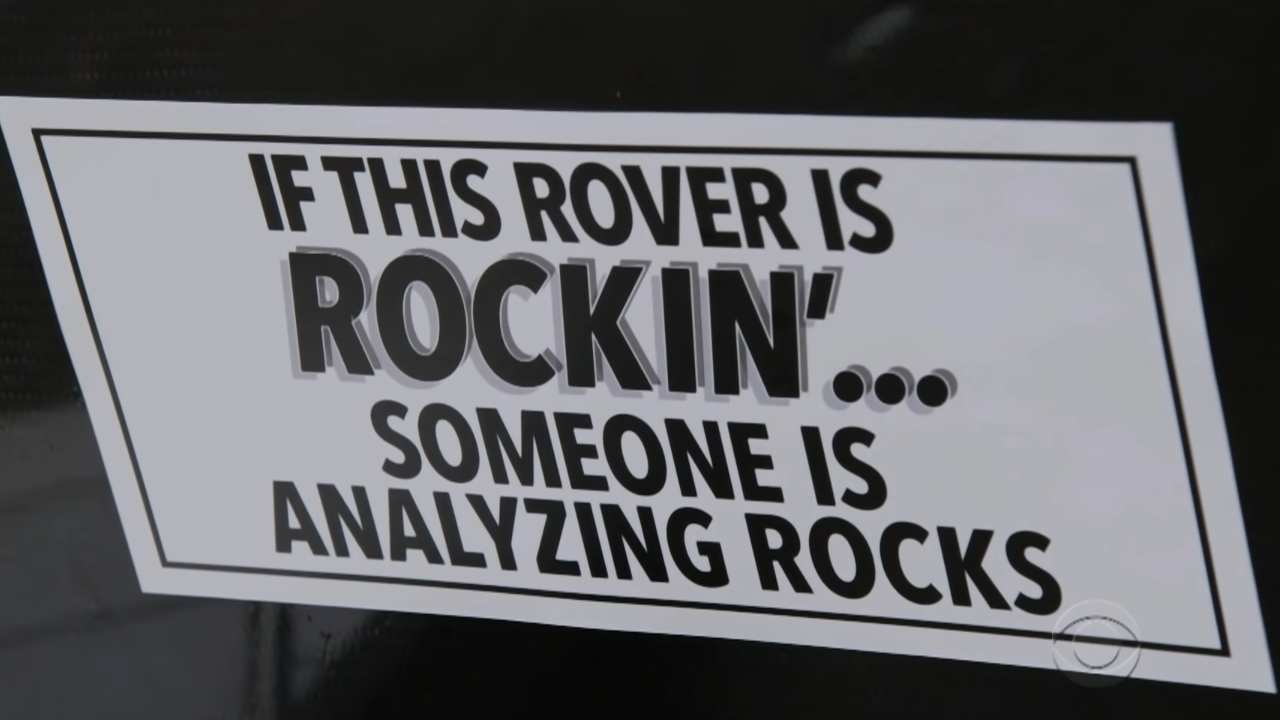 A sign on the rover. Image courtesy: Screengrab from YouTube/Late Night with Stephen Colbert[/caption]They also discussed the challenges of interstellar space travel, the best chances of our survival over generations on such a journey. All this while driving the Mars-mobile on Manhattan streets and shopping for 'supplies' a hypothetical might need.Among the duo’s banter are plans to colonise Mars, potatoes grown from poop, how having a rover like the Mars-mobile might affect one's dating life and the nuances of travelling to and on Mars.
First Published:Sep 28, 2018, 12:32:01 IST
Advertisement
Advertisement

Careless Whispers: Scientists discover that plants can 'talk' to each other using smells
Japanese scientists have recorded a video that shows plants, in certain conditions, communicate with each other using mists that carry smells. The discovery, reveals that plants release a fine mist of airborne compounds, to warn nearby plants of potential dangers
Life on Mars? European Space Agency’s Orbiter discovers ice water deposits at equator
European Space Agency's Mars Express Orbiter has identified massive ice and ice water deposits beneath the surface of Mars. The Mars Express orbiter was also the first to confirmed the presence of ice on Mars in 2004
Microsoft briefly overtakes Apple as the most valuable company, Apple back on top again
At its peak during the session, Microsoft's value reached $2.903 trillion, with a 2% surge. As of writing this article, Apple closed at $2.89 trillion, whereas Microsoft closed at $2.86 trillion
Even NASA is facing a tough time, starts layoffs following major budget cuts
NASA is facing some massive budget cuts, because of which, it has been forced to postpone some upcoming missions. NASA's Jet Propulsion Laboratory has been hit hard by recent federal budget cuts, resulting in the layoff of 100 contractors last week
ISRO, NASA's NISAR satellite to get ready by Jan-end, will monitor Earth's snow-covered regions
The NISAR satellite which has been developed jointly ISRO and NASA, should be ready for launch by the end of January 2024. The collaboration between NASA and ISRO on NISAR is the first time the two agencies have cooperated on hardware development for an Earth-observing mission
Advertisement
Advertisement