
Advertisement


Sections
Climate Sensitivity: Why is predicting climate change, temperature rise so damn hard?
Scientists use a tool to measure how factors actually affect climate, but they don't fully understand it.

We've heard it only every other day: the Earth is getting hotter. Human activity has had a big hand in it — pumping more carbon into the atmosphere than is good for the temperature on Earth, which is currently higher (on average) than it has been at any point in human history.There's been less and less debate about "global warming" and "climate change" in recent years, as international organisations like the United Nations have rallied support for it and global efforts like the Kyoto Protocol, Paris Agreement and IPCC report have been signed to ensure that the world's biggest polluters are held accountable for their part in the problem and working on sustainable solutions.In the case of humankind vs climate change, good luck wished it had the chance.[caption id="attachment_6630181" align="alignnone" width="1280"]![Is the Sun responsible for global warming? No. The Sun can influence Earth’s climate, but it is not responsible for the warming trend we’ve seen over the past few decades. Image: NASA]() Is the Sun responsible for global warming? No. The Sun can influence Earth’s climate, but it is not responsible for the warming trend we’ve seen over the past few decades. Image: NASA[/caption]Warming triggers changes to the planet. Some of these changes can speed the temperature rise even further (like the rapidly melting Arctic glaciers), and others, in a spot of (insanely) good luck, may slow down the warming we've caused. This "feedback" comes from the influence of natural factors, like water vapour, clouds, surface reflectivity, and others, which can change how the Earth warms.To study how these many factors actually affect climate, researchers use an artificial, very useful concept called climate "sensitivity". It is an estimate of how high global temperatures will rise in response to specific factors — like carbon emissions, for instance. While it sounds fairly straightforward, climate sensitivity has befuddled scientists for years — and it still does, according to Carbon Brief.Using simple calculations, physicists can show that the world will become warmer by a little over 1 degree Celcius if carbon levels in the atmosphere double (from its pre-industrial concentrations of 280 parts per million) and no other factor is taken into account. If only the real world were that simple.But these calculations haven't fit the trend. There's strong evidence that other factors will affect warming significantly, too. Water vapour, another greenhouse gas, is one of the single-largest, best-understood climate feedbacks, according to a Carbon Brief report. In a warming world, the amount of water vapour in the air that affects temperature will also increase, making the trends more dynamic.[caption id="attachment_5525951" align="alignnone" width="1280"]
Is the Sun responsible for global warming? No. The Sun can influence Earth’s climate, but it is not responsible for the warming trend we’ve seen over the past few decades. Image: NASA[/caption]Warming triggers changes to the planet. Some of these changes can speed the temperature rise even further (like the rapidly melting Arctic glaciers), and others, in a spot of (insanely) good luck, may slow down the warming we've caused. This "feedback" comes from the influence of natural factors, like water vapour, clouds, surface reflectivity, and others, which can change how the Earth warms.To study how these many factors actually affect climate, researchers use an artificial, very useful concept called climate "sensitivity". It is an estimate of how high global temperatures will rise in response to specific factors — like carbon emissions, for instance. While it sounds fairly straightforward, climate sensitivity has befuddled scientists for years — and it still does, according to Carbon Brief.Using simple calculations, physicists can show that the world will become warmer by a little over 1 degree Celcius if carbon levels in the atmosphere double (from its pre-industrial concentrations of 280 parts per million) and no other factor is taken into account. If only the real world were that simple.But these calculations haven't fit the trend. There's strong evidence that other factors will affect warming significantly, too. Water vapour, another greenhouse gas, is one of the single-largest, best-understood climate feedbacks, according to a Carbon Brief report. In a warming world, the amount of water vapour in the air that affects temperature will also increase, making the trends more dynamic.[caption id="attachment_5525951" align="alignnone" width="1280"]![]() The lush greenery that comes with diversity in the tree species in the Amazon appears to be under threat from climate change. Image courtesy: WWF[/caption]The tried and tested way of observing a pattern is to simulate it, with as many data points from the real world as possible. Climate models, too, are mainstream in studying climate change and predicting future warming. Estimates of climate sensitivity use a combination of climate models, recent observations and palaeoclimate data from the Earth's distant past.Like all models, climate models, too, are imperfect representations of the real world, says Dr Kate Marvel writing for Scientific American. "They tell us something useful about the planet we're changing, but not (exactly) how much we'll change it."In Dr Marvel's view, the only way to really know how things pan out when atmospheric carbon doubles is to wait and experience it first hand.
The lush greenery that comes with diversity in the tree species in the Amazon appears to be under threat from climate change. Image courtesy: WWF[/caption]The tried and tested way of observing a pattern is to simulate it, with as many data points from the real world as possible. Climate models, too, are mainstream in studying climate change and predicting future warming. Estimates of climate sensitivity use a combination of climate models, recent observations and palaeoclimate data from the Earth's distant past.Like all models, climate models, too, are imperfect representations of the real world, says Dr Kate Marvel writing for Scientific American. "They tell us something useful about the planet we're changing, but not (exactly) how much we'll change it."In Dr Marvel's view, the only way to really know how things pan out when atmospheric carbon doubles is to wait and experience it first hand.
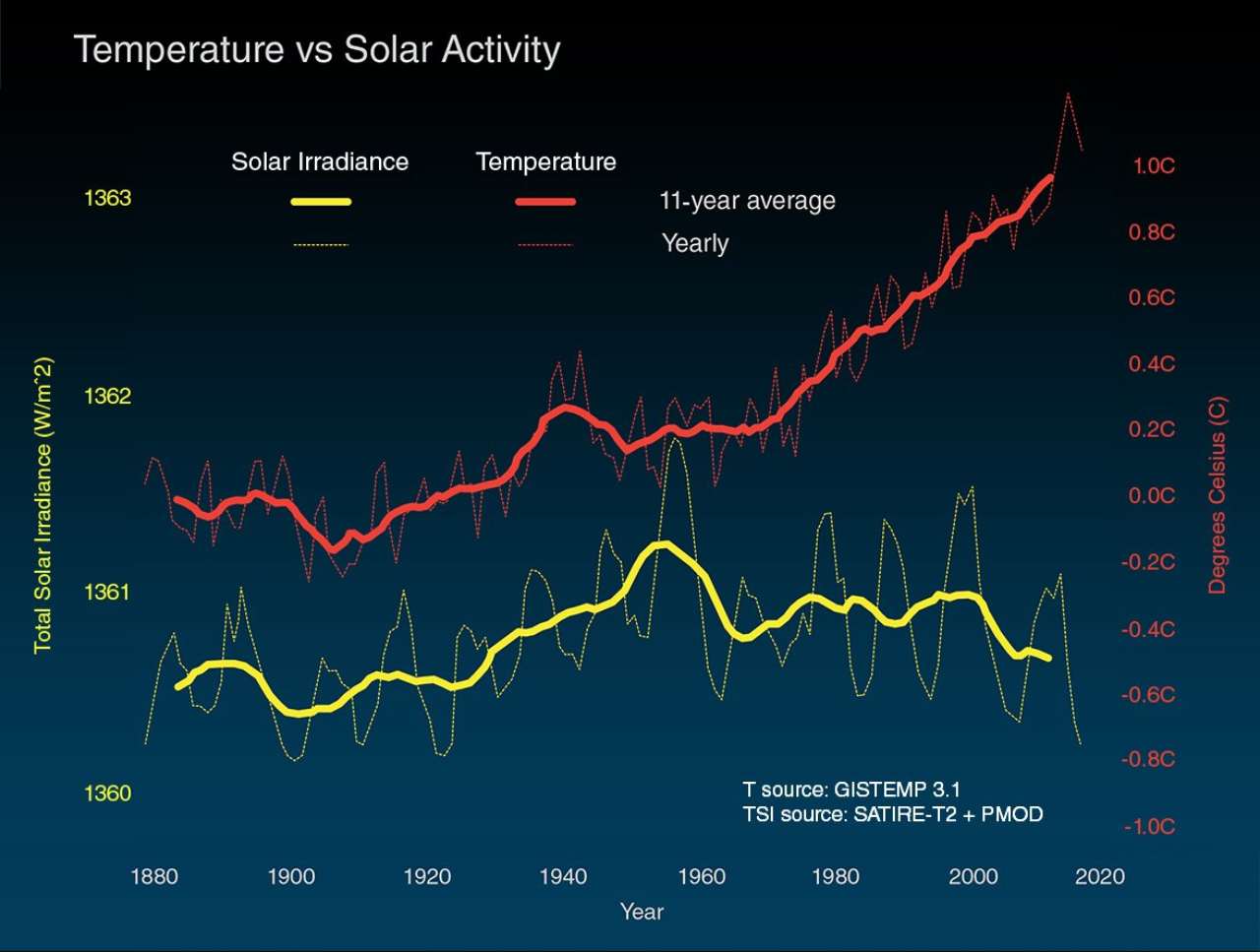 Is the Sun responsible for global warming? No. The Sun can influence Earth’s climate, but it is not responsible for the warming trend we’ve seen over the past few decades. Image: NASA[/caption]Warming triggers changes to the planet. Some of these changes can speed the temperature rise even further (like the rapidly melting Arctic glaciers), and others, in a spot of (insanely) good luck, may slow down the warming we've caused. This "feedback" comes from the influence of natural factors, like water vapour, clouds, surface reflectivity, and others, which can change how the Earth warms.To study how these many factors actually affect climate, researchers use an artificial, very useful concept called climate "sensitivity". It is an estimate of how high global temperatures will rise in response to specific factors — like carbon emissions, for instance. While it sounds fairly straightforward, climate sensitivity has befuddled scientists for years — and it still does, according to Carbon Brief.
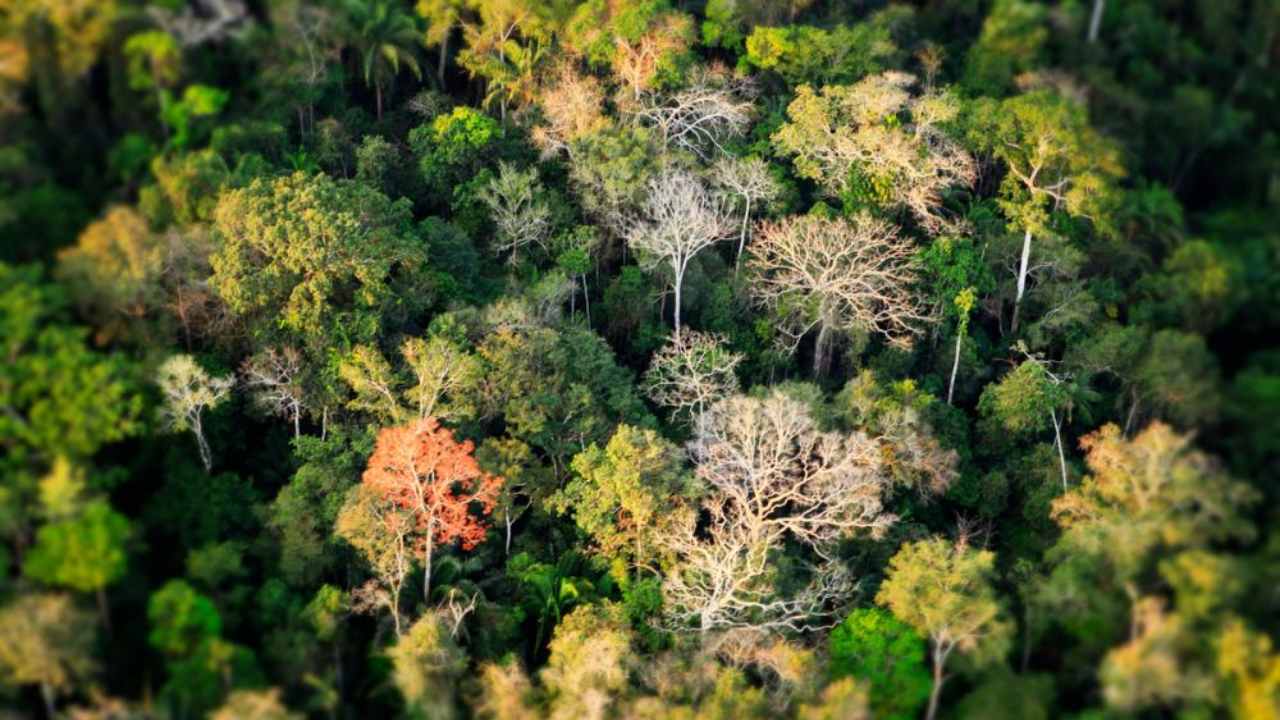 The lush greenery that comes with diversity in the tree species in the Amazon appears to be under threat from climate change. Image courtesy: WWF[/caption]The tried and tested way of observing a pattern is to simulate it, with as many data points from the real world as possible. Climate models, too, are mainstream in studying climate change and predicting future warming. Estimates of climate sensitivity use a combination of climate models, recent observations and palaeoclimate data from the Earth's distant past.Like all models, climate models, too, are imperfect representations of the real world, says Dr Kate Marvel writing for Scientific American. "They tell us something useful about the planet we're changing, but not (exactly) how much we'll change it."In Dr Marvel's view, the only way to really know how things pan out when atmospheric carbon doubles is to wait and experience it first hand.
First Published:May 15, 2019, 10:19:23 IST
Advertisement
Advertisement

Careless Whispers: Scientists discover that plants can 'talk' to each other using smells
Japanese scientists have recorded a video that shows plants, in certain conditions, communicate with each other using mists that carry smells. The discovery, reveals that plants release a fine mist of airborne compounds, to warn nearby plants of potential dangers
Life on Mars? European Space Agency’s Orbiter discovers ice water deposits at equator
European Space Agency's Mars Express Orbiter has identified massive ice and ice water deposits beneath the surface of Mars. The Mars Express orbiter was also the first to confirmed the presence of ice on Mars in 2004
Microsoft briefly overtakes Apple as the most valuable company, Apple back on top again
At its peak during the session, Microsoft's value reached $2.903 trillion, with a 2% surge. As of writing this article, Apple closed at $2.89 trillion, whereas Microsoft closed at $2.86 trillion
Even NASA is facing a tough time, starts layoffs following major budget cuts
NASA is facing some massive budget cuts, because of which, it has been forced to postpone some upcoming missions. NASA's Jet Propulsion Laboratory has been hit hard by recent federal budget cuts, resulting in the layoff of 100 contractors last week
ISRO, NASA's NISAR satellite to get ready by Jan-end, will monitor Earth's snow-covered regions
The NISAR satellite which has been developed jointly ISRO and NASA, should be ready for launch by the end of January 2024. The collaboration between NASA and ISRO on NISAR is the first time the two agencies have cooperated on hardware development for an Earth-observing mission
Advertisement
Advertisement