
Advertisement


Sections
Citizen scientists help create 'most complete' 3D map of brown dwarfs in Milky Way
Telescopes can detect brown dwarfs because they emit heat in the form of infrared light, left over from their formation.

Citizen scientists from NASA-funded Backyard Worlds: Planet 9 have now managed to create the 'most complete' three-dimensional map of 525 brown dwarfs in our cosmic Milky Way neighbourhood. The brown dwarfs are objects that are balls of gas not heavy enough to be stars, since they cannot power themselves through nuclear fusion the way stars do, according to a statement from NASA. While they are named brown dwarfs, they appear magenta or orange-red if a person could see them close up.Brown dwarfs can have temperatures of up to thousands of degrees Fahrenheit, but the Y dwarfs may be below freezing temperatures and have clouds made of water, the space agency said. The map encompasses a radius of 65-light years, or about 400 trillion miles. NASA added that citizen scientists have been searching for brown dwarf candidates as part of Backyard Worlds, using data from NASA’s Near-Earth Object Wide-Field Infrared Survey Explorer (NEOWISE) satellite along with all-sky observations collected between 2010 and 2011 under its previous moniker, WISE, since 2017.[caption id="attachment_9238381" align="alignnone" width="1280"]![Earth surrounded by the nearest brown dwarfs, shown in red, against the backdrop of surrounding constellations. Image credits: NASA/Jacqueline Faherty/OpenSpace]() The study which was presented at the 237th meeting of the American Astronomical Society had listed worldwide volunteers and high school students in the Pasadena, California. J Davy Kirkpatrick, lead author of the study and scientist at the Infrared Processing and Analysis Center at the California Institute of Technology, said that without the citizen scientists, they could not have created such a comprehensive map in such a short time. Having the power of thousands of inquiring eyes on the data enables them to find brown dwarf candidates much faster, he added.A statement from the National Science Foundation’s NOIRLab revealed that a total of 525 brown dwarfs were mapped in the new 3D visualization, including 38 new brown dwarfs that were discovered by the citizen scientist group.
The study which was presented at the 237th meeting of the American Astronomical Society had listed worldwide volunteers and high school students in the Pasadena, California. J Davy Kirkpatrick, lead author of the study and scientist at the Infrared Processing and Analysis Center at the California Institute of Technology, said that without the citizen scientists, they could not have created such a comprehensive map in such a short time. Having the power of thousands of inquiring eyes on the data enables them to find brown dwarf candidates much faster, he added.A statement from the National Science Foundation’s NOIRLab revealed that a total of 525 brown dwarfs were mapped in the new 3D visualization, including 38 new brown dwarfs that were discovered by the citizen scientist group.
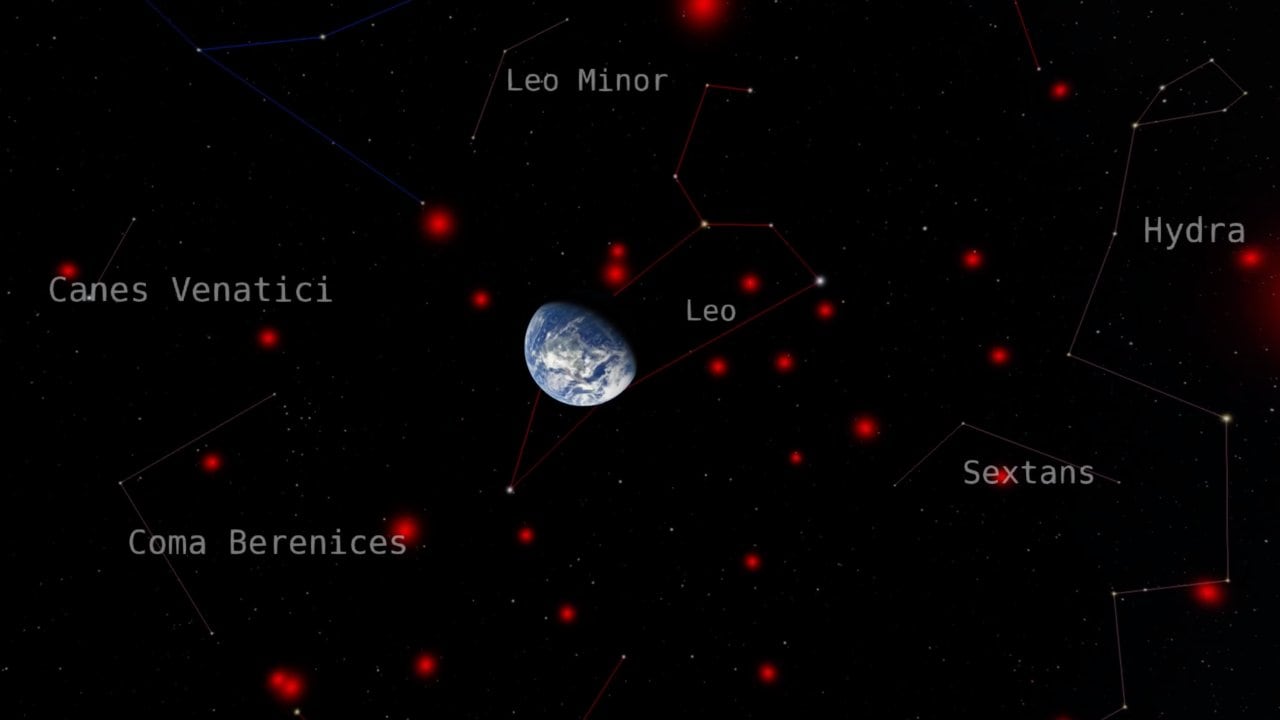
Earth surrounded by the nearest brown dwarfs, shown in red, against the backdrop of surrounding constellations. Image credits: NASA/Jacqueline Faherty/OpenSpace[/caption]By making a complete map of the objects, scientists can find out whether different kinds of brown dwarfs and are evenly distributed in the solar system's neighbourhood. NASA said that telescopes can detect brown dwarfs because they emit heat in the form of infrared light, left over from their formation. The new citizen scientist project is the most complete map to date of L, T and Y dwarfs in the vicinity of the solar system.
First Published:Jan 25, 2021, 19:27:44 IST
Advertisement
Advertisement

Careless Whispers: Scientists discover that plants can 'talk' to each other using smells
Japanese scientists have recorded a video that shows plants, in certain conditions, communicate with each other using mists that carry smells. The discovery, reveals that plants release a fine mist of airborne compounds, to warn nearby plants of potential dangers
Life on Mars? European Space Agency’s Orbiter discovers ice water deposits at equator
European Space Agency's Mars Express Orbiter has identified massive ice and ice water deposits beneath the surface of Mars. The Mars Express orbiter was also the first to confirmed the presence of ice on Mars in 2004
Microsoft briefly overtakes Apple as the most valuable company, Apple back on top again
At its peak during the session, Microsoft's value reached $2.903 trillion, with a 2% surge. As of writing this article, Apple closed at $2.89 trillion, whereas Microsoft closed at $2.86 trillion
Even NASA is facing a tough time, starts layoffs following major budget cuts
NASA is facing some massive budget cuts, because of which, it has been forced to postpone some upcoming missions. NASA's Jet Propulsion Laboratory has been hit hard by recent federal budget cuts, resulting in the layoff of 100 contractors last week
ISRO, NASA's NISAR satellite to get ready by Jan-end, will monitor Earth's snow-covered regions
The NISAR satellite which has been developed jointly ISRO and NASA, should be ready for launch by the end of January 2024. The collaboration between NASA and ISRO on NISAR is the first time the two agencies have cooperated on hardware development for an Earth-observing mission
Advertisement
Advertisement