


CERN's Large Hadron Collider gets major upgrade, experiments to resume in 2021
The LHC is the world's most advanced particle accelerator, which began work in September 2008.

The European Organisation for Nuclear Research (CERN) is in the middle of giving the Large Hadron Collider (LHC), the most powerful particle accelerator in the world, a major upgrade. This is the second such long shutdown since the LHC opened in September 2008. Work on the reactor is scheduled to go on for two years.
CERN scientists are working on each individual part of the collider to get it running to its maximum potential. They are reinforcing and upgrading the entire accelerator complex and detectors. They are also changing the accelerator's interiors to make it more 'high-luminosity tolerant and radiation tolerant' and adding in four new connection cryosats to ensure all parts in the LHC remain at the same temperature (-271 degrees Celsius). The LHC's superconducting magnets, which are crucial to the bending and tightening of trajectories that the particles take, will also be removed and replaced, according to a statement.
 More from Science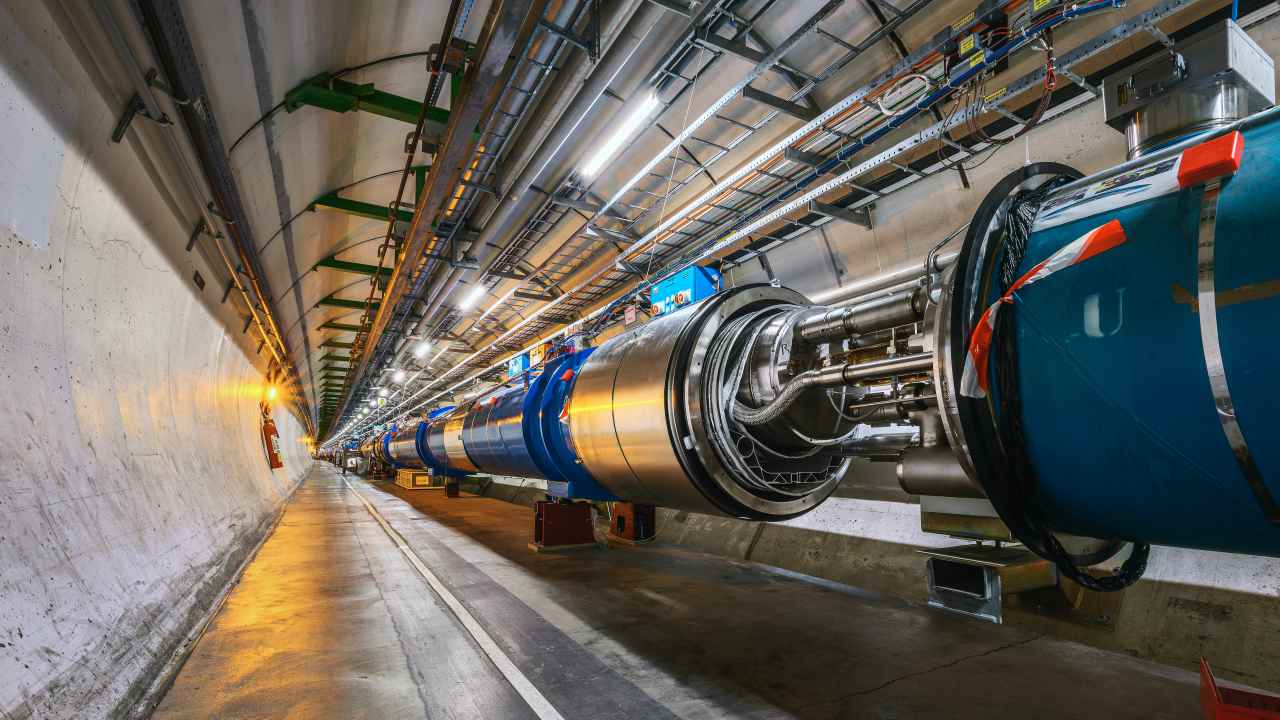
In the LHC tunnel during an upgrade. Image credit: CERN[/caption]CERN is the largest particle physics laboratory in the world, and the LHC, its most advanced particle accelerator. The organisation has shared images of the particle collide, with its exposed steel, colourful components and detailed explanations alongside each image. The LHC is a 27-kilometer ring in which particles travel in a continuous loop with the help of superconducting magnets and several accelerating structures to give the particles' energy a boost at multiple steps along the way. CERN uses eight accelerators and two decelerators, joined together, to reach energies.
CERN also has plans for starting a high-luminosity LHC, which is expected to begin functioning from 2026. The new collider will reach five to ten times the luminosities (a way to characterize the performance of an accelerator) than any previous CERN experiments.

Careless Whispers: Scientists discover that plants can 'talk' to each other using smells
Life on Mars? European Space Agency’s Orbiter discovers ice water deposits at equator
Microsoft briefly overtakes Apple as the most valuable company, Apple back on top again
Even NASA is facing a tough time, starts layoffs following major budget cuts
ISRO, NASA's NISAR satellite to get ready by Jan-end, will monitor Earth's snow-covered regions