
Advertisement


Sections
Breathtaking visuals of asteroid Ryugu's surface captured by Hayabusa 2's MASCOT probe
Hayabusa2 will eventually return to Earth with samples, but these observations help provide geologic context to the asteroid.

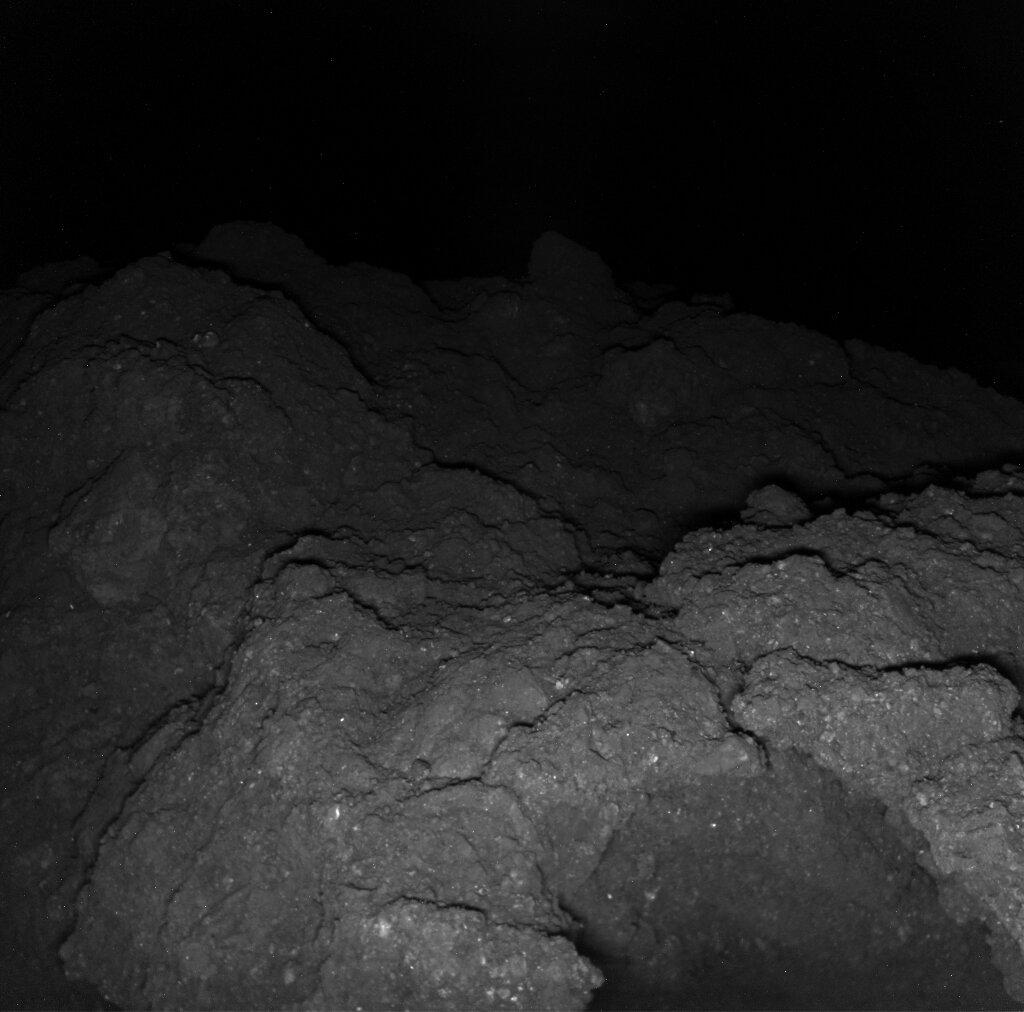
Photographs snapped by a shoebox-sized probe that explored the near-Earth asteroid Ryugu have offered new clues about its composition, insights that will help scientists understand the formation of our solar system.The German-French Mobile Asteroid Surface Scout (MASCOT) hitched a ride on Japan's Hayabusa 2 spacecraft, touching down on the 900-meter-wide asteroid, whose orbit lies mostly between Earth and Mars, on 3 October 2018. Ryugu's gravity is 66,500 times weaker than Earth's, and the forward motion of wheels would have launched MASCOT back into space.So instead, it hopped around the surface using the tiny amount of momentum generated by a metal swing arm attached to its boxy body, which weighed 10 kilograms.[caption id="attachment_7212801" align="alignnone" width="1023"]![The first image acquired by the MASCAM camera system on Hayabusa2 during its descent, shortly after separation from the landing module at a height of 41 meters with a viewing direction towards the south pole. Particularly striking is a huge block near the South Pole, which stands out clearly above the horizon line named 'Otohime Saxum'. It is up ~100 meters tall. Image: Jaumann et al/Science]() The first image acquired by the MASCAM camera system on Hayabusa2 during its descent, shortly after separation from the landing module at a height of 41 meters with a viewing direction towards the south pole. Particularly striking is a huge block near the South Pole, which stands out clearly above the horizon line named 'Otohime Saxum'. It is up ~100 meters tall. Image: Jaumann et al/Science[/caption]In addition to taking temperature readings and other measurements, MASCOT reeled off a series of pictures showing the asteroid is covered with rocks and boulders that fall into one of two categories: dark and rough with crumbly surfaces that resemble cauliflowers, or bright and smooth."The interesting thing there is it really shows that Ryugu is the product of some kind of violent process," Ralf Jaumann of the German Aerospace Center and the lead author of a paper describing the findings in the journal Science on Thursday, told AFP. Ryugu may be the "child" of two-parent bodies that collided, broke up, and then came back together through gravity, the researchers say. Another theory is that it could have been struck by another body that created different interior temperature and pressure conditions, resulting in the two types of material.[caption id="attachment_7212821" align="alignnone" width="1024"]
The first image acquired by the MASCAM camera system on Hayabusa2 during its descent, shortly after separation from the landing module at a height of 41 meters with a viewing direction towards the south pole. Particularly striking is a huge block near the South Pole, which stands out clearly above the horizon line named 'Otohime Saxum'. It is up ~100 meters tall. Image: Jaumann et al/Science[/caption]In addition to taking temperature readings and other measurements, MASCOT reeled off a series of pictures showing the asteroid is covered with rocks and boulders that fall into one of two categories: dark and rough with crumbly surfaces that resemble cauliflowers, or bright and smooth."The interesting thing there is it really shows that Ryugu is the product of some kind of violent process," Ralf Jaumann of the German Aerospace Center and the lead author of a paper describing the findings in the journal Science on Thursday, told AFP. Ryugu may be the "child" of two-parent bodies that collided, broke up, and then came back together through gravity, the researchers say. Another theory is that it could have been struck by another body that created different interior temperature and pressure conditions, resulting in the two types of material.[caption id="attachment_7212821" align="alignnone" width="1024"]![Before first contact with a large rock on Ryugu, MASCAM photographed the area of Hayabusa's descent with a backward-facing view. Image: Jaumann et al/Science]() Before first contact with a large rock on Ryugu, MASCAM photographed the area of Hayabusa's descent with a backward-facing view. Image: Jaumann et al/Science[/caption]Many of the rocks also contained small blue and red "inclusions" — material that was trapped in the rock during its formation — making them extremely similar to a type of rare, primitive meteorites found on Earth called carbonaceous chondrites."This material is primitive material — it's the very first material of the solar nebula," or the cloud of interstellar dust and gas that formed the planets of our system, said Jaumann.Hayabusa 2 will eventually return to Earth carrying samples, but MASCOT's observations provide information on the material's original geologic context: how it is exposed to temperature changes, how it gets weathered, and so on."We don't know how planets formed in the beginning," said Jaumann."And in order to understand this, (we must) go to the small bodies, these primitive bodies, primordial in their history in their evolution, in order to understand the first 10 to 100 million years of planetary formation."
Before first contact with a large rock on Ryugu, MASCAM photographed the area of Hayabusa's descent with a backward-facing view. Image: Jaumann et al/Science[/caption]Many of the rocks also contained small blue and red "inclusions" — material that was trapped in the rock during its formation — making them extremely similar to a type of rare, primitive meteorites found on Earth called carbonaceous chondrites."This material is primitive material — it's the very first material of the solar nebula," or the cloud of interstellar dust and gas that formed the planets of our system, said Jaumann.Hayabusa 2 will eventually return to Earth carrying samples, but MASCOT's observations provide information on the material's original geologic context: how it is exposed to temperature changes, how it gets weathered, and so on."We don't know how planets formed in the beginning," said Jaumann."And in order to understand this, (we must) go to the small bodies, these primitive bodies, primordial in their history in their evolution, in order to understand the first 10 to 100 million years of planetary formation."
 The first image acquired by the MASCAM camera system on Hayabusa2 during its descent, shortly after separation from the landing module at a height of 41 meters with a viewing direction towards the south pole. Particularly striking is a huge block near the South Pole, which stands out clearly above the horizon line named 'Otohime Saxum'. It is up ~100 meters tall. Image: Jaumann et al/Science[/caption]In addition to taking temperature readings and other measurements, MASCOT reeled off a series of pictures showing the asteroid is covered with rocks and boulders that fall into one of two categories: dark and rough with crumbly surfaces that resemble cauliflowers, or bright and smooth."The interesting thing there is it really shows that Ryugu is the product of some kind of violent process," Ralf Jaumann of the German Aerospace Center and the lead author of a paper describing the findings in the journal Science on Thursday, told AFP. Ryugu may be the "child" of two-parent bodies that collided, broke up, and then came back together through gravity, the researchers say. Another theory is that it could have been struck by another body that created different interior temperature and pressure conditions, resulting in the two types of material.[caption id="attachment_7212821" align="alignnone" width="1024"]
 Before first contact with a large rock on Ryugu, MASCAM photographed the area of Hayabusa's descent with a backward-facing view. Image: Jaumann et al/Science[/caption]Many of the rocks also contained small blue and red "inclusions" — material that was trapped in the rock during its formation — making them extremely similar to a type of rare, primitive meteorites found on Earth called carbonaceous chondrites."This material is primitive material — it's the very first material of the solar nebula," or the cloud of interstellar dust and gas that formed the planets of our system, said Jaumann.Hayabusa 2 will eventually return to Earth carrying samples, but MASCOT's observations provide information on the material's original geologic context: how it is exposed to temperature changes, how it gets weathered, and so on."We don't know how planets formed in the beginning," said Jaumann."And in order to understand this, (we must) go to the small bodies, these primitive bodies, primordial in their history in their evolution, in order to understand the first 10 to 100 million years of planetary formation."
First Published:Aug 23, 2019, 11:49:36 IST
Advertisement
Advertisement

Careless Whispers: Scientists discover that plants can 'talk' to each other using smells
Japanese scientists have recorded a video that shows plants, in certain conditions, communicate with each other using mists that carry smells. The discovery, reveals that plants release a fine mist of airborne compounds, to warn nearby plants of potential dangers
Life on Mars? European Space Agency’s Orbiter discovers ice water deposits at equator
European Space Agency's Mars Express Orbiter has identified massive ice and ice water deposits beneath the surface of Mars. The Mars Express orbiter was also the first to confirmed the presence of ice on Mars in 2004
Microsoft briefly overtakes Apple as the most valuable company, Apple back on top again
At its peak during the session, Microsoft's value reached $2.903 trillion, with a 2% surge. As of writing this article, Apple closed at $2.89 trillion, whereas Microsoft closed at $2.86 trillion
Even NASA is facing a tough time, starts layoffs following major budget cuts
NASA is facing some massive budget cuts, because of which, it has been forced to postpone some upcoming missions. NASA's Jet Propulsion Laboratory has been hit hard by recent federal budget cuts, resulting in the layoff of 100 contractors last week
ISRO, NASA's NISAR satellite to get ready by Jan-end, will monitor Earth's snow-covered regions
The NISAR satellite which has been developed jointly ISRO and NASA, should be ready for launch by the end of January 2024. The collaboration between NASA and ISRO on NISAR is the first time the two agencies have cooperated on hardware development for an Earth-observing mission
Advertisement
Advertisement