


Breakthrough discovery of misbehaving muon challenges known laws of the physical universe
Physicists say the anomaly has given hundreds of scientists new ideas for how to look for new particles in the universe.

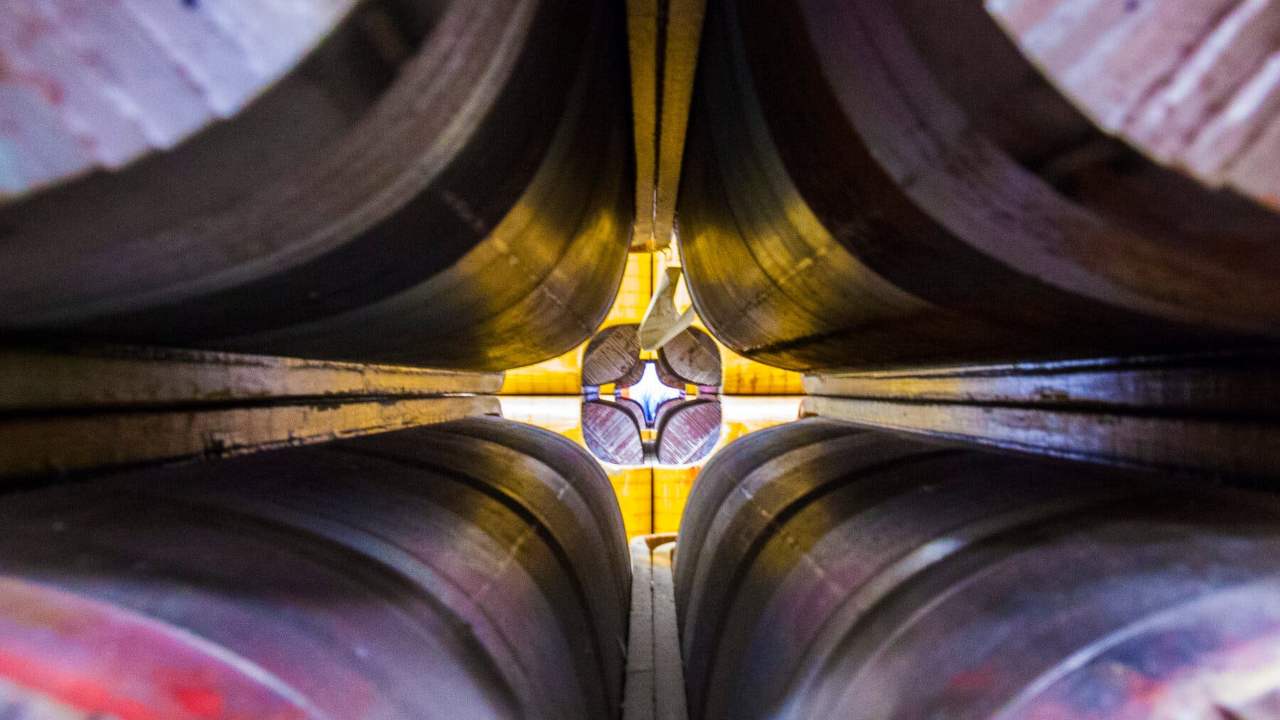
The Muon g-2 particle storage ring in the MC-1 Building at Fermilab. Image: Fermilab[/caption]Among other things, quantum theory holds that empty space is not really empty but is in fact boiling with “virtual” particles that flit in and out of existence.“You might think that it’s possible for a particle to be alone in the world,” Polly said in a biographical statement posted by Fermilab. “But in fact, it’s not lonely at all. Because of the quantum world, we know every particle is surrounded by an entourage of other particles.”This entourage influences the behavior of existing particles, including a property of the muon called its magnetic moment, represented in equations by a factor called g. According to a formula derived in 1928 by Paul Dirac, the English theoretical physicist and a founder of quantum theory, the g factor of a lone muon should be 2.But muons are not alone, so the formula must be corrected for the quantum buzz arising from all the other potential particles in the universe. That leads the factor g for the muon to be more than 2, hence the name of the experiment: Muon g-2.The extent to which g-2 deviates from theoretical predictions is one indication of how much is still unknown about the universe — how many monsters, as Polly put it, are lurking in the dark for physicists to discover.In 1998 physicists at Brookhaven, including Polly, who was then a graduate student, set out to explore this cosmic ignorance by actually measuring g-2 and comparing it to predictions.In the experiment, an accelerator called the Alternating Gradient Synchrotron created beams of muons and sent them into a 50-foot-wide storage ring, a giant racetrack controlled by superconducting magnets.The value of g they obtained disagreed with the Standard Model’s prediction by enough to excite the imaginations of physicists — but without enough certainty to claim a solid discovery. Moreover, experts could not agree on the Standard Model’s exact prediction, further muddying hopeful waters.Lacking money to redo the experiment, Brookhaven retired the 50-foot muon storage ring in 2001. The universe was left hanging.
The Big Move
At Fermilab, a new campus devoted to studying muons was being built.“That opened up a world of possibility,” Polly recalled in his biographical article. By this time, Polly was working at Fermilab; he urged the lab to redo the g-2 experiment there. They put him in charge.To conduct the experiment, however, they needed the 50-foot magnet racetrack from Brookhaven. And so in 2013, the magnet went on a 3,200-mile odyssey, mostly by barge, down the Eastern Seaboard, around Florida and up the Mississippi River, then by truck across Illinois to Batavia, home of Fermilab.The magnet resembled a flying saucer, and it drew attention as it was driven south across Long Island at 10 mph. “I walked along and talked to people about the science we were doing," Polly wrote. "It stayed over one night in a Costco parking lot. Well over a thousand people came out to see it and hear about the science.”The experiment started up in 2018 with a more intense muon beam and the goal of compiling 20 times as much data as the Brookhaven version.Meanwhile, in 2020 a group of 170 experts known as the Muon g-2 Theory Initiative published a new consensus value of the theoretical value of muon’s magnetic moment, based on three years of workshops and calculations using the Standard Model. That answer reinforced the original discrepancy reported by Brookhaven.
Into the Dark
The team had to accommodate another wrinkle. To avoid human bias — and to prevent any fudging — the experimenters engaged in a practice, called blinding, that is common to big experiments. In this case, the master clock that keeps track of the muons’ wobble had been set to a rate unknown to the researchers. The figure was sealed in envelopes locked in the offices at Fermilab and the University of Washington in Seattle.In a ceremony Feb. 25 that was recorded on video and watched around the world on Zoom, Polly opened the Fermilab envelope, and David Hertzog from the University of Washington opened the Seattle envelope. The number inside was entered into a spreadsheet, providing a key to all the data, and the result popped out to a chorus of wows.“That really led to a really exciting moment, because nobody on the collaboration knew the answer until the same moment,” said Saskia Charity, a Fermilab postdoctoral fellow who has been working remotely from Liverpool, England, during the pandemic.There was pride that they had managed to perform such a hard measurement and then joy that the results matched those from Brookhaven.“This seems to be a confirmation that Brookhaven was not a fluke,” Carena, the theorist, said. “They have a real chance to break the Standard Model.”Physicists say the anomaly has given them ideas for how to search for new particles. Among them are particles lightweight enough to be within the grasp of the Large Hadron Collider or its projected successor. Indeed, some might already have been recorded but are so rare that they have not yet emerged from the blizzard of data recorded by the instrument.Another candidate called the Z-prime could shed light on some puzzles in the Big Bang, according to Gordan Krnjaic, a cosmologist at Fermilab.The g-2 result, he said in an email, could set the agenda for physics in the next generation. “If the central value of the observed anomaly stays fixed, the new particles can’t hide forever,” he said. “We will learn a great deal more about fundamental physics going forward.”Dennis Overbye. c. 2021 The New York Times Company
 More from Science
Careless Whispers: Scientists discover that plants can 'talk' to each other using smells
Life on Mars? European Space Agency’s Orbiter discovers ice water deposits at equator
Microsoft briefly overtakes Apple as the most valuable company, Apple back on top again
Even NASA is facing a tough time, starts layoffs following major budget cuts
ISRO, NASA's NISAR satellite to get ready by Jan-end, will monitor Earth's snow-covered regions