
Advertisement


Sections
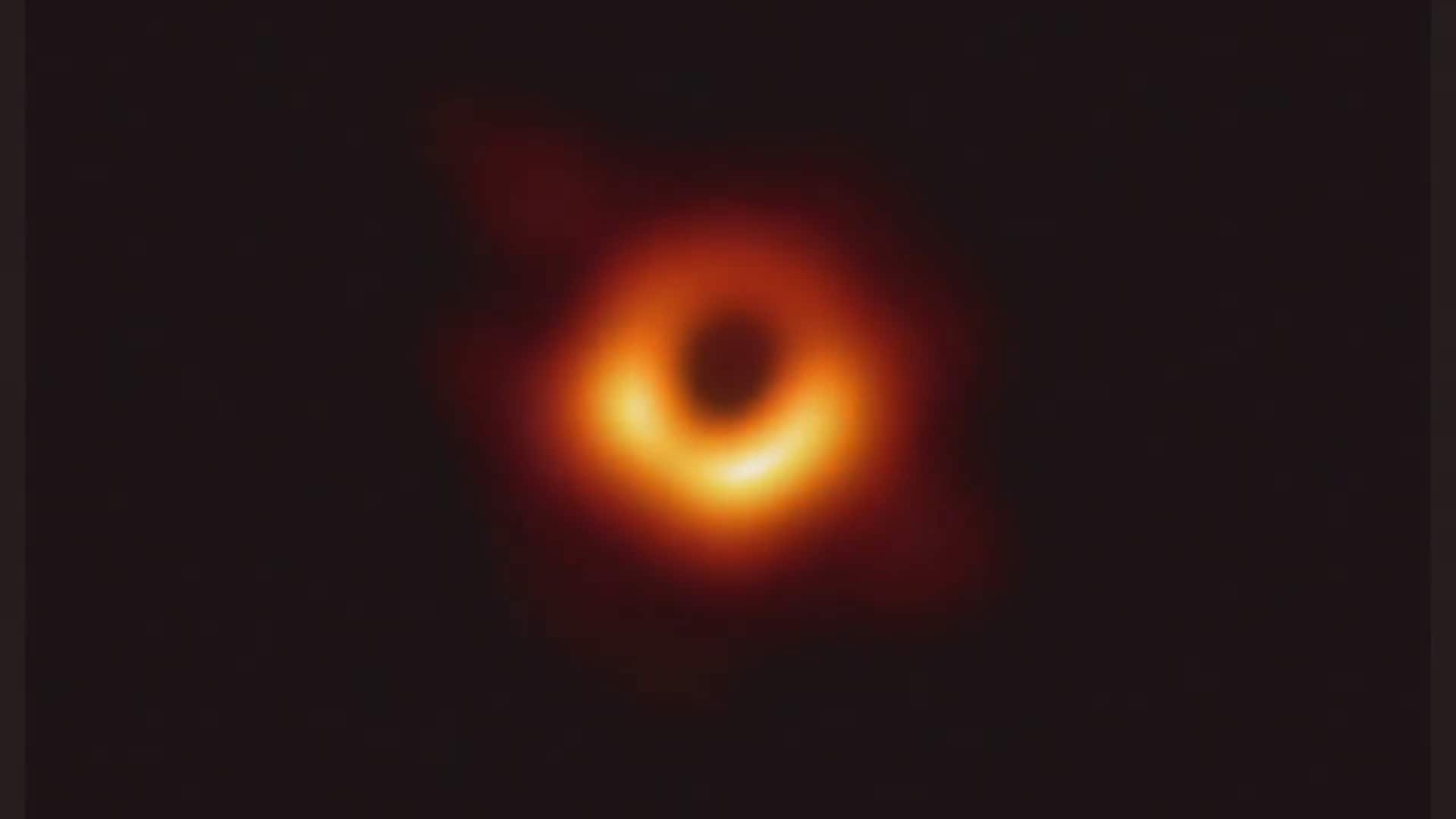
Black hole event horizon: This is the first image of a black hole captured using a global network of telescopes
The Event Horizon Telescope (EHT) project studied the black hole at the center of the Messier 87 galaxy.

An international scientific team on Wednesday announced a milestone in astrophysics — the first-ever photo of a black hole — using a global network of telescopes to gain insight into celestial objects with gravitational fields so strong no matter or light can escape.[caption id="attachment_6424421" align="alignnone" width="1920"]![First ever image of a black hole.]() First ever image of a black hole.[/caption]The research was conducted by the Event Horizon Telescope (EHT) project, an international collaboration begun in 2012 to try to directly observe the immediate environment of a black hole using a global network of Earth-based telescopes. The announcement was made in simultaneous news conferences in Washington, Brussels, Santiago, Shanghai, Taipei and Tokyo.The image reveals the black hole at the center of Messier 87, a massive galaxy in the nearby Virgo galaxy cluster. This black hole resides about 54 million light-years from Earth.Black holes, phenomenally dense celestial entities, are extraordinarily difficult to observe despite their great mass. A black hole’s event horizon is the point of no return beyond which anything - stars, planets, gas, dust and all forms of electromagnetic radiation - gets swallowed into oblivion.“This is a huge day in astrophysics,” said U.S. National Science Foundation Director France Córdova. “We’re seeing the unseeable.”The fact that black holes do not allow light to escape makes viewing them difficult. The scientists look for a ring of light - disrupted matter and radiation circling at tremendous speed at the edge of the event horizon - around a region of darkness representing the actual black hole. This is known as the black hole’s shadow or silhouette.The project’s researchers obtained the first data in April 2017 using telescopes in the U.S. states of Arizona and Hawaii as well as in Mexico, Chile, Spain and Antarctica. Since then, telescopes in France and Greenland have been added to the global network. The global network of telescopes has essentially created a planet-sized observational dish.Black hole event horizon: Also read
First ever image of a black hole.[/caption]The research was conducted by the Event Horizon Telescope (EHT) project, an international collaboration begun in 2012 to try to directly observe the immediate environment of a black hole using a global network of Earth-based telescopes. The announcement was made in simultaneous news conferences in Washington, Brussels, Santiago, Shanghai, Taipei and Tokyo.The image reveals the black hole at the center of Messier 87, a massive galaxy in the nearby Virgo galaxy cluster. This black hole resides about 54 million light-years from Earth.Black holes, phenomenally dense celestial entities, are extraordinarily difficult to observe despite their great mass. A black hole’s event horizon is the point of no return beyond which anything - stars, planets, gas, dust and all forms of electromagnetic radiation - gets swallowed into oblivion.“This is a huge day in astrophysics,” said U.S. National Science Foundation Director France Córdova. “We’re seeing the unseeable.”The fact that black holes do not allow light to escape makes viewing them difficult. The scientists look for a ring of light - disrupted matter and radiation circling at tremendous speed at the edge of the event horizon - around a region of darkness representing the actual black hole. This is known as the black hole’s shadow or silhouette.The project’s researchers obtained the first data in April 2017 using telescopes in the U.S. states of Arizona and Hawaii as well as in Mexico, Chile, Spain and Antarctica. Since then, telescopes in France and Greenland have been added to the global network. The global network of telescopes has essentially created a planet-sized observational dish.Black hole event horizon: Also read
 First ever image of a black hole.[/caption]The research was conducted by the Event Horizon Telescope (EHT) project, an international collaboration begun in 2012 to try to directly observe the immediate environment of a black hole using a global network of Earth-based telescopes. The announcement was made in simultaneous news conferences in Washington, Brussels, Santiago, Shanghai, Taipei and Tokyo.The image reveals the black hole at the center of Messier 87, a massive galaxy in the nearby Virgo galaxy cluster. This black hole resides about 54 million light-years from Earth.Black holes, phenomenally dense celestial entities, are extraordinarily difficult to observe despite their great mass. A black hole’s event horizon is the point of no return beyond which anything - stars, planets, gas, dust and all forms of electromagnetic radiation - gets swallowed into oblivion.“This is a huge day in astrophysics,” said U.S. National Science Foundation Director France Córdova. “We’re seeing the unseeable.”The fact that black holes do not allow light to escape makes viewing them difficult. The scientists look for a ring of light - disrupted matter and radiation circling at tremendous speed at the edge of the event horizon - around a region of darkness representing the actual black hole. This is known as the black hole’s shadow or silhouette.The project’s researchers obtained the first data in April 2017 using telescopes in the U.S. states of Arizona and Hawaii as well as in Mexico, Chile, Spain and Antarctica. Since then, telescopes in France and Greenland have been added to the global network. The global network of telescopes has essentially created a planet-sized observational dish.Black hole event horizon: Also read
First Published:Apr 10, 2019, 19:14:59 IST
Advertisement
Advertisement

Careless Whispers: Scientists discover that plants can 'talk' to each other using smells
Japanese scientists have recorded a video that shows plants, in certain conditions, communicate with each other using mists that carry smells. The discovery, reveals that plants release a fine mist of airborne compounds, to warn nearby plants of potential dangers
Life on Mars? European Space Agency’s Orbiter discovers ice water deposits at equator
European Space Agency's Mars Express Orbiter has identified massive ice and ice water deposits beneath the surface of Mars. The Mars Express orbiter was also the first to confirmed the presence of ice on Mars in 2004
Microsoft briefly overtakes Apple as the most valuable company, Apple back on top again
At its peak during the session, Microsoft's value reached $2.903 trillion, with a 2% surge. As of writing this article, Apple closed at $2.89 trillion, whereas Microsoft closed at $2.86 trillion
Even NASA is facing a tough time, starts layoffs following major budget cuts
NASA is facing some massive budget cuts, because of which, it has been forced to postpone some upcoming missions. NASA's Jet Propulsion Laboratory has been hit hard by recent federal budget cuts, resulting in the layoff of 100 contractors last week
ISRO, NASA's NISAR satellite to get ready by Jan-end, will monitor Earth's snow-covered regions
The NISAR satellite which has been developed jointly ISRO and NASA, should be ready for launch by the end of January 2024. The collaboration between NASA and ISRO on NISAR is the first time the two agencies have cooperated on hardware development for an Earth-observing mission
Advertisement
Advertisement