


Bizarre infant star with deformed disc could shed new light on planet formation
The young star could offer an explanation for misalignment in our universe, such as that of planetary orbits.


Artist’s impression of a warped disc around a protostar. ALMA observed the protostar IRAS04368+2557 in the dark cloud L1527 and discovered that the protostar has a disc with two misaligned parts. Credit: RIKEN[/caption]The team believes it could offer an explanation for asymmetry and misalignment in our universe, such as those of planetary orbits, for instance.The researchers, a group from both the RIKEN Cluster for Pioneering Research (CPR) and Chiba University in Japan, reported their findings in Nature. L1527, the protostar in question, is roughly 450 light years away from the Earth in the Taurus Molecular Cloud and is a particularly interesting object to study since its disc is angled perfectly along our line-of-sight.
"This observation shows that it is conceivable that the misalignment of planetary orbits can be caused by a warped structure formed in the earliest stages of planetary formation," Nami Sakai, lead researcher in the group from the RIKEN Cluster for Pioneering Research (CPR) and Chiba University in Japan, told Daily Mail. "We will have to investigate more systems to find out if this is a common phenomenon or not."[caption id="attachment_5820861" align="alignnone" width="1280"]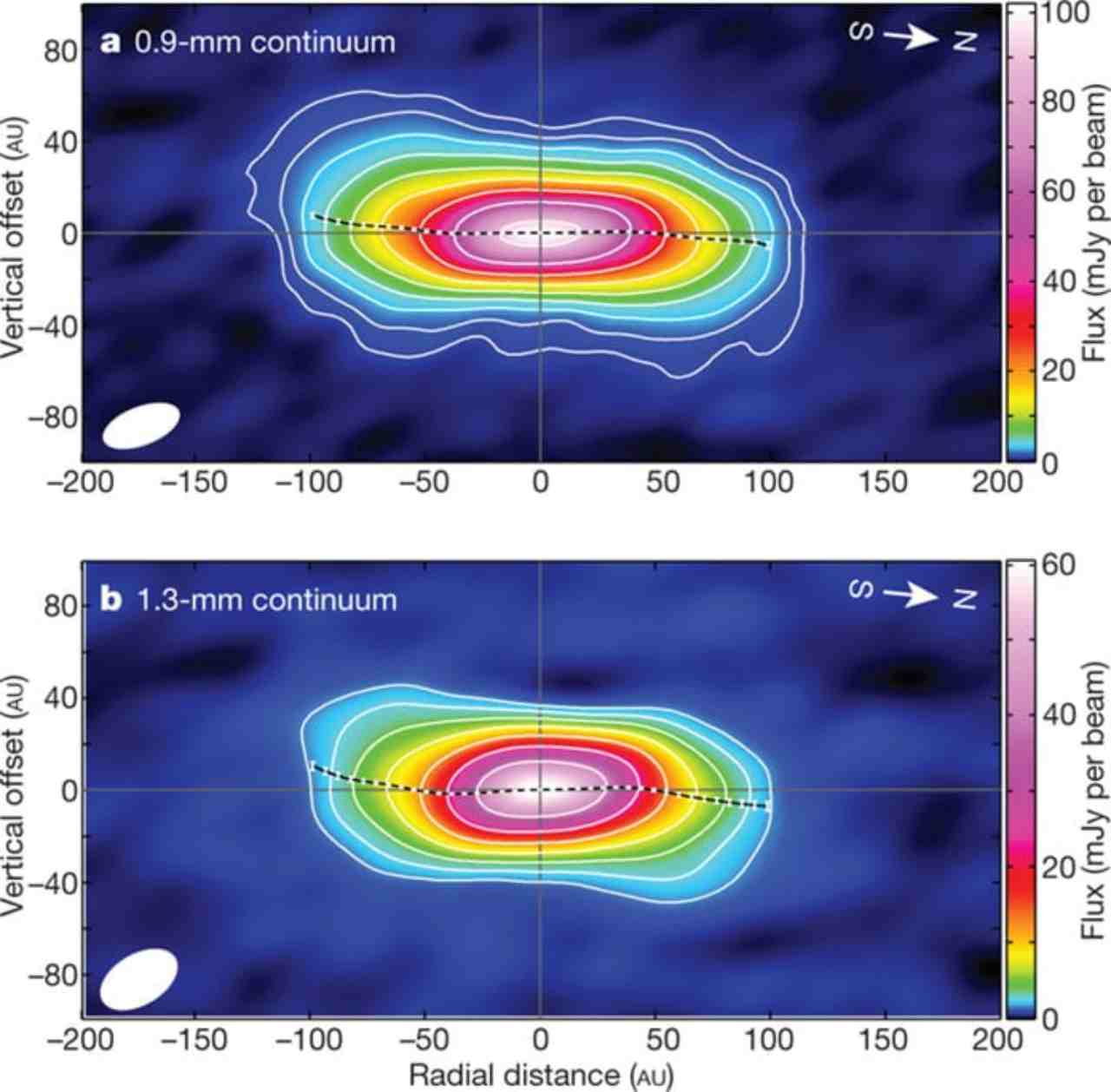
The infant-disc system around IRAS 04368+2557 as seen by ALMA, also called a dust-continuum emission. Image courtesy: Nature/Sakai et al.[/caption]The second key takeaway from their study was the reason for the distortion in the first place – the factor or force that causes the disc of the young star to warp.
"One possibility," Sakai says, "is that irregularities in the flow of gas and dust in the protostellar cloud are still preserved and manifest themselves as the warped disc."
The second theory is that the star's rotational disc and its magnetic field are on different planes. This would mean that while the inner disc around the star is being pulled in one direction, the rest of the disc rotates in another direction due to the star's magnetic field.
The researchers continue to work on observations from ALMA of the protostar to find out why the star's disc is warped.

Careless Whispers: Scientists discover that plants can 'talk' to each other using smells
Life on Mars? European Space Agency’s Orbiter discovers ice water deposits at equator
Microsoft briefly overtakes Apple as the most valuable company, Apple back on top again
Even NASA is facing a tough time, starts layoffs following major budget cuts
ISRO, NASA's NISAR satellite to get ready by Jan-end, will monitor Earth's snow-covered regions