


Biggest asteroids to hit the moon in billion years recreated with sound, animation
Moon & Earth share similar bombardment histories — the numbers have been staring us right in the face.

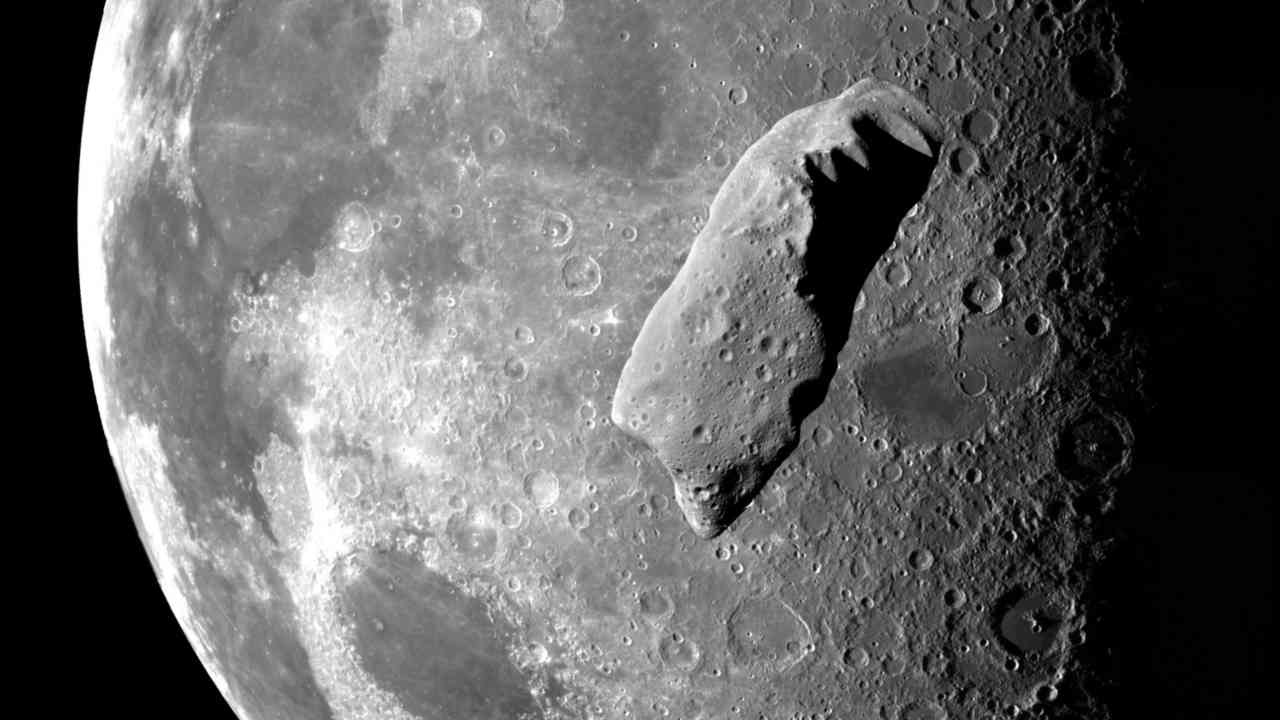
Artist's impression of the moon and a fly-by asteroid. Image courtesy: FederalLabs.org[/caption]"The moon is like a time capsule, helping us understand the Earth," William Bottke, a space scientist at the Southwest Research Institute, said in a press release. "We found that the moon shared a similar bombardment history, which meant the answer to Earth's impact rate was staring everyone right in the face."The team of researchers analyzed images taken by NASA's Lunar Reconnaissance Orbiter (LRO) to gauge how old these craters are. The study showed a total of 111 major impact sites over a period of 1 billion years.Their findings were that the biggest strikes over the first 700 million years of those billion left fewer craters, but big strikes were 260 percent more frequent in the last 300 million years. The team also found that wind and water on Earth probably didn't contribute to hiding as many impact sites as early astronomers had assumed and theorized."Earth has fewer older craters on stable terrains — not because of erosion, but because the impact rate was lower prior to 290 million years ago," Bottke said in the release.The surge is probably a temporary one, driven by the "breakup of one or more large asteroids in the inner and/or central main asteroid belt," the study reads.The findings could be an important step in the astronomy community's understanding of Earth's history and its complex link with life."Our findings also have implications for the history of life, which is punctuated by extinction events and rapid evolution of new species," Bottke said. "Though the forces driving these events are complicated, asteroid impacts have surely played a role in this ongoing saga."

Careless Whispers: Scientists discover that plants can 'talk' to each other using smells
Life on Mars? European Space Agency’s Orbiter discovers ice water deposits at equator
Microsoft briefly overtakes Apple as the most valuable company, Apple back on top again
Even NASA is facing a tough time, starts layoffs following major budget cuts
ISRO, NASA's NISAR satellite to get ready by Jan-end, will monitor Earth's snow-covered regions