


Astroscale signs contract with Rocket Lab to launch its orbital debris removal demo mission in 2023
The Electron rocket will launch the Active Debris Removal by Astroscale-Japan satellite for the first phase of JAXA's Commercial Removal of Debris Demonstration Project.

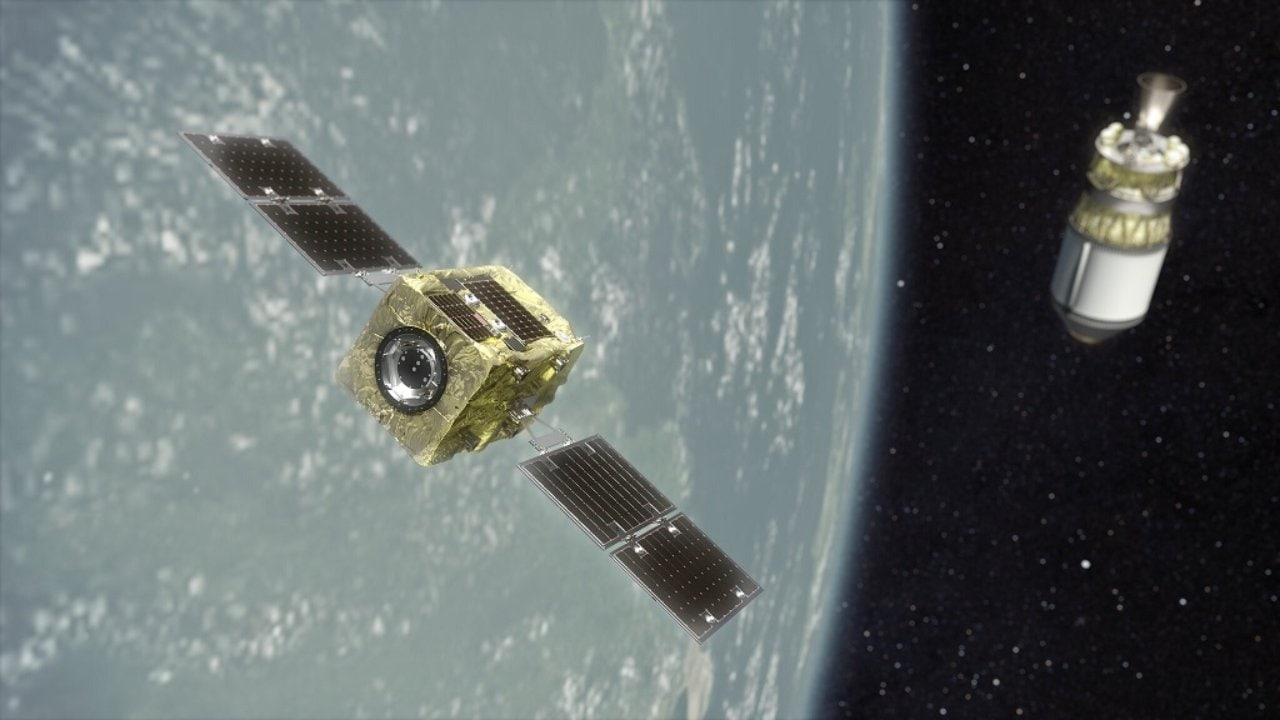
Illustration of Astroscale's orbital debris removal satellite. Image credit: Astroscale[/caption]Rocket Lab founder and Chief Executive Officer (CEO) Peter Beck said that the ability to remove space debris from orbit is likely to play a big role in creating a sustainable environment for the future. He added that the task is a complex one, which requires “absolute precision when it comes to orbital deployment. Electron’s Kick Stage has demonstrated this precision across 18 missions, providing in-space transportation to place our customers’ satellites exactly where they need to go”.After Electron’s Kick Stage deploys it to a precise orbit, the ADRAS-J satellite will rendezvous with a piece of orbital debris. It aims to demonstrate proximity operations, while obtaining pictures of the debris, an abandoned upper stage rocket body. The ADRAS-J will also deliver observational data to gain better knowledge of the debris environment.The second phase of the mission aims to show the de-orbit of the debris.Nobu Okada, Founder and CEO of Astroscale said that commercially viable and reliable vehicles like the Electron rocket will allow the company to advance its on-orbit services, which are crucial to the growth of the space economy and infrastructure.Last month, Astroscale had previously successfully demonstrated the removal of space debris through its End-of-Life Services by Astroscale-demonstration (ELSA-d) mission. The ELSA-d was successful in using a magnetic system for capturing and releasing a client spacecraft.The unused man-made junk revolving in the Earth’s orbit, also known as space debris, poses a risk of collision with other satellites.Astroscale is just one of the several companies working on the removal of this debris. The European Space Agency (ESA) got into a 86 million Euro contract with Swiss start-up ClearSpace SA in 2020 to bring back a large piece of orbital trash to the planet. The Clearspace-1 is scheduled to launch in 2025 to bring back the Vespa (Vega Secondary Payload Adapter), which itself was used to capture and release a satellite in 2013.

Careless Whispers: Scientists discover that plants can 'talk' to each other using smells
Life on Mars? European Space Agency’s Orbiter discovers ice water deposits at equator
Microsoft briefly overtakes Apple as the most valuable company, Apple back on top again
Even NASA is facing a tough time, starts layoffs following major budget cuts
ISRO, NASA's NISAR satellite to get ready by Jan-end, will monitor Earth's snow-covered regions