
Advertisement


Sections
Astrophysicist Neil deGrasse Tyson tweets about US election day asteroid approaching Earth on 2 Nov
The Asteroid 2018VP1 is currently flying at a speed more than 40,000 km per hour but isnt “big enough” to cause any harm.

A few days ago renowned astrophysicist Neil deGrasse Tyson sent out a word of warning, talking about a “refrigerator-sized space-rock” that was approaching Earth and was going to buzz-cut our planet on 2 November, the day before the US presidential elections.The tweet has managed to create curiosity among the netizens about the ‘Election Day Asteroid’ and the harm it might carry for us. Tyson, however, said that the Asteroid 2018VP1, which is currently flying at a speed more than 40,000 km per hour, is not “big enough” to cause harm. He then jokingly added that if the world somehow was going to end in 2020, it is not going to be the fault of the Universe.[caption id="attachment_8932731" align="alignnone" width="1280"]![scientists are saying that there is no reason for 2018VP1 to enjoy such buzz as asteroids this small hit the Earth several times per year. Image credit: ESA-ScienceOffice.org]()
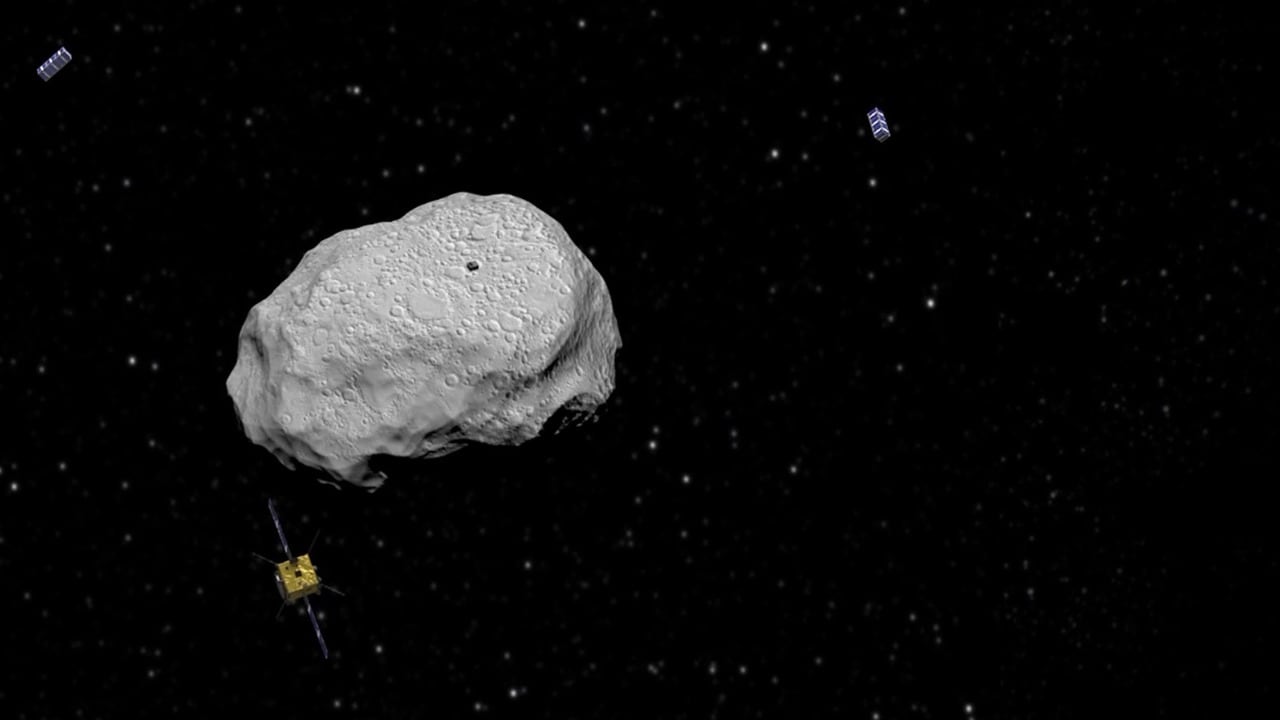
Scientists have said that there is no reason for 2018VP1 to enjoy such buzz as asteroids this small hit the Earth several times per year.
Image credit: ESA-ScienceOffice.org[/caption]Going by the track record of the wide-ranging damage brought upon us in 2020, many people believed that the ‘Election Day asteroid’ could bring about an end of life. But NASA has maintained that the space rock posed “no threat” to Earth. The 6.5 feet inch asteroid has a 0.41 per cent or one in 240 chance of entering our world’s atmosphere. But even if it did, there is still no apparent danger as 2018VP1 would “disintegrate due to its extremely small size”.Moreover, scientists are saying that there is no reason for 2018VP1 to enjoy such buzz as asteroids this small hit the Earth several times per year. Bill Bottke, director of the department of space studies at the Southwest Research Institute, added that we were lucky as we detected it before it made a close encounter.For comparison, the Chicxulub impactor that led to the sudden extinction of the dinosaurs from the planet some 66 million years ago, was nearly 10 km wide.The asteroid 2018VP1 was first discovered at the Palomar Observatory in California’s San Diego County in 2018 and hence the mention of the year in its name. NASA has detailed information catalogued for the asteroid in its JPL Small-Body Database Browser.
First Published:Oct 20, 2020, 13:06:05 IST
Advertisement
Advertisement

Careless Whispers: Scientists discover that plants can 'talk' to each other using smells
Japanese scientists have recorded a video that shows plants, in certain conditions, communicate with each other using mists that carry smells. The discovery, reveals that plants release a fine mist of airborne compounds, to warn nearby plants of potential dangers
Life on Mars? European Space Agency’s Orbiter discovers ice water deposits at equator
European Space Agency's Mars Express Orbiter has identified massive ice and ice water deposits beneath the surface of Mars. The Mars Express orbiter was also the first to confirmed the presence of ice on Mars in 2004
Microsoft briefly overtakes Apple as the most valuable company, Apple back on top again
At its peak during the session, Microsoft's value reached $2.903 trillion, with a 2% surge. As of writing this article, Apple closed at $2.89 trillion, whereas Microsoft closed at $2.86 trillion
Even NASA is facing a tough time, starts layoffs following major budget cuts
NASA is facing some massive budget cuts, because of which, it has been forced to postpone some upcoming missions. NASA's Jet Propulsion Laboratory has been hit hard by recent federal budget cuts, resulting in the layoff of 100 contractors last week
ISRO, NASA's NISAR satellite to get ready by Jan-end, will monitor Earth's snow-covered regions
The NISAR satellite which has been developed jointly ISRO and NASA, should be ready for launch by the end of January 2024. The collaboration between NASA and ISRO on NISAR is the first time the two agencies have cooperated on hardware development for an Earth-observing mission
Advertisement
Advertisement