


Are mindfulness and emotional intelligence the next frontiers in evolution of humankind and society?
On emotional intelligence, the science of mindfulness, and the many ways it can change the world – from one spiritual sceptic to another.

Did we evolved to be emotionally intelligent and mindful?
 Cutest puppy in the world. Image: Pinterest/MrWallpaper[/caption]Give the picture above a good, hard look.The cute puppers likely gave you a sense of “loving acceptance”. Few (or hopefully, none of us) would probably pick up a stick and give the puppy a beating. Instead, cute puppies often totter around the streets being showered with loving acceptance from all kinds of people… who make a sound characteristic of loving acceptance, which goes something like this: awwwwwwww!Let's say the puppy poops or pees somewhere inappropriate. While it may anger you, you’d still probably not pick up that stick. You’d instead quickly reason with yourself that the puppy is young, it’ll learn and that it doesn’t know any better. There’s a lot of perks to owning an attitude of accepting situations in life lovingly.Neither our thoughts nor our memories of life are factual. Both are coloured to varying degrees by our emotions. Our bad moods last longer than a fleeting minute or two because our thoughts are pretty negative at the time, and our outlook for the future seems equally dire. It’s the same for positivity and positive thoughts. Ultimately, our attitudes decide when we step out of a negative or positive bubble.In the workplace, something terrible often happens not when things are carefully thought and planned, but when someone is either hurt, humiliated or emotionally uncomfortable in some other way. Much of the emotional trappings that continue to affect us are the same things that have been plaguing humanity for eons. Problems with cooperation, war and love aren’t all that different from back when. But in the modern world, we have new ones.[caption id="attachment_7578821" align="alignnone" width="1280"]
 Social media addiction is gripping us in ways we don't realise and affects the bulk of today's digital natives.[/caption]One of them is the emotional stimulation we get from social media, where your social esteem is shaped by a lot of carefully thought-out feedback loops. A like will make you feel good. 50 likes make you feel even better. That millisecond of tension before opening an important email, that loop of checking our notifications on our go-to social media apps. 81 percent of employees in a large study forgot to breathe when they're reading their emails (8 in 10 people in every workplace in the world!) in an acknowledged, medically-recognised condition called email apnea.The anticipation and encouragement are part of a hormone hack into the dopamine network of the brain, teasing our natural craving for small self-esteem boosts through the day.
Have we no time for mental health?
In the meanwhile, mindfulness experts and psychologists around the world are tackling social media addiction with mindfulness and EQ tools. Acceptance from the society on issues affecting the mind, of addiction and the importance of sound mental health is going to decide whether the practice of mindfulness, which is currently a human experiment in self-improvement, grows and reaches everyone that needs it.There's still a long journey ahead for mental health in India, where the industry is simply too young and too small to matter in any tangible way. India's mental health budget was less than 1 percent of its total health budget for 2017. The cost of seeing a therapist or counselor weekly is undeniably high, but the more pressing challenge is the stigma and taboo that accompanies discussions on mental health.For reasons that are irrational and unfair, a mental health illness is treated on part with a mental disability by the large chunk of Indian society – with the same disdain and hopelessness. They're viewed as personal failings and not as a part and parcel of life – like bankruptcy in business. There are also very few new faces – the influential kind – that come around to discussing mental health on public forums. Many families in India are seeing the first generation of its members acknowledging a mental health problem and seeking help. For a country of 123 crore citizens, with some 80 crore (65 percent) below the age of 35, the want of understanding, accepting and treating mental health issues is a tragedy.[caption id="attachment_6411921" align="alignnone" width="825"]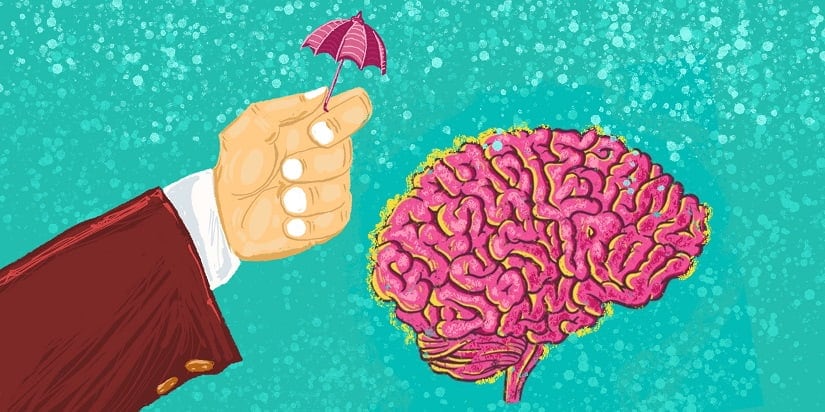
Illustration courtesy Satwik Gade[/caption]It’s okay not to be okay, but it’s okay to also seek help. On the preventive side, be positive and move on ahead when something bad happens. “When we deny our stories and disengage from tough emotions, they don't go away; instead, they own us, they define us,” Brene Brown.That said, there’s no doubt some progress – slow progress but some, stemming from the corporate sector. New companies are building mindful workplaces, and others are adapting to workplaces where employees are paid attention to, are less conflicted, and more capable to support the company and each other as and when needed.But the journey to discovering mindfulness in any aspect of your life starts with something small, and something that benefits you. Maybe observe the differences in how you react the next time you hear surprising news vs how you respond to it. Even something as virtuous as compassion starts with yourself.Some resources to get you started on a mindful journey:The Free Mindfulness ProjectMindfulness, Awareness and Compassion & forms of meditation: What is good for what?University of Chicago–Sand Diego Mindfulness ResourcesMindfulness-Based Stress Reduction Exercises and Courses

Careless Whispers: Scientists discover that plants can 'talk' to each other using smells
Life on Mars? European Space Agency’s Orbiter discovers ice water deposits at equator
Microsoft briefly overtakes Apple as the most valuable company, Apple back on top again
Even NASA is facing a tough time, starts layoffs following major budget cuts
ISRO, NASA's NISAR satellite to get ready by Jan-end, will monitor Earth's snow-covered regions