


After taking a nap, China's Chang'e-4 probe resumes work for 24th lunar day
The lander woke up at 12.42 am IST (3.12 am Beijing time) on Tuesday while the rover Yutu-2 woke up at 7.47 am IST (10.17 am Beijing time) on Monday.

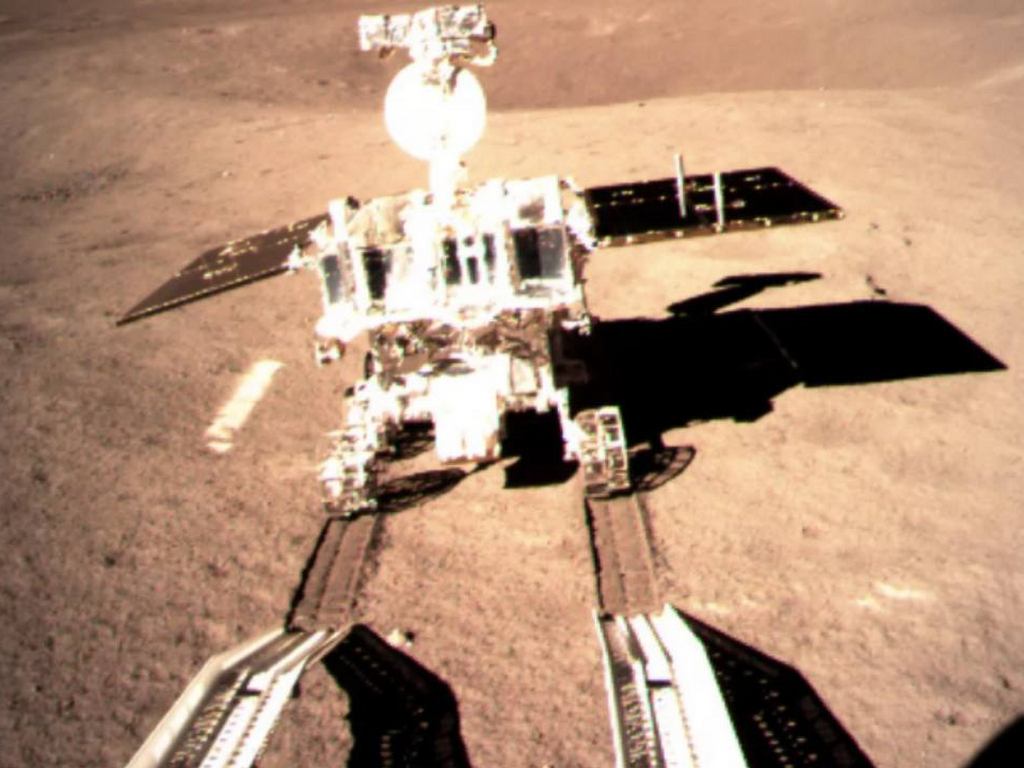
China's Jade Rabbit-2 rover making its first wheel tracks on the far side of the moon on 3 January, 2019, after rolling down from the Chang'e 4 lander. Image courtesy: CNSA[/caption]The report added that one lunar day is equal to 14 Earth days, while lunar nights are the same as Earth nights. As the Chang'e-4 probe runs on solar energy it goes into a dormant mode during the nights. Thus, as a lunar day approaches, the lander and the rover have to wake up to continue their research studies on the far side of the moon.The rover Yutu-2, also known as Jade Rabbit-2, is set to move northwest during the 24th lunar day to explore the basalt area or the impact craters with high reflectivity. Here, it will take “at least one panoramic photo, and its infrared imaging spectrometer, neutral atom detector and lunar radar will continue to carry out scientific explorations”.The report brushed upon the importance of data collected by the Chang'e-4 probe as Chinese scientists have found that the characteristics of mafic components in the South Pole-Aitken basin are similar to remote sensing results using the probe's detection of ejecta.The research conducted by the probe has helped scientists understand the basis of mafic anomaly found in the South Pole-Aitken basin of the moon. The entire research and its result can be accessed from the journal Science China Information Sciences.The probe had woken up in September for its work on the 22nd lunar day. The aim of the rover was marching to the northwest side of the moon even then.

Careless Whispers: Scientists discover that plants can 'talk' to each other using smells
Life on Mars? European Space Agency’s Orbiter discovers ice water deposits at equator
Microsoft briefly overtakes Apple as the most valuable company, Apple back on top again
Even NASA is facing a tough time, starts layoffs following major budget cuts
ISRO, NASA's NISAR satellite to get ready by Jan-end, will monitor Earth's snow-covered regions