
Advertisement


Sections
A mysterious cosmic flare, 'the cow' might just be the birth of a black hole
Scientists also think that the flare could be a monster black hole shredding a passing star.

Black holes are perhaps the most mysterious things in the universe; science fiction scenarios that use a black hole as a portal to another dimension are always exciting and full of wonder. The birth of one might have happened in a sudden flash last summer.A very unusual flare which was spotted in the night sky last summer, on 16 June 2018, stunned and excited scientists, and they're wondering now that the explosion might have just given birth to a black hole or a neutron star.The flash has been named as "the Cow" because the auto-generated name was — AT2018cow ("The Cow" has the same last three letters from the official name). The Cow, according to NASA, is unlike any celestial outburst ever seen in history.[caption id="attachment_5879541" align="alignnone" width="1024"]![A look at The Cow (approximately 80 days after explosion) from the W.M. Keck Observatory in Maunakea, Hawaii. The Cow is nestled in the CGCG 137-068 galaxy, 200 million light years from Earth. Credit: Raffaella Margutti/Northwestern University]() A look at The Cow (approximately 80 days after explosion) from the WM Keck Observatory in Maunakea, Hawaii. Image: Northwestern University[/caption]The flare was registered by astronomers using the ATLAS or the Asteroid Terrestrial-impact Last Alert System. ATLAS is a robotic astronomical survey and early-warning system for detecting smaller near-Earth objects, which is funded by NASA. It was developed and is being operated by the University of Hawaii's Institute for Astronomy,The flare occurred near a star-forming spiral galaxy known as the CGCG 137-068, which is 200 million light years away from us, which is relatively close to us, according to astronomers. Just as fast as it appeared, it also vanished.[caption id="attachment_5879851" align="alignnone" width="1280"]
A look at The Cow (approximately 80 days after explosion) from the WM Keck Observatory in Maunakea, Hawaii. Image: Northwestern University[/caption]The flare was registered by astronomers using the ATLAS or the Asteroid Terrestrial-impact Last Alert System. ATLAS is a robotic astronomical survey and early-warning system for detecting smaller near-Earth objects, which is funded by NASA. It was developed and is being operated by the University of Hawaii's Institute for Astronomy,The flare occurred near a star-forming spiral galaxy known as the CGCG 137-068, which is 200 million light years away from us, which is relatively close to us, according to astronomers. Just as fast as it appeared, it also vanished.[caption id="attachment_5879851" align="alignnone" width="1280"]![AT2018cow erupted in or near a galaxy known as CGCG 137-068. Image: Sloan Digital Sky Survey]() AT2018cow erupted in or near a galaxy known as CGCG 137-068. Image: Sloan Digital Sky Survey[/caption]So what is "the Cow" more than just an unusual flare?Currently, two groups are working on their respective papers to provide explanations for what "the Cow" truly is and its origins. NASA says that the two groups are using data from multiple missions.One of the two papers says that it is "monster black hole shredding a passing star."The second paper wonders that it is a "supernova, a stellar explosion, that gave birth to a black hole or a neutron star."Monster black hole shredding a passing starAccording to one of the research teams, the Cow is a star that has been ripped apart. This phenomenon is scientifically known as the 'tidal disruption event.' It occurs when a star gets close enough to a supermassive black hole that it is pulled apart by the black hole and shredded.Here's a video of what scientists think happens when a black hole tears apart a hot, dense white dwarf star.The paper was co-authored by Amy Lien, who is an assistant research scientist at the University of Maryland, Baltimore County and NASA's Goddard Space Flight Center in Greenbelt, Maryland. "We've never seen anything exactly like the Cow, which is very exciting," said Lien.Lien along with her team think that the shredded star is roughly the size of the earth, and was making its way to reach the final state of stars.Birth to a black hole or a neutron starA team at the Northwestern University, on the other hand, through their investigation think that the incredibly bright object that burst in the northern sky might actually be a black hole or neutron star.[caption id="attachment_5879821" align="alignnone" width="1280"]
AT2018cow erupted in or near a galaxy known as CGCG 137-068. Image: Sloan Digital Sky Survey[/caption]So what is "the Cow" more than just an unusual flare?Currently, two groups are working on their respective papers to provide explanations for what "the Cow" truly is and its origins. NASA says that the two groups are using data from multiple missions.One of the two papers says that it is "monster black hole shredding a passing star."The second paper wonders that it is a "supernova, a stellar explosion, that gave birth to a black hole or a neutron star."Monster black hole shredding a passing starAccording to one of the research teams, the Cow is a star that has been ripped apart. This phenomenon is scientifically known as the 'tidal disruption event.' It occurs when a star gets close enough to a supermassive black hole that it is pulled apart by the black hole and shredded.Here's a video of what scientists think happens when a black hole tears apart a hot, dense white dwarf star.The paper was co-authored by Amy Lien, who is an assistant research scientist at the University of Maryland, Baltimore County and NASA's Goddard Space Flight Center in Greenbelt, Maryland. "We've never seen anything exactly like the Cow, which is very exciting," said Lien.Lien along with her team think that the shredded star is roughly the size of the earth, and was making its way to reach the final state of stars.Birth to a black hole or a neutron starA team at the Northwestern University, on the other hand, through their investigation think that the incredibly bright object that burst in the northern sky might actually be a black hole or neutron star.[caption id="attachment_5879821" align="alignnone" width="1280"]![The progression of a cosmic event nicknamed]() The progression of a cosmic event nicknamed "the Cow," as seen in these three images. Image: NASA[/caption]“We think that ‘The Cow’ is the formation of an accreting black hole or neutron star. We know from theory that black holes and neutron stars form when a star dies, but we’ve never seen them right after they are born. Never,” said Northwestern’s Raffaella Margutti, who led the research.
The progression of a cosmic event nicknamed "the Cow," as seen in these three images. Image: NASA[/caption]“We think that ‘The Cow’ is the formation of an accreting black hole or neutron star. We know from theory that black holes and neutron stars form when a star dies, but we’ve never seen them right after they are born. Never,” said Northwestern’s Raffaella Margutti, who led the research.
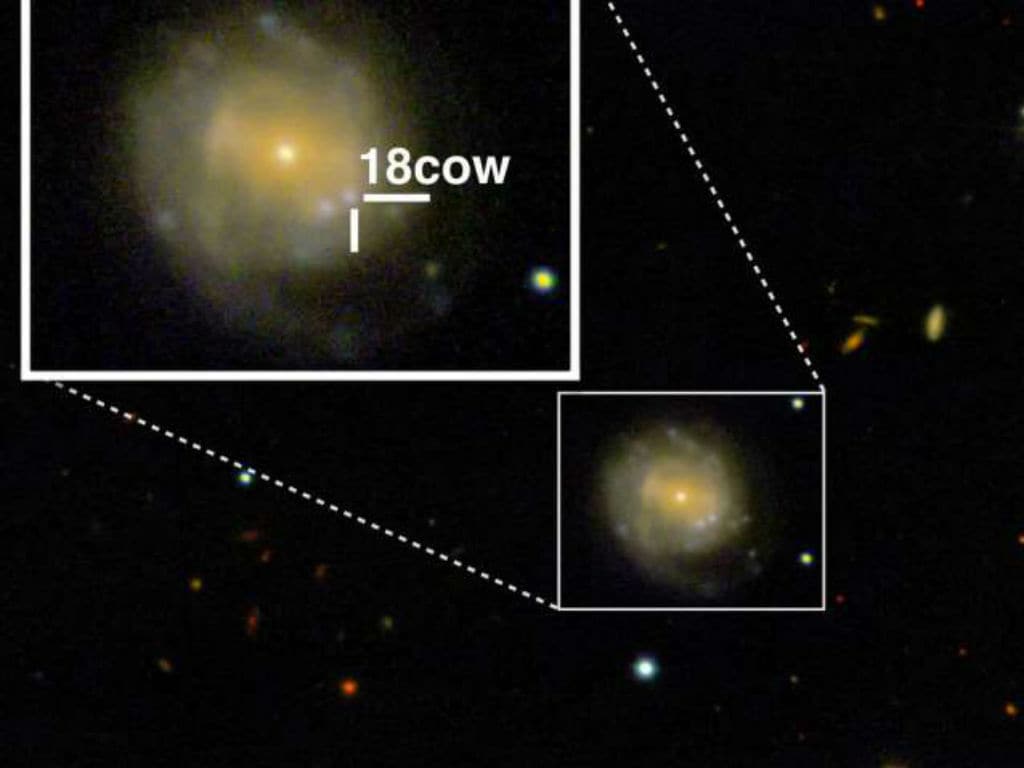 A look at The Cow (approximately 80 days after explosion) from the WM Keck Observatory in Maunakea, Hawaii. Image: Northwestern University[/caption]The flare was registered by astronomers using the ATLAS or the Asteroid Terrestrial-impact Last Alert System. ATLAS is a robotic astronomical survey and early-warning system for detecting smaller near-Earth objects, which is funded by NASA. It was developed and is being operated by the University of Hawaii's Institute for Astronomy,The flare occurred near a star-forming spiral galaxy known as the CGCG 137-068, which is 200 million light years away from us, which is relatively close to us, according to astronomers. Just as fast as it appeared, it also vanished.[caption id="attachment_5879851" align="alignnone" width="1280"]
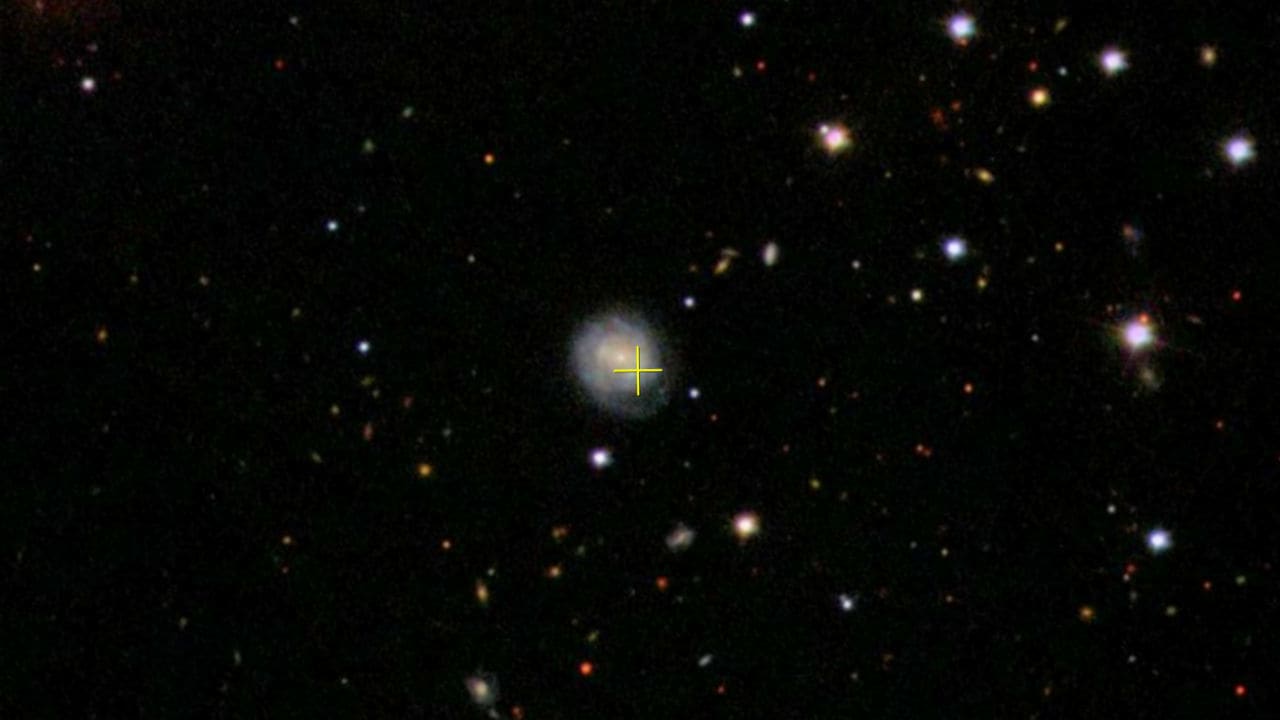 AT2018cow erupted in or near a galaxy known as CGCG 137-068. Image: Sloan Digital Sky Survey[/caption]So what is "the Cow" more than just an unusual flare?Currently, two groups are working on their respective papers to provide explanations for what "the Cow" truly is and its origins. NASA says that the two groups are using data from multiple missions.One of the two papers says that it is "monster black hole shredding a passing star."The second paper wonders that it is a "supernova, a stellar explosion, that gave birth to a black hole or a neutron star."Monster black hole shredding a passing starAccording to one of the research teams, the Cow is a star that has been ripped apart. This phenomenon is scientifically known as the 'tidal disruption event.' It occurs when a star gets close enough to a supermassive black hole that it is pulled apart by the black hole and shredded.Here's a video of what scientists think happens when a black hole tears apart a hot, dense white dwarf star.
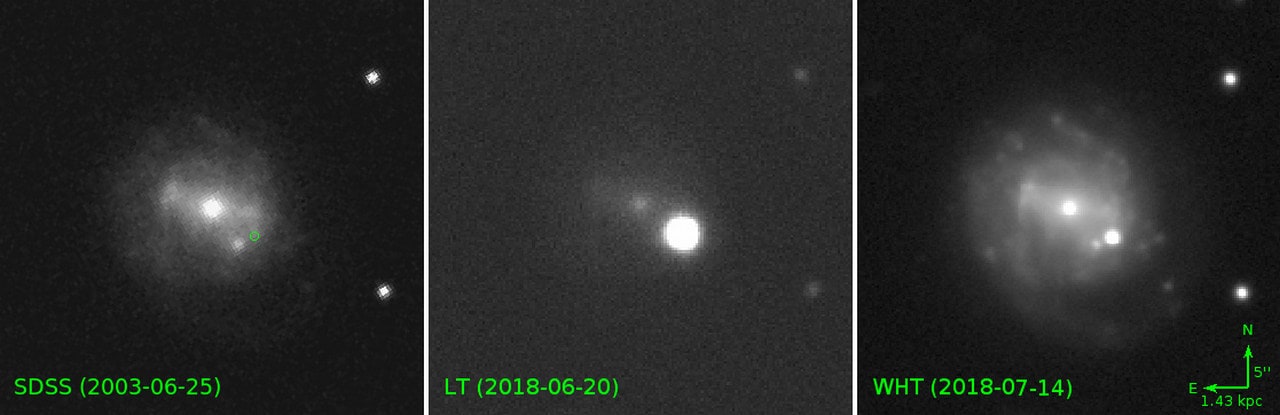 The progression of a cosmic event nicknamed "the Cow," as seen in these three images. Image: NASA[/caption]“We think that ‘The Cow’ is the formation of an accreting black hole or neutron star. We know from theory that black holes and neutron stars form when a star dies, but we’ve never seen them right after they are born. Never,” said Northwestern’s Raffaella Margutti, who led the research.
First Published:Jan 11, 2019, 18:21:20 IST
Advertisement
Advertisement

Careless Whispers: Scientists discover that plants can 'talk' to each other using smells
Japanese scientists have recorded a video that shows plants, in certain conditions, communicate with each other using mists that carry smells. The discovery, reveals that plants release a fine mist of airborne compounds, to warn nearby plants of potential dangers
Life on Mars? European Space Agency’s Orbiter discovers ice water deposits at equator
European Space Agency's Mars Express Orbiter has identified massive ice and ice water deposits beneath the surface of Mars. The Mars Express orbiter was also the first to confirmed the presence of ice on Mars in 2004
Microsoft briefly overtakes Apple as the most valuable company, Apple back on top again
At its peak during the session, Microsoft's value reached $2.903 trillion, with a 2% surge. As of writing this article, Apple closed at $2.89 trillion, whereas Microsoft closed at $2.86 trillion
Even NASA is facing a tough time, starts layoffs following major budget cuts
NASA is facing some massive budget cuts, because of which, it has been forced to postpone some upcoming missions. NASA's Jet Propulsion Laboratory has been hit hard by recent federal budget cuts, resulting in the layoff of 100 contractors last week
ISRO, NASA's NISAR satellite to get ready by Jan-end, will monitor Earth's snow-covered regions
The NISAR satellite which has been developed jointly ISRO and NASA, should be ready for launch by the end of January 2024. The collaboration between NASA and ISRO on NISAR is the first time the two agencies have cooperated on hardware development for an Earth-observing mission
Advertisement
Advertisement