
Advertisement


Sections
3D printed noise barrier blocks 94% of all sound passing through an open tube
The researchers have big ideas about how the material could work to make the real world quieter.

Scientists say that it is possible to silence noise using an open, ring-like structure, created to mathematically perfect specifications, for cutting out sounds while maintaining airflow.It is possible to silence noise using an open, ring-like structure, created to mathematically perfect specifications, for cutting out sounds while maintaining airflow, scientists say.Although noise-mitigating barricades, called sound baffles, can help drown out the whoosh of rush hour traffic or contain the symphony of music within concert hall walls, they are a clunky approach not well suited to situations where airflow is also critical, said researchers from Boston University in the US.In the study published in Physical Review B, they let mathematics guide them towards a workable design for what the acoustic metamaterial would look like.[caption id="attachment_6241171" align="alignnone" width="1280"]![Boston University engineers have built synthetic, sound-silencing structures —]() Boston University engineers have built synthetic, sound-silencing structures — "acoustic metamaterials" — that can block 94% of sounds. Reza Ghaffarivardavagh(front center) holds two of the open, ringlike structures over his ears while Stephan Anderson (left), Xin Zhang (rear center), and Jacob Nikolajczyk (right) make a racket. Image courtesy: Boston University[/caption]The researchers calculated the dimensions and specifications that the metamaterial would need to have in order to interfere with the transmitted sound waves, preventing sound — but not air — from being radiated through the open structure.The basic premise is that the metamaterial needs to be shaped in such a way that it sends incoming sounds back to where they came from, the researchers said.As a test case, they decided to create a structure that could silence sound from a loudspeaker. Based on their calculations, they modelled the physical dimensions that would most effectively silence noises. Bringing those models to life, they used 3D printing to materialise an open, noise-cancelling structure made of plastic.The researchers sealed the loudspeaker into one end of a polyvinyl chloride (PVC ) pipe.[caption id="attachment_6241181" align="alignnone" width="1280"]
Boston University engineers have built synthetic, sound-silencing structures — "acoustic metamaterials" — that can block 94% of sounds. Reza Ghaffarivardavagh(front center) holds two of the open, ringlike structures over his ears while Stephan Anderson (left), Xin Zhang (rear center), and Jacob Nikolajczyk (right) make a racket. Image courtesy: Boston University[/caption]The researchers calculated the dimensions and specifications that the metamaterial would need to have in order to interfere with the transmitted sound waves, preventing sound — but not air — from being radiated through the open structure.The basic premise is that the metamaterial needs to be shaped in such a way that it sends incoming sounds back to where they came from, the researchers said.As a test case, they decided to create a structure that could silence sound from a loudspeaker. Based on their calculations, they modelled the physical dimensions that would most effectively silence noises. Bringing those models to life, they used 3D printing to materialise an open, noise-cancelling structure made of plastic.The researchers sealed the loudspeaker into one end of a polyvinyl chloride (PVC ) pipe.[caption id="attachment_6241181" align="alignnone" width="1280"]![The mathematically-designed, 3D-printed acoustic metamaterial is shaped such that it sends incoming sounds back to where they came from. Image courtesy: Boston University]() The mathematically-designed, 3D-printed acoustic metamaterial is shaped such that it sends incoming sounds back to where they came from. Image courtesy: Boston University[/caption]On the other end, the tailor-made acoustic metamaterial was fastened into the opening, said Xin Zhang, a professor at Boston University. With the hit of the play button, the experimental loudspeaker set-up came to life in the lab. Standing in the room, based on your sense of hearing alone, you’d never know that the loudspeaker was blasting an irritatingly high-pitched note.If, however, you peered into the PVC pipe, you would see the loudspeaker’s subwoofers thrumming away.The metamaterial, ringing around the internal perimeter of the pipe’s mouth, worked like a mute button incarnate until the moment when researchers reached down and pulled it free.The lab suddenly echoed with the screeching of the loudspeaker’s tune.“The moment we first placed and removed the silencer…was literally night and day,” said Jacob Nikolajczyk, a study co author and former undergraduate researcher in Zhang’s lab.“We had been seeing these sorts of results in our computer modelling for months — but it is one thing to see modelled sound pressure levels on a computer, and another to hear its impact yourself,” Nikolajczyk said.By comparing sound levels with and without the metamaterial fastened in place, the team found that they could silence nearly all — 94 per cent to be exact — of the noise, making the sounds emanating from the loudspeaker imperceptible to the human ear.The researchers have some big ideas about how their acoustic-silencing metamaterial could go to work making the real world quieter.“Drones are a very hot topic. Companies like Amazon are interested in using drones to deliver goods, she says, and “people are complaining about the potential noise,” Zhang said.
The mathematically-designed, 3D-printed acoustic metamaterial is shaped such that it sends incoming sounds back to where they came from. Image courtesy: Boston University[/caption]On the other end, the tailor-made acoustic metamaterial was fastened into the opening, said Xin Zhang, a professor at Boston University. With the hit of the play button, the experimental loudspeaker set-up came to life in the lab. Standing in the room, based on your sense of hearing alone, you’d never know that the loudspeaker was blasting an irritatingly high-pitched note.If, however, you peered into the PVC pipe, you would see the loudspeaker’s subwoofers thrumming away.The metamaterial, ringing around the internal perimeter of the pipe’s mouth, worked like a mute button incarnate until the moment when researchers reached down and pulled it free.The lab suddenly echoed with the screeching of the loudspeaker’s tune.“The moment we first placed and removed the silencer…was literally night and day,” said Jacob Nikolajczyk, a study co author and former undergraduate researcher in Zhang’s lab.“We had been seeing these sorts of results in our computer modelling for months — but it is one thing to see modelled sound pressure levels on a computer, and another to hear its impact yourself,” Nikolajczyk said.By comparing sound levels with and without the metamaterial fastened in place, the team found that they could silence nearly all — 94 per cent to be exact — of the noise, making the sounds emanating from the loudspeaker imperceptible to the human ear.The researchers have some big ideas about how their acoustic-silencing metamaterial could go to work making the real world quieter.“Drones are a very hot topic. Companies like Amazon are interested in using drones to deliver goods, she says, and “people are complaining about the potential noise,” Zhang said.
 Boston University engineers have built synthetic, sound-silencing structures — "acoustic metamaterials" — that can block 94% of sounds. Reza Ghaffarivardavagh(front center) holds two of the open, ringlike structures over his ears while Stephan Anderson (left), Xin Zhang (rear center), and Jacob Nikolajczyk (right) make a racket. Image courtesy: Boston University[/caption]The researchers calculated the dimensions and specifications that the metamaterial would need to have in order to interfere with the transmitted sound waves, preventing sound — but not air — from being radiated through the open structure.The basic premise is that the metamaterial needs to be shaped in such a way that it sends incoming sounds back to where they came from, the researchers said.As a test case, they decided to create a structure that could silence sound from a loudspeaker. Based on their calculations, they modelled the physical dimensions that would most effectively silence noises. Bringing those models to life, they used 3D printing to materialise an open, noise-cancelling structure made of plastic.The researchers sealed the loudspeaker into one end of a polyvinyl chloride (PVC ) pipe.[caption id="attachment_6241181" align="alignnone" width="1280"]
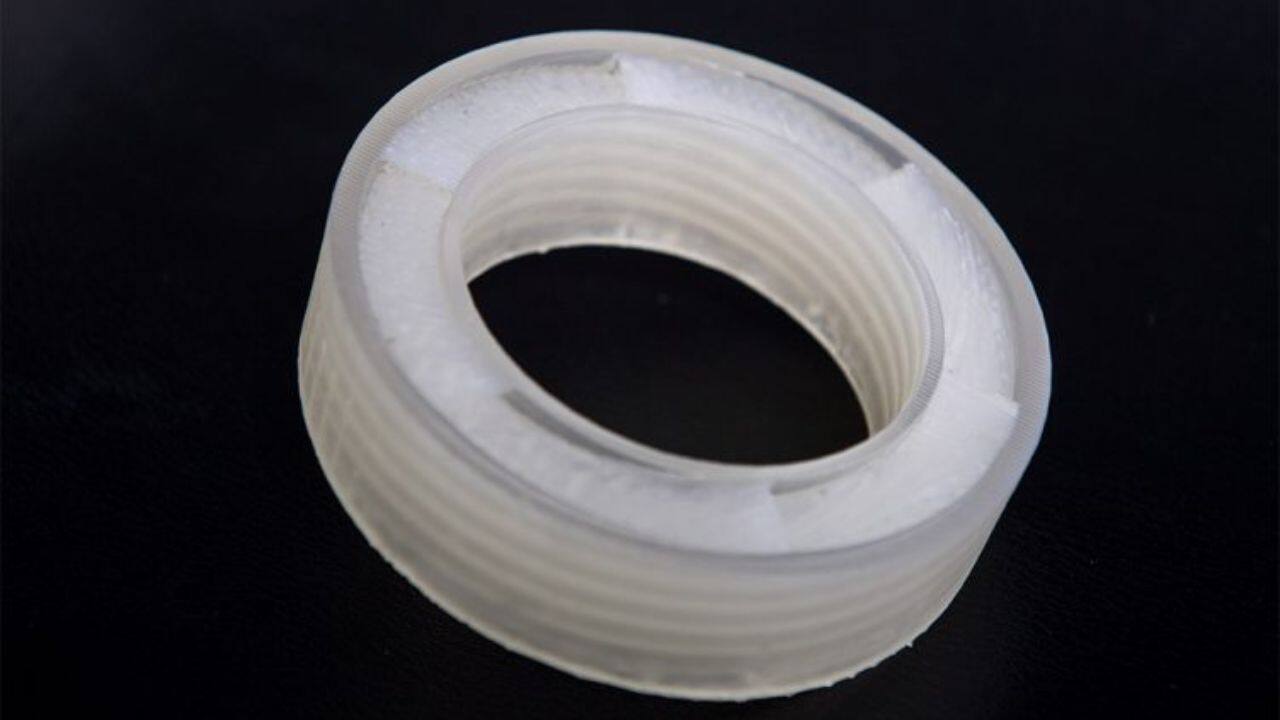 The mathematically-designed, 3D-printed acoustic metamaterial is shaped such that it sends incoming sounds back to where they came from. Image courtesy: Boston University[/caption]On the other end, the tailor-made acoustic metamaterial was fastened into the opening, said Xin Zhang, a professor at Boston University. With the hit of the play button, the experimental loudspeaker set-up came to life in the lab. Standing in the room, based on your sense of hearing alone, you’d never know that the loudspeaker was blasting an irritatingly high-pitched note.If, however, you peered into the PVC pipe, you would see the loudspeaker’s subwoofers thrumming away.The metamaterial, ringing around the internal perimeter of the pipe’s mouth, worked like a mute button incarnate until the moment when researchers reached down and pulled it free.The lab suddenly echoed with the screeching of the loudspeaker’s tune.
First Published:Mar 12, 2019, 08:35:53 IST
Advertisement
Advertisement

Careless Whispers: Scientists discover that plants can 'talk' to each other using smells
Japanese scientists have recorded a video that shows plants, in certain conditions, communicate with each other using mists that carry smells. The discovery, reveals that plants release a fine mist of airborne compounds, to warn nearby plants of potential dangers
Life on Mars? European Space Agency’s Orbiter discovers ice water deposits at equator
European Space Agency's Mars Express Orbiter has identified massive ice and ice water deposits beneath the surface of Mars. The Mars Express orbiter was also the first to confirmed the presence of ice on Mars in 2004
Microsoft briefly overtakes Apple as the most valuable company, Apple back on top again
At its peak during the session, Microsoft's value reached $2.903 trillion, with a 2% surge. As of writing this article, Apple closed at $2.89 trillion, whereas Microsoft closed at $2.86 trillion
Even NASA is facing a tough time, starts layoffs following major budget cuts
NASA is facing some massive budget cuts, because of which, it has been forced to postpone some upcoming missions. NASA's Jet Propulsion Laboratory has been hit hard by recent federal budget cuts, resulting in the layoff of 100 contractors last week
ISRO, NASA's NISAR satellite to get ready by Jan-end, will monitor Earth's snow-covered regions
The NISAR satellite which has been developed jointly ISRO and NASA, should be ready for launch by the end of January 2024. The collaboration between NASA and ISRO on NISAR is the first time the two agencies have cooperated on hardware development for an Earth-observing mission
Advertisement
Advertisement