


18,000-year-old pre-historic puppy unearthed from Russia's permafrost, completely intact
As the permafrost in Russia melts due to climate change the remains of many animals have been revealed.

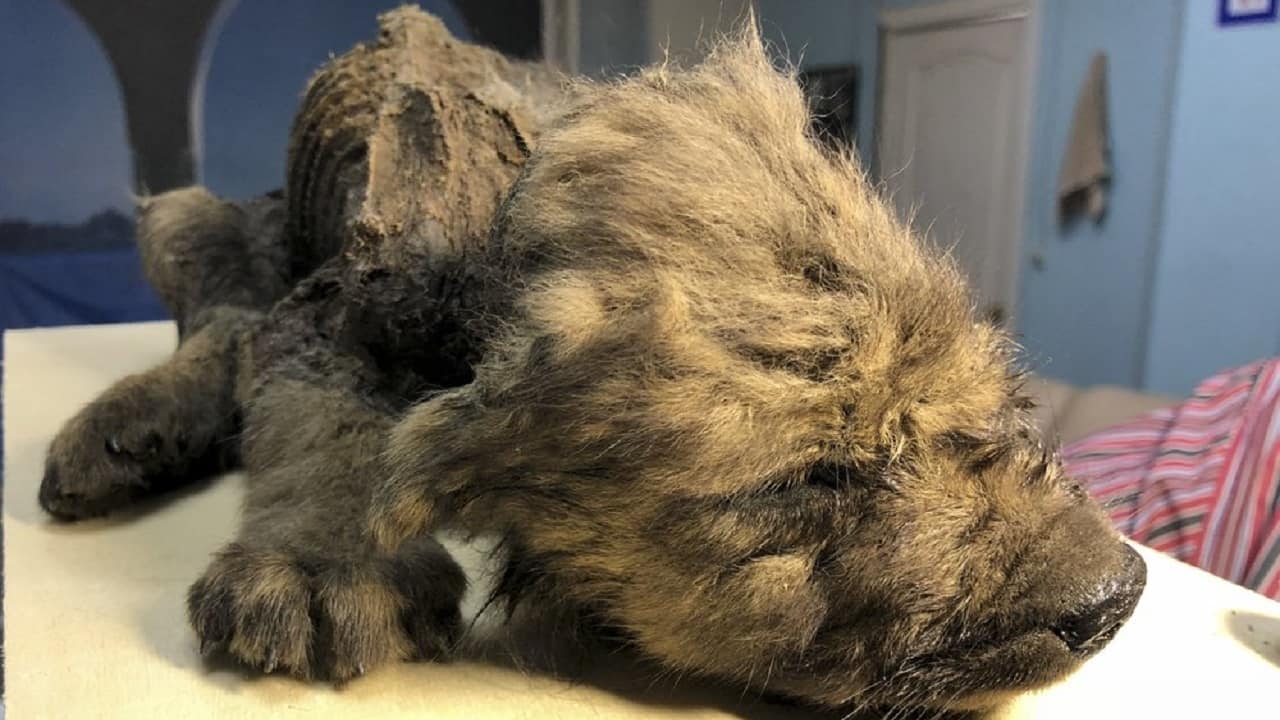
The 18,000 years old puppy found in permafrost in Russia's Far East, on display at the Yakutsk's Mammoth Museum, Russia. Image credit AP[/caption]In recent years, Russia’s Far East has provided many riches for scientists studying the remains of ancient animals. As the permafrost melts, affected by climate change, more and more parts of woolly mammoths, canines and other prehistoric animals are being discovered. Often it is mammoth tusk hunters who discover them.“Why has Yakutia come through a real spate of such unique findings over the last decade? First, it’s global warming. It really exists, we feel it, and local people feel it strongly. Winter comes later, spring comes earlier,” Sergei Fyodorov, a scientist with the North-Eastern Federal University, told The Associated Press. “And the second very serious, deep reason, of why there are a lot of finds is the very high price of a mammoth tusk in the Chinese market.”When the puppy was discovered, scientists from the Stockholm-based Center for Palaeogenetics took a piece of bone to study its DNA.“The first step was, of course, to send the sample to radiocarbon dating to see how old it was and when we got the results back it turned out that it was roughly 18,000 years old,” Love Dalén, professor of evolutionary genetics at the centre, said in an online interview.Further tests, however, left the scientists with more questions than answers — they couldn’t definitively tell whether it was a dog or a wolf.“We have now generated a nearly complete genome sequence from it and normally when you have a two-fold coverage genome, which is what we have, you should be able to relatively easily say whether it’s a dog or a wolf, but we still can’t say and that makes it even more interesting,” Dalén said.He added that the scientists are about to do a third round of genome sequencing, which might solve the mystery.

Careless Whispers: Scientists discover that plants can 'talk' to each other using smells
Life on Mars? European Space Agency’s Orbiter discovers ice water deposits at equator
Microsoft briefly overtakes Apple as the most valuable company, Apple back on top again
Even NASA is facing a tough time, starts layoffs following major budget cuts
ISRO, NASA's NISAR satellite to get ready by Jan-end, will monitor Earth's snow-covered regions