
Advertisement


Sections
Virtual reality can help you remember information better: Research
Researchers at University of Maryland found that people remember information better if it is presented to them in a virtual environment.

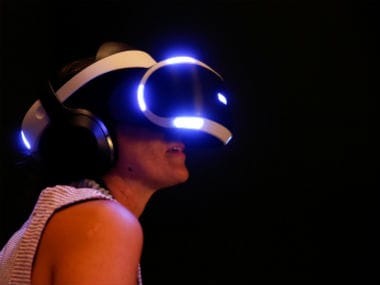
Not just gaming or entertainment, virtual reality (VR) can also help people recall information better as opposed to desktop computers, say researchers including one of Indian-origin.[caption id="attachment_4229959" align="alignleft" width="380"]![Representational image. Reuters.]() Representational image. Reuters.[/caption]The team from University of Maryland conducted in-depth analyses on whether people learn better through virtual, immersive environments, as opposed to more traditional platforms like a computers or tablets.They found that people remember information better if it is presented to them in a virtual environment."This data is exciting in that it suggests that immersive environments could offer new pathways for improved outcomes in education and high-proficiency training," said Amitabh Varshney, Professor of Computer Science, in a survey published in the journal Virtual Reality.Varshney leads several major research efforts involving virtual and augmented reality (AR), including close collaboration with health care professionals interested in developing AR-based diagnostic tools for emergency medicine and VR training for surgical residents.For the study, the team used the concept of a "memory palace," where people recall an object or item by placing it in an imaginary physical location like a building or town.This method has been used since classical times, taking advantage of the human brain's ability to spatially organize thoughts and memories."Humans have always used visual-based methods to help them remember information, whether it's cave drawings, clay tablets, printed text, and images, or video," said Eric Krokos, a doctoral student in computer science and lead author on the paper."We wanted to see if virtual reality might be the next logical step in this progression," Krokos added.For the study, the researchers recruited 40 volunteers unfamiliar with virtual reality and split the participants into two groups -- one viewed information first via a VR head-mounted display and then on a desktop and the other group did the opposite.The results showed an 8.8 percent improvement overall in recall accuracy using the VR headsets, a statistically significant number.Many of the participants said the immersive "presence" while using VR allowed them to focus better."This leads to the possibility that an immersive virtual environment could enhance learning and recall by leveraging a person's overall sense of body position, movement and acceleration," said Catherine Plaisant, Senior Research Scientist in University of Maryland Institute for Advanced Computer Studies.
Representational image. Reuters.[/caption]The team from University of Maryland conducted in-depth analyses on whether people learn better through virtual, immersive environments, as opposed to more traditional platforms like a computers or tablets.They found that people remember information better if it is presented to them in a virtual environment."This data is exciting in that it suggests that immersive environments could offer new pathways for improved outcomes in education and high-proficiency training," said Amitabh Varshney, Professor of Computer Science, in a survey published in the journal Virtual Reality.Varshney leads several major research efforts involving virtual and augmented reality (AR), including close collaboration with health care professionals interested in developing AR-based diagnostic tools for emergency medicine and VR training for surgical residents.For the study, the team used the concept of a "memory palace," where people recall an object or item by placing it in an imaginary physical location like a building or town.This method has been used since classical times, taking advantage of the human brain's ability to spatially organize thoughts and memories."Humans have always used visual-based methods to help them remember information, whether it's cave drawings, clay tablets, printed text, and images, or video," said Eric Krokos, a doctoral student in computer science and lead author on the paper."We wanted to see if virtual reality might be the next logical step in this progression," Krokos added.For the study, the researchers recruited 40 volunteers unfamiliar with virtual reality and split the participants into two groups -- one viewed information first via a VR head-mounted display and then on a desktop and the other group did the opposite.The results showed an 8.8 percent improvement overall in recall accuracy using the VR headsets, a statistically significant number.Many of the participants said the immersive "presence" while using VR allowed them to focus better."This leads to the possibility that an immersive virtual environment could enhance learning and recall by leveraging a person's overall sense of body position, movement and acceleration," said Catherine Plaisant, Senior Research Scientist in University of Maryland Institute for Advanced Computer Studies.
 Representational image. Reuters.[/caption]The team from University of Maryland conducted in-depth analyses on whether people learn better through virtual, immersive environments, as opposed to more traditional platforms like a computers or tablets.They found that people remember information better if it is presented to them in a virtual environment."This data is exciting in that it suggests that immersive environments could offer new pathways for improved outcomes in education and high-proficiency training," said Amitabh Varshney, Professor of Computer Science, in a survey published in the journal Virtual Reality.Varshney leads several major research efforts involving virtual and augmented reality (AR), including close collaboration with health care professionals interested in developing AR-based diagnostic tools for emergency medicine and VR training for surgical residents.For the study, the team used the concept of a "memory palace," where people recall an object or item by placing it in an imaginary physical location like a building or town.This method has been used since classical times, taking advantage of the human brain's ability to spatially organize thoughts and memories."Humans have always used visual-based methods to help them remember information, whether it's cave drawings, clay tablets, printed text, and images, or video," said Eric Krokos, a doctoral student in computer science and lead author on the paper.
First Published:Jun 15, 2018, 17:03:56 IST
Advertisement
Advertisement

Why AI notetakers are raising serious privacy and security concerns
AI notetakers promise effortless meeting summaries, but experts warn they could expose confidential conversations, corporate secrets and personal voiceprints. As businesses increasingly adopt AI-powered meeting assistants, questions over data storage, privacy, consent and legal risks are becoming impossible to ignore
5 min read
China's low-cost AI models are changing the global AI race. Here's why Silicon Valley is worried
As Chinese firms continue to improve performance while keeping prices low, the AI race is no longer just about building the smartest model—it is increasingly becoming a battle over who can deliver the best value
2 min read
China's Kimi K3 challenges US AI leaders with frontier-level performance at lower cost
Chinese artificial intelligence startup Moonshot AI has unveiled its latest open-weight AI model, Kimi K3, with early results suggesting it could compete with some of the world's most advanced AI systems developed by leading US companies
2 min read
How did Instagram run ads promoting child abuse in India?
India has issued a notice to Meta after an investigation alleged that Instagram displayed paid advertisements promoting child sexual abuse material. MeitY ordered Meta to remove such Instagram ads and explain within seven days how they were approved
8 min read
Why has India halted WhatsApp’s username feature before launch?
India has halted WhatsApp’s planned username feature, citing concerns about cybercrime, impersonation, and law enforcement challenges. As Meta races to address security concerns, here’s why MeitY has paused the rollout, what the feature does, and how it could influence privacy and online safety in India
3 min read
Advertisement
Advertisement