


US to keenly observe activity in space for potential risk as China increases activity in low Earth orbit
Last month, the Chinese space programme launched the final three modules of its Tiangong Space Station and stationed a crew of three astronauts for a brief period. China built its own space station with little to no help from any other country.

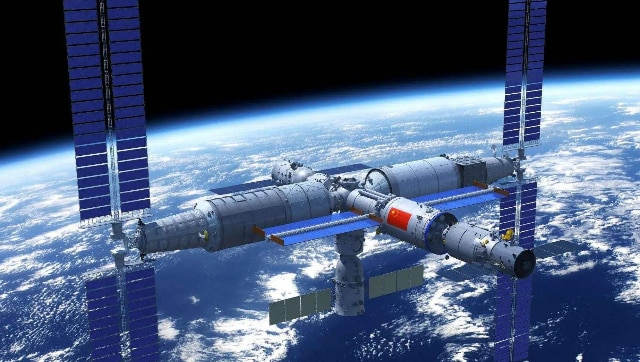
Last month, the Chinese space programme launched the final three modules of its Tiangong Space Station and stationed a crew of three astronauts for a brief period. China built its own space station with little to no help from any other country. Image Credit: Space.com[/caption]General Dickinson also cheered the overwhelming passage in the United Nations of a resolution that countries should not conduct direct-ascent antisatellite tests that create vast fields of space debris, which endanger satellites and space stations.Of the four countries that have conducted such ASAT tests, the United States was the only one that voted in favour, while China and Russia voted no and India abstained. Most of that debris lies in crucial low Earth orbit, which has become “congested, competitive and contested, said General Dickinson.The US Space Command is now tracking more than 48,000 objects in near Earth orbit, including satellites, telescopes, space stations and pieces of debris of all sizes, up from 25,000 just three years ago.The Chinese space program drew rare international criticism after it conducted an unannounced test in 2007 in which it used a missile to blow up a defunct Chinese satellite, creating debris that continues to pose a hazard.“Beijing believes that space is a very important piece to not only their economic or the global economic environment, but also the military environment, so we continue to watch that very closely as they continue to increase capabilities,” said General Dickinson. The Chinese space program, which is run by the ruling Communist Party’s military wing, the People’s Liberation Army, set up its own space station, in the hopes that other nations will abandon the ISS or the International Space Station, before it is decommissioned in 2031. Last month, the Chinese space programme launched the final three modules of its Tiangong Space Station and stationed a crew of three astronauts for a brief period. China built its own space station with little to no help from any other country.With U.S.-China tensions high over Taiwan, the South China Sea, trade and technology, space is increasingly becoming a potential flash point. In addition, the Pentagon last week released an annual China security report that warned Beijing would likely have 1,500 nuclear warheads by 2035, and that it has provided no clarity on how it plans to use them.“China continues to build capabilities that, really quite frankly, hold most of our assets at risk in the space domain,” Dickinson said.

Why AI notetakers are raising serious privacy and security concerns
China's low-cost AI models are changing the global AI race. Here's why Silicon Valley is worried
China's Kimi K3 challenges US AI leaders with frontier-level performance at lower cost
How did Instagram run ads promoting child abuse in India?
Why has India halted WhatsApp’s username feature before launch?