
Advertisement


Sections
UC San Diego researchers develop soft robotic gripper that can screw in a lightbulb
Researchers also are investigating using 3D printing for the grippers fingers to make them more durable.

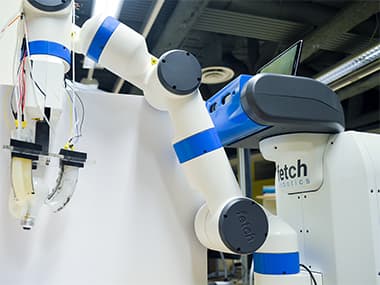
Scientists have built a new robotic gripper with soft fingers that can pick up and manipulate a range of objects and perform tasks such as screwing in a light bulb. The team from University of California (UC) San Diego in the US built the gripper that can pick up and manipulate objects without seeing them and needing to be trained. The gripper is unique because it brings together three different capabilities. It can twist objects; it can sense objects; and it can build models of the objects it is manipulating.[caption id="attachment_4133115" align="alignleft" width="380"]![The gripper. Image: UC San Diego]() The gripper. Image: UC San Diego[/caption]This allows the gripper to operate in low light and low visibility conditions, researchers said. They tested the gripper on an industrial robot and demonstrated that it could pick up, manipulate and model a wide range of objects, from lightbulbs to screwdrivers. "We designed the device to mimic what happens when you reach into your pocket and feel for your keys," said Michael T Tolley, a roboticist at UC San Diego.The gripper has three fingers. Each finger is made of three soft flexible pneumatic chambers, which move when air pressure is applied. This gives the gripper more than one degree of freedom, so it can actually manipulate the objects it is holding. For example, the gripper can turn screwdrivers, screw in lightbulbs and even hold pieces of paper, thanks to this design. In addition, each finger is covered with a smart, sensing skin. The skin is made of silicone rubber, where sensors made of conducting carbon nanotubes are embedded.The sheets of rubber are then rolled up, sealed and slipped onto the flexible fingers to cover them like skin. The conductivity of the nanotubes changes as the fingers flex, which allows the sensing skin to record and detect when the fingers are moving and coming into contact with an object. The data the sensors generate is transmitted to a control board, which puts the information together to create a 3D model of the object the gripper is manipulating.It is a process similar to a CT scan, where 2D image slices add up to a 3D picture. The breakthroughs were possible because of the teams diverse expertise and their experience in the fields of soft robotics and manufacturing, Tolley said. Next steps include adding machine learning and artificial intelligence to data processing so that the gripper will actually be able to identify the objects it is manipulating, rather than just model them.Researchers also are investigating using 3D printing for the grippers fingers to make them more durable.
The gripper. Image: UC San Diego[/caption]This allows the gripper to operate in low light and low visibility conditions, researchers said. They tested the gripper on an industrial robot and demonstrated that it could pick up, manipulate and model a wide range of objects, from lightbulbs to screwdrivers. "We designed the device to mimic what happens when you reach into your pocket and feel for your keys," said Michael T Tolley, a roboticist at UC San Diego.The gripper has three fingers. Each finger is made of three soft flexible pneumatic chambers, which move when air pressure is applied. This gives the gripper more than one degree of freedom, so it can actually manipulate the objects it is holding. For example, the gripper can turn screwdrivers, screw in lightbulbs and even hold pieces of paper, thanks to this design. In addition, each finger is covered with a smart, sensing skin. The skin is made of silicone rubber, where sensors made of conducting carbon nanotubes are embedded.The sheets of rubber are then rolled up, sealed and slipped onto the flexible fingers to cover them like skin. The conductivity of the nanotubes changes as the fingers flex, which allows the sensing skin to record and detect when the fingers are moving and coming into contact with an object. The data the sensors generate is transmitted to a control board, which puts the information together to create a 3D model of the object the gripper is manipulating.It is a process similar to a CT scan, where 2D image slices add up to a 3D picture. The breakthroughs were possible because of the teams diverse expertise and their experience in the fields of soft robotics and manufacturing, Tolley said. Next steps include adding machine learning and artificial intelligence to data processing so that the gripper will actually be able to identify the objects it is manipulating, rather than just model them.Researchers also are investigating using 3D printing for the grippers fingers to make them more durable.
 The gripper. Image: UC San Diego[/caption]This allows the gripper to operate in low light and low visibility conditions, researchers said. They tested the gripper on an industrial robot and demonstrated that it could pick up, manipulate and model a wide range of objects, from lightbulbs to screwdrivers. "We designed the device to mimic what happens when you reach into your pocket and feel for your keys," said Michael T Tolley, a roboticist at UC San Diego.The gripper has three fingers. Each finger is made of three soft flexible pneumatic chambers, which move when air pressure is applied. This gives the gripper more than one degree of freedom, so it can actually manipulate the objects it is holding. For example, the gripper can turn screwdrivers, screw in lightbulbs and even hold pieces of paper, thanks to this design. In addition, each finger is covered with a smart, sensing skin. The skin is made of silicone rubber, where sensors made of conducting carbon nanotubes are embedded.The sheets of rubber are then rolled up, sealed and slipped onto the flexible fingers to cover them like skin. The conductivity of the nanotubes changes as the fingers flex, which allows the sensing skin to record and detect when the fingers are moving and coming into contact with an object. The data the sensors generate is transmitted to a control board, which puts the information together to create a 3D model of the object the gripper is manipulating.It is a process similar to a CT scan, where 2D image slices add up to a 3D picture. The breakthroughs were possible because of the teams diverse expertise and their experience in the fields of soft robotics and manufacturing, Tolley said. Next steps include adding machine learning and artificial intelligence to data processing so that the gripper will actually be able to identify the objects it is manipulating, rather than just model them.Researchers also are investigating using 3D printing for the grippers fingers to make them more durable.
First Published:Oct 11, 2017, 18:08:22 IST
Advertisement
Advertisement

Why AI notetakers are raising serious privacy and security concerns
AI notetakers promise effortless meeting summaries, but experts warn they could expose confidential conversations, corporate secrets and personal voiceprints. As businesses increasingly adopt AI-powered meeting assistants, questions over data storage, privacy, consent and legal risks are becoming impossible to ignore
5 min read
China's low-cost AI models are changing the global AI race. Here's why Silicon Valley is worried
As Chinese firms continue to improve performance while keeping prices low, the AI race is no longer just about building the smartest model—it is increasingly becoming a battle over who can deliver the best value
2 min read
China's Kimi K3 challenges US AI leaders with frontier-level performance at lower cost
Chinese artificial intelligence startup Moonshot AI has unveiled its latest open-weight AI model, Kimi K3, with early results suggesting it could compete with some of the world's most advanced AI systems developed by leading US companies
2 min read
How did Instagram run ads promoting child abuse in India?
India has issued a notice to Meta after an investigation alleged that Instagram displayed paid advertisements promoting child sexual abuse material. MeitY ordered Meta to remove such Instagram ads and explain within seven days how they were approved
8 min read
Why has India halted WhatsApp’s username feature before launch?
India has halted WhatsApp’s planned username feature, citing concerns about cybercrime, impersonation, and law enforcement challenges. As Meta races to address security concerns, here’s why MeitY has paused the rollout, what the feature does, and how it could influence privacy and online safety in India
3 min read
Advertisement
Advertisement