


Qualcomm Snapdragon 855 announced: AI, 5G and 3D fingerprint scanner to be the focus
Qualcomm said that they’re working with developers to further optimise the platform for gaming.


Behold, the Snapdragon 855. Image: Tech2[/caption]
Ultrasonic fingerprint scanner
Another interesting feature of the chip is support for a new generation of fingerprint scanner called the 3D Sonic Scanner. As the name suggests, the sensor uses sound waves (ultrasonic) to map your finger in 3D. Since sound can permeate through materials, the sensor can even be placed under the display of a smartphone or device. Better yet, the ability to map a fingerprint in 3D means that the sensor will be more secure than the 2D optical scanning technology that we see in phones like the recently released OnePlus 6T.
Improved AI performance
[caption id="attachment_5673571" align="alignnone" width="1280"]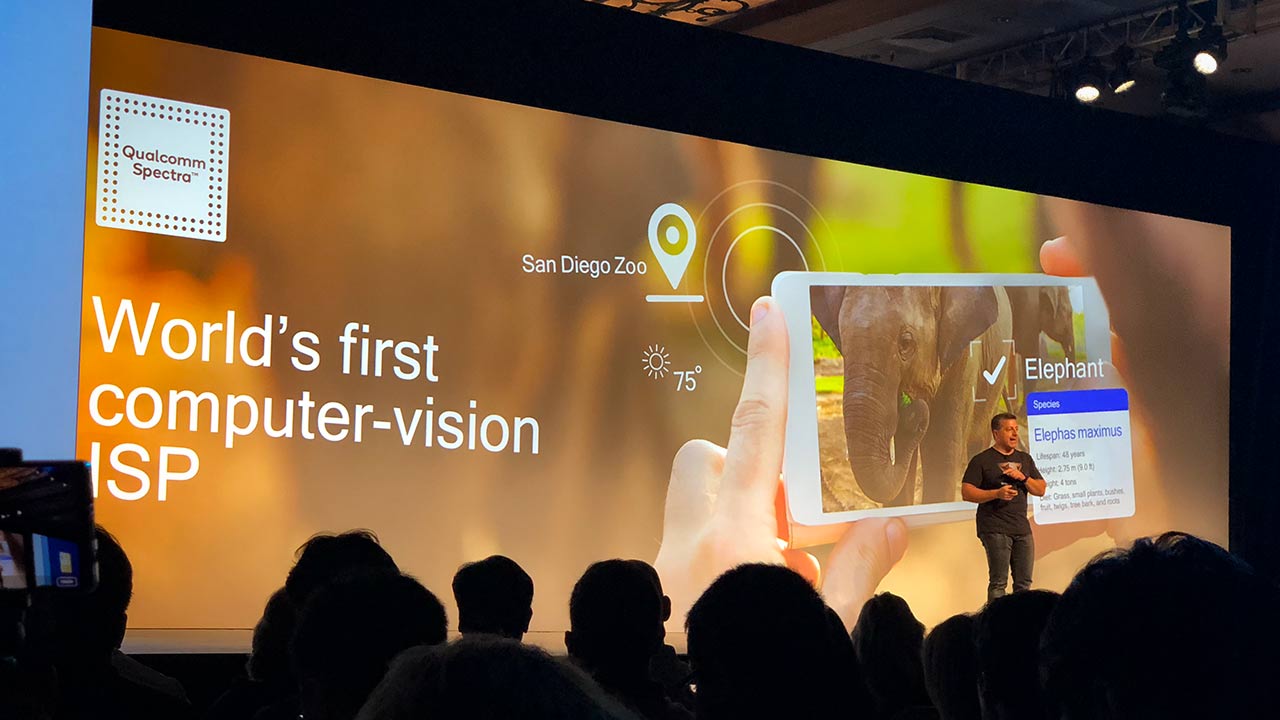
Qualcomm claims that the Snapdragon 855 offers twice the AI performance of its nearest competitors.[/caption]On the AI front, rumour has it that the chip features a dedicated AI core, but this is yet to be confirmed. Qualcomm has confirmed that as with its previous chips, the 855 will distribute AI processing to whatever core is best suited to the task at hand. This ensures more efficient utilisation of resources as well as improved performance. Included in this AI feature-set is a dedicated “Computer-Vision ISP”. In simple terms, this chip will help with faster, real-time image recognition, which is great for AI applications, but could also be a boon for computational photography, which is what most smartphone cameras are pivoting towards.
Elite gaming
Elite gaming is another feature that Qualcomm touched upon at the summit. Again, details are scant, but Qualcomm did say that they’re working with game developers and makers of game engines (including Unity and Unreal Engine) to further optimise their platform for gaming.
5G
Lastly, the new platform incorporates the X50 modem, which is key to Qualcomm’s 5G roadmap. 5G is a technology that can be hard to explain, suffice it to say that it is the future of wireless networking and goes far beyond anything that current 4G LTE networks have to offer. once it rolls out in your city, you’ll be very glad to have a phone that actually supports the network.Disclaimer: The correspondent was invited by Qualcomm India for the Snapdragon Summit at Hawaii, USA. All travel and accommodation expenses were taken care of by Qualcomm.
 More from News Analysis
Why AI notetakers are raising serious privacy and security concerns
China's low-cost AI models are changing the global AI race. Here's why Silicon Valley is worried
China's Kimi K3 challenges US AI leaders with frontier-level performance at lower cost
How did Instagram run ads promoting child abuse in India?
Why has India halted WhatsApp’s username feature before launch?